
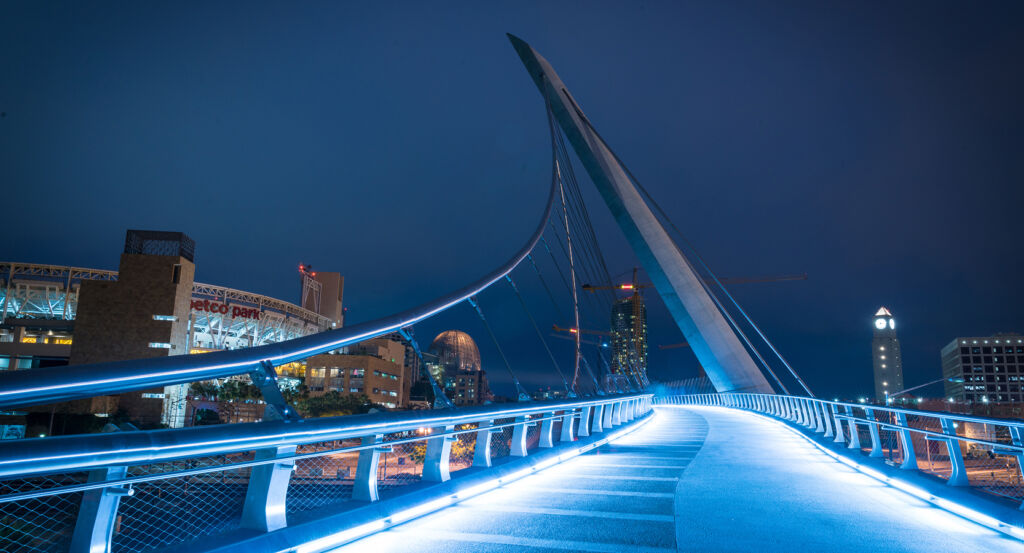
Why you should experience Carroll Canyon Road in San Diego, California.
Carroll Canyon Road is a enterprising corridor where Mira Mesa's innovation economy, canyon landscapes, scientific enterprise, and environmental stewardship converge along one of northern San Diego's defining technology corridors.
Running through Mira Mesa between Sorrento Valley and Miramar, the corridor traverses the preserved watershed of Carroll Canyon while linking research campuses, advanced manufacturing centers, biotechnology headquarters, landscaped business parks, and restored open space that collectively reflect San Diego's emergence as a global center for scientific innovation. Contemporary office architecture, research laboratories, structural glass façades, coast live oaks, California sycamores, Torrey pines, and carefully restored riparian landscapes establish a streetscape where technological advancement remains inseparable from the surrounding canyon ecosystem. Throughout the corridor, scientific discovery, coordinated planning, and decades of public and private investment reinforce an atmosphere shaped by innovation and long-term environmental management. The result is an experience defined by architectural sophistication, ecological balance, and one of Mira Mesa's most influential research corridors.
What you should know about Carroll Canyon Road.
Carroll Canyon Road is best known for traversing Carroll Canyon, a major tributary watershed whose modern character evolved during the 1970s, 1980s, and 1990s as San Diego coordinated regional employment growth with habitat preservation, transportation infrastructure, and master-planned development throughout Mira Mesa and Sorrento Valley. The corridor developed alongside one of Southern California's largest concentrations of biotechnology, telecommunications, defense engineering, software development, and advanced manufacturing, where companies including Qualcomm, Illumina, General Atomics, and numerous life-science firms helped establish the surrounding district as an internationally recognized center for research and technological innovation. Buildings bordering the corridor introduced Contemporary, Modernist, and Postmodern architecture distinguished by structural steel framing, reinforced concrete systems, curtain-wall glazing, aluminum sunshades, natural stone cladding, and campus-style landscape planning designed to accommodate collaborative scientific research. Coast live oaks, California sycamores, mule deer, coyotes, red-tailed hawks, great horned owls, monarch butterflies, western fence lizards, and extensive coastal sage scrub continue defining the canyon's ecological character. Together, these economic milestones, scientific institutions, architectural traditions, advanced construction methods, and protected ecosystems establish Carroll Canyon Road as a defining expression of Mira Mesa's historical evolution.
Regional planning efforts established Carroll Canyon as one of San Diego's principal employment districts through the 1992 Mira Mesa Community Plan, the 1994 Carroll Canyon Master Plan, and successive transportation investments that coordinated research campuses, restored creek corridors, habitat conservation, and multimodal infrastructure across hundreds of acres. Completion of the Carroll Canyon Road Extension beneath Interstate 805 in 2014, delivered through a partnership involving SANDAG, Caltrans, the City of San Diego, Qualcomm, and TransNet, created a continuous east-west transportation link while expanding regional mobility for one of Southern California's largest innovation clusters. Native riparian restoration, engineered flood-control channels, wildlife habitat preservation, bioswales, recycled-water landscape systems, and protected open-space buffers continue demonstrating how environmental stewardship remains integrated with large-scale commercial development throughout the corridor. Together, these planning initiatives, transportation investments, engineering systems, and conservation strategies demonstrate how Carroll Canyon Road developed into one of San Diego's most significant innovation corridors.
How to fold Carroll Canyon Road into your trip.
Carroll Canyon Road works as an exploration of Mira Mesa's innovation economy, preserved canyon landscapes, and scientific achievements.
Begin at Los Peñasquitos Canyon Preserve, where extensive trail networks and native habitats introduce the ecological landscape that continues shaping development throughout northern San Diego. Continue to Mira Mesa Community Park, whose expansive recreational facilities and civic gathering spaces deepen appreciation for the carefully planned community supporting the surrounding research district. Conclude at Flying Leatherneck Aviation Museum, where historic military aircraft provide the historical payoff by illustrating the aerospace and defense industries that helped cultivate San Diego's internationally recognized innovation economy. The progression moves naturally from protected canyon ecosystems through the heart of the surrounding community before culminating in one of the region's defining aviation collections, revealing why Carroll Canyon Road remains one of Mira Mesa's most influential corridors.
Where your story begins.
Foresyte Travel reveals places that feel extraordinary long before you arrive.
Experience premium editorial crafted for luxury travelers.





































































































