
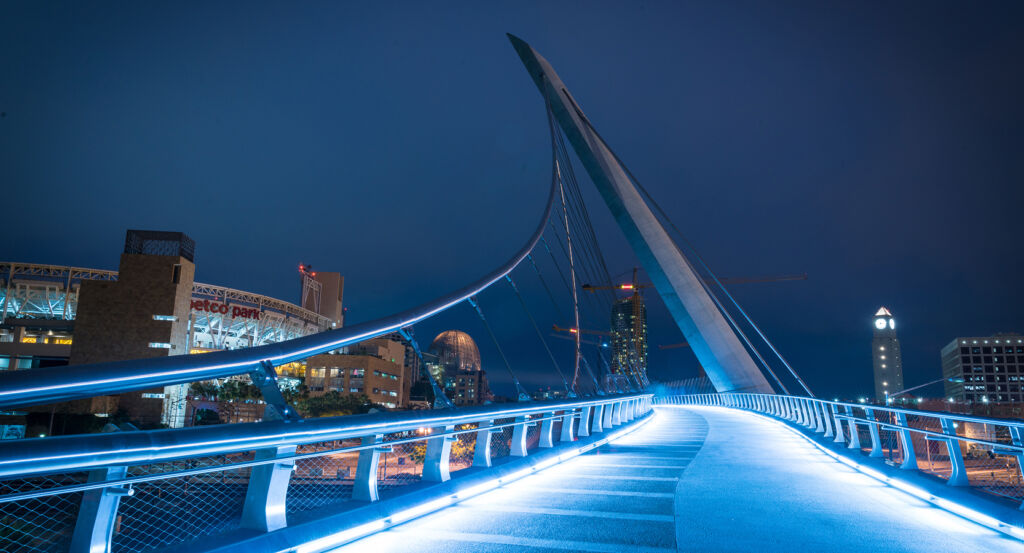
Why you should experience Columbia Street in San Diego, California.
Columbia Street is a distinguished Columbia District corridor where waterfront ambition, architectural power, and Downtown's civic character converge along one of the city's most important urban streets.
Running through Columbia District between Little Italy and the Marina District, this dynamic corridor connects high-rise office towers, historic transit architecture, luxury hotels, waterfront promenades, cultural institutions, and public gathering spaces that define the city's downtown core. Glass towers, restored early twentieth century buildings, bayfront views, and walkable streets create an atmosphere where San Diego's commercial future remains closely tied to its maritime and transportation past. As the Columbia District evolved into one of Downtown's most influential urban neighborhoods, Columbia Street became a defining corridor of skyline growth and metropolitan connection. The result is a corridor defined by architectural ambition, civic importance, and enduring waterfront significance.
What you should know about Columbia Street.
Columbia Street is best known for bordering One America Plaza, the 500-foot, 34-story skyscraper completed in 1991 that remains the tallest building in San Diego, a rare three-decade reign preserved by downtown airport height restrictions and one of the city's most unusual architectural constraints.
The tower's continued dominance tells a larger story about San Diego's skyline, where proximity to San Diego International Airport limits vertical construction and prevents the city from joining the supertall race that reshaped other major American downtowns. Designed by Helmut Jahn with Murphy/Jahn Architects and KMA Architecture, One America Plaza became the city's defining vertical marker while concentrating more than 600,000 square feet of office space inside a postmodern tower visible across the waterfront. Its location near Santa Fe Depot and the bayfront helped reinforce Columbia Street as a corridor where transit, commerce, and skyline character converge. More than thirty years after completion, the building still functions as San Diego's architectural ceiling, making Columbia Street one of the clearest places to understand how geography, aviation policy, and design ambition shaped the city's modern downtown.
How to fold Columbia Street into your trip.
Columbia Street works as an exploration of Downtown's architecture, transit heritage, and waterfront culture.
Begin at One America Plaza, where the city's tallest skyscraper immediately establishes the corridor's architectural significance. Continue toward Santa Fe Depot, whose Spanish Colonial Revival architecture and historic rail connections reveal the transportation legacy that helped shape the surrounding district. From there, make your way to Waterfront Park, where expansive lawns, public fountains, and harbor views provide a memorable conclusion while connecting Columbia Street to San Diego Bay. The progression moves naturally from the city's defining skyscraper to its historic rail gateway before concluding along the waterfront, revealing why Columbia Street remains one of Downtown's most important urban corridors.
Where your story begins.
Foresyte Travel reveals places that feel extraordinary long before you arrive.
Experience premium editorial crafted for luxury travelers.





































































































