
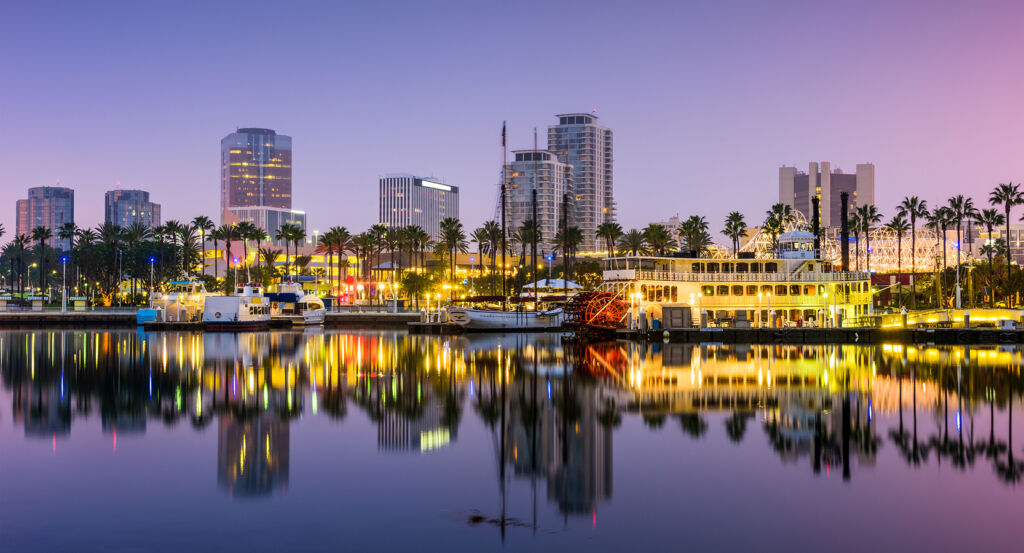
Why Cute Little Wedding Chapel matters.
Cute Little Wedding Chapel is an intimate wedding venue where Bixby Knolls' neighborhood character meets small-format ceremonies, theatrical officiating and Alan Katz's two-decade career building one of Southern California's largest officiant operations.
Set along Atlantic Avenue near East 37th Street and just north of Interstate 405, the chapel occupies Bixby Knolls' principal commercial spine between low-rise storefronts, restaurants and residential streets extending west toward Virginia Country Club. The second-floor venue divides ceremonies between an indoor chapel and an outdoor terrace, both scaled around gatherings of no more than 30 people. Colored candlelight, floral treatments and ceremony music shape the enclosed room, and the terrace centers its seating around a bamboo-framed ceremonial focal point. Elvis ceremonies add performance to a program that also encompasses conventional civil, religious, interfaith and personalized formats. The result is a deliberately small wedding venue whose physical scale supports the humorous, highly personalized ceremony style Katz developed across thousands of Southern California weddings.
What defines Cute Little Wedding Chapel.
Cute Little Wedding Chapel is best known for the boutique ceremony concept Alan Katz opened in Long Beach in 2008 after demand for his officiating work expanded beyond what he could personally handle. Katz had begun performing weddings five years earlier, then assembled additional officiants as bookings grew and couples requested priests, rabbis, ministers, bilingual officiants, nonreligious ceremonies and culturally specific formats. He created the chapel for couples seeking a ceremony and marriage license in one place, designing the operation around weddings for two to 30 people that could be completed within 30 minutes. The first location stood in Downtown Long Beach near the Breakers building before Katz outgrew it after eight years and returned to a part of the city he had known since adolescence. His parents had operated The Tenderloin near Atlantic Avenue and San Antonio Drive during the late 1970s, giving Bixby Knolls a family connection predating his wedding business by decades. Katz selected the neighborhood for the chapel's next chapter and developed the Atlantic Avenue property as both an indoor and outdoor ceremony venue. More than 7,000 weddings followed across his career, alongside expansion into Great Officiants, SoCal Beach Weddings and elopement services extending the original officiant business into ceremonies throughout Southern California.
How Cute Little Wedding Chapel fits.
Cute Little Wedding Chapel works as the anchor for an outing connecting Bixby Knolls' local historical archive with Long Beach's pioneering aviation heritage and the nineteenth-century rancho from which much of the modern city emerged.
Begin at Historical Society of Long Beach, whose collections span photographs, newspapers, oil maps, real-estate material, community ephemera and artifacts chronicling the city's development. The organization moved into the former Icaro Gallery on Atlantic Avenue in 2007 after the city secured the property and Camden Developers financed its purchase and retrofit. Its inaugural exhibition examined North Long Beach, placing the institution's new home within the history of the communities surrounding Bixby Knolls. The former gallery's high ceilings and basement vault created exhibition and archival space for a collection encompassing subjects from the Pike to harbor development and the Toyota Grand Prix. Continue to Long Beach Airport Historic Terminal, designed by William Horace Austin and Kenneth Smith Wing as a Streamline Moderne building bridging 1930s aerodynamic design and postwar modernism. Groundbreaking occurred in January 1941, but the planned December 8 opening was overtaken by the attack on Pearl Harbor the previous day. The terminal was painted in camouflage, housed soldiers and military equipment, and formally opened on April 25, 1942. Artist Grace Clements created its WPA-funded floor composition from 1.6 million hand-cut tiles in 32 colors, incorporating aircraft, maritime imagery, oil wells and communications imagery across the building. Conclude at Rancho Los Cerritos, where John Temple constructed the surviving two-story Monterey-style adobe in 1844 as headquarters for a cattle operation reaching 15,000 animals. Flint, Bixby & Co. purchased the property for $20,000 in 1866 and converted the vast holding toward sheep ranching, with as many as 30,000 sheep kept there under Jotham Bixby. Declining sheep production eventually opened the land to subdivision, and by 1884 the developing town of Long Beach occupied part of the former rancho. Llewellyn Bixby restored the adobe beginning in 1930, landscape architect Ralph Cornell reshaped its grounds, and the property became a public museum in 1955 before receiving national, local and state historic designations. The progression moves from a neighborhood archive preserving Long Beach's accumulated civic memory through an aviation terminal shaped by wartime disruption and public art and culminates at the adobe headquarters whose enormous ranch holdings preceded the modern city itself.
Where your story begins.
Foresyte Travel reveals places that feel extraordinary long before you arrive.
Enjoy editorial crafted for luxury travelers.





































































































