
Why Fairfield by Marriott Inn & Suites Tustin Orange County matters.
Fairfield Inn & Suites Tustin Orange County is a modern hotel where Tustin's freeway-connected business corridor meets R.D. Olson Development's Pacific Center project, Marriott's first Southern California expression of a new Fairfield design generation and an urban position bridging historic Tustin with John Wayne Airport.
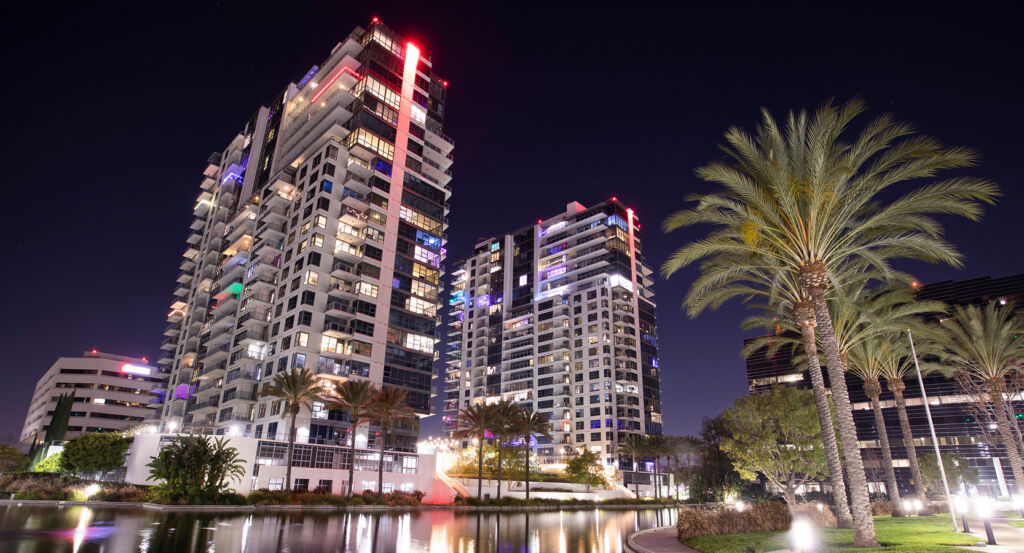
Set along Newport Avenue near Edinger Avenue and just steps from The District at Tustin Legacy, the hotel occupies Central Tustin between the Costa Mesa Freeway, Old Town Tustin and the former Marine Corps Air Station landscape extending southwest toward Irvine. A four-story profile keeps the building closely aligned with the surrounding commercial district, with palms and landscaped setbacks softening its relationship with the adjacent freeway infrastructure. Public areas favor an open contemporary composition whose seating zones and circulation establish a more social arrival sequence within the select-service format. Immediate freeway access places the property within a transportation network connecting Santa Ana, Irvine, Costa Mesa and the airport district across Central Orange County. The result is a hotel whose compact form and strategically connected setting express the business-oriented character of Tustin's early twenty-first-century hospitality growth.
What defines Fairfield Inn & Suites Tustin Orange County.
Fairfield Inn & Suites Tustin Orange County is best known for opening on August 1, 2013 as part of R.D. Olson Development's $60 million Tustin Pacific Center. Bob Olson's Irvine-based company broke ground in August 2012, beginning construction during a broader revival in Orange County commercial real estate after several subdued development years. The undertaking covered 7.5 acres at the Costa Mesa Freeway and Edinger Avenue, combining two Marriott hotels with 16,180 square feet devoted to restaurant and service businesses. R.D. Olson Development controlled the project, with its affiliated R.D. Olson Construction responsible for turning the concept into a 196,000-square-foot complex in one year. Gene Fong and Associates supplied architectural work for the Fairfield component, placing the firm within an integrated development whose separate hospitality buildings addressed different segments of the same business-travel market. Construction cost for the Fairfield component was budgeted at $20.652 million before the broader Pacific Center opened. The development carried particular local significance as Tustin's first new hotel construction in more than fifteen years, ending a lengthy period without additions to the city's hospitality base. Pacific Center also extended R.D. Olson's long Orange County development history into a highly visible freeway site near the border with Santa Ana and Irvine. Completion transformed a single development parcel into a concentrated hospitality and retail destination whose economic logic depended on the employment centers, airport traffic and freeway connectivity surrounding Central Tustin.
Apple REIT Ten initiated the property's next major institutional chapter less than two years after the Pacific Center debut. The Virginia-based real estate investment company acquired the Fairfield property on February 5, 2015 for $31 million, separating its financial history from R.D. Olson Development's original ownership period. The adjacent Residence Inn changed hands in the same transaction cycle for $42.8 million, producing a combined $73.8 million investment in the two Tustin hotels. Apple REIT Ten funded the acquisitions through cash and its unsecured revolving credit facility, incorporating both properties into a geographically diversified portfolio of Marriott and Hilton brands. Marriott remained the manager after the acquisition, preserving the relationship established when R.D. Olson opened the hotel. Apple Hospitality REIT subsequently emerged through the 2016 merger with Apple REIT Ten, carrying the Tustin asset into a larger publicly traded lodging company. The acquisition demonstrated how quickly R.D. Olson's development matured from a locally conceived project into an institutional real estate investment. Fairfield's Generation 4 concept gave the property another consequential distinction, since the Tustin opening represented the first Southern California deployment of the brand design. Flexible public zones, contemporary finishes and redesigned social areas translated Marriott's changing select-service strategy into a property conceived from inception around that newer brand direction. The combination of rapid institutional acquisition and first-generation regional design significance gives the hotel a factual history rooted in both Orange County development and the evolution of Marriott's select-service platform.
How Fairfield Inn & Suites Tustin Orange County fits.
Fairfield Inn & Suites Tustin Orange County works as a Central Tustin base for an outing connecting the city's pioneer architecture, its locally assembled historical collection and an automotive museum created from a family racing legacy.
Begin at Stevens House, where pioneer Sherman Stevens built an elaborate Queen Anne residence in 1887 from redwood shipped south from Eureka. The house remained with the Stevens family until 1980, preserving a nineteenth-century domestic connection with the agricultural community that developed after Columbus Tustin acquired land in the area during the 1860s. Avocado groves once surrounding the residence disappeared during later office development, leaving the house as a surviving architectural marker of an earlier landscape. Continue to Tustin Area Museum, operated by the Tustin Area Historical Society after the organization formed in 1976 to preserve the city's history. Exhibits address Columbus Tustin, early pioneers, agriculture, local businesses, public safety and the former lighter-than-air military base, concentrating more than a century of community development within Old Town. A 1912 Buick modified into Tustin's first fire engine provides a particularly tangible connection with the city's early municipal era. Conclude at Marconi Automotive Museum, where Dick and John Marconi converted decades of racing and collecting into a philanthropic institution. The family acquired a former salad-oil manufacturing plant in the early 1990s to house its racing operation and expanding collection. Dick and John donated the building and collection in 1994 to create the Marconi Foundation for Kids, linking exotic and competition automobiles with fundraising for children's organizations throughout Orange County. The progression moves from a pioneer family residence through a community archive and culminates inside a former industrial building transformed by motorsport and philanthropy, tracing Tustin through domestic settlement, civic preservation and entrepreneurial reinvention.
Where your story begins.
Foresyte Travel reveals places that feel extraordinary long before you arrive.
Enjoy editorial crafted for luxury travelers.
Foresyte may earn a commission when you book.





































































































