
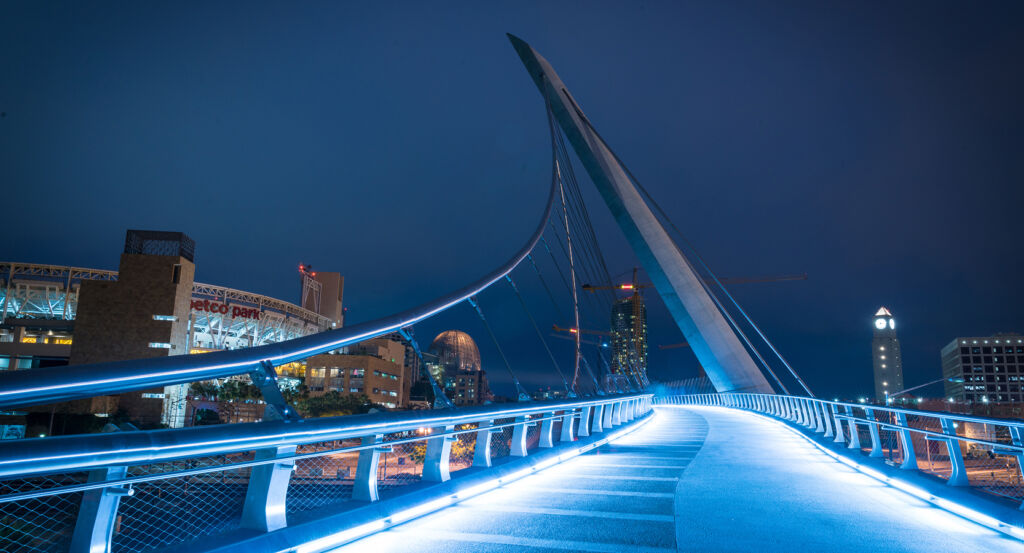
Why you should experience Fanuel Street in San Diego, California.
Fanuel Street is a salt-kissed corridor where Pacific Beach's bayside charm, recreational heritage, coastal ecology, and neighborhood character converge along one of San Diego's most inviting waterfront streets.
Running through Pacific Beach between Crown Point and Mission Beach, the corridor follows the shoreline of Mission Bay, linking bayside parks, early residential blocks, marinas, mature palms, and public waterfront spaces that collectively reflect more than a century of thoughtful coastal development. California bungalows, Spanish Colonial Revival residences, Mid-century Modern apartments, Canary Island date palms, Brisbane box trees, coastal landscaping, and broad pedestrian pathways establish a streetscape where architecture remains inseparable from the sheltered waters of Mission Bay. Throughout the corridor, outdoor recreation, environmental stewardship, and generations of neighborhood investment reinforce an atmosphere shaped by San Diego's enduring relationship with the bay. The result is an experience defined by relaxed waterfront scenery, architectural continuity, and one of Pacific Beach's most treasured bayside corridors.
What you should know about Fanuel Street.
Fanuel Street is best known for bordering Mission Bay, whose modern landscape emerged following one of California's largest coastal engineering projects when extensive tidal marshes and mudflats were transformed during the 1940s, 1950s, and 1960s into a regional aquatic recreation system encompassing more than 4,200 acres of land and water. The corridor developed alongside the expansion of Mission Bay, whose master planning introduced protected coves, engineered shorelines, public beaches, navigable waterways, landscaped parkland, and recreational infrastructure that established San Diego as an international center for sailing, rowing, paddling, and waterfront recreation. Residential neighborhoods surrounding the corridor introduced cohesive collections of California Bungalows, Spanish Colonial Revival, Ranch, and Mid-century Modern architecture distinguished by hand-troweled stucco, redwood framing, clay roof tiles, aluminum window systems, decorative masonry, and broad outdoor living spaces designed to capitalize on the temperate marine climate. Torrey pines, Monterey cypress, California fan palms, great blue herons, snowy egrets, brown pelicans, western grebes, leopard sharks, bat rays, and native eelgrass habitat continue defining the corridor's ecological setting. Together, these engineering achievements, recreational milestones, architectural traditions, construction materials, and coastal ecosystems establish Fanuel Street as a defining expression of Pacific Beach's historical evolution.
Marine engineers designed the surrounding shoreline using stabilized embankments, protected coves, navigational channels, pedestrian promenades, and carefully managed tidal circulation that balanced public recreation with long-term environmental management throughout Mission Bay. Native dune vegetation, restored wetlands, granite shoreline treatments, reinforced seawalls, timber docks, and resilient coastal landscaping remain integral components of the corridor, demonstrating how ecological restoration and waterfront engineering continue functioning together. Continued habitat conservation has enabled migratory birds, marine species, and recreational uses to coexist within one of Southern California's most intensively managed urban estuaries. Together, these engineering systems, preserved coastal habitats, and enduring environmental management practices demonstrate how Fanuel Street developed within a corridor where recreation and ecological stewardship remain inseparable.
How to fold Fanuel Street into your trip.
Fanuel Street works as an exploration of Mission Bay's waterfront landscapes, coastal ecology, and recreational heritage.
Begin at Fanuel Street Park, where sandy shoreline, grassy lawns, and calm bay waters introduce the relaxed waterfront setting that defines the corridor. Continue to Crown Point Park, whose panoramic shoreline and recreational amenities deepen appreciation for Mission Bay's carefully planned public landscape. Conclude at Mission Bay Aquatic Center, where one of the nation's leading waterfront education facilities provides the historical payoff by showcasing the recreational traditions that have shaped Mission Bay since its modern transformation. The progression moves naturally from neighborhood shoreline through expansive public parkland before culminating in one of San Diego's premier aquatic institutions, revealing why Fanuel Street remains one of Pacific Beach's defining waterfront corridors.
Where your story begins.
Foresyte Travel reveals places that feel extraordinary long before you arrive.
Experience premium editorial crafted for luxury travelers.





































































































