
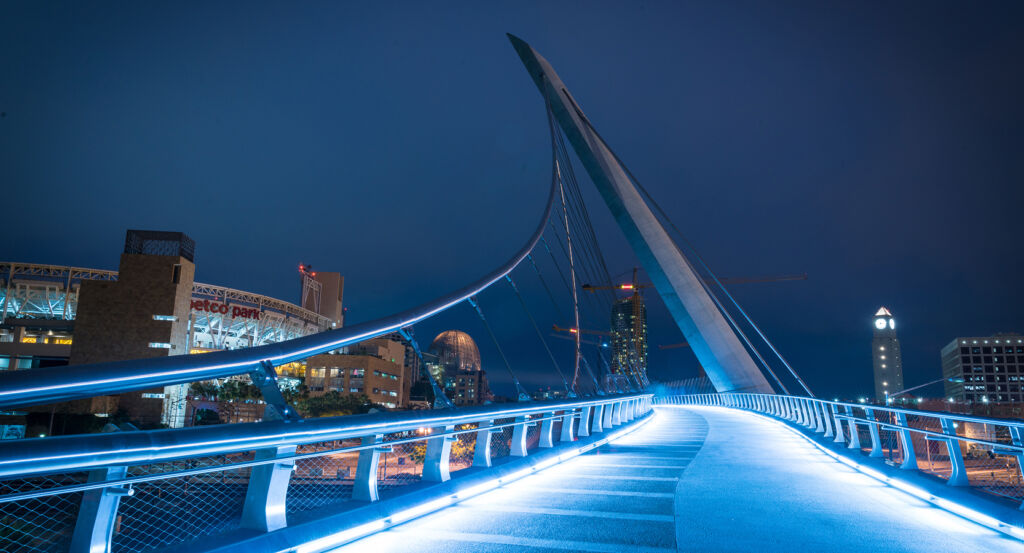
Why Front Street matters.
Front Street is a stately corridor where Cortez Hill's civic prominence, architectural heritage, urban sophistication, and hillside character converge along one of Downtown's most distinguished streets.
Running through Cortez Hill between Little Italy and Bankers Hill, the corridor ascends elevated terrain lined with historic civic buildings, architect-designed towers, mature street trees, and commanding views across San Diego Bay that collectively reflect more than a century of downtown evolution. Beaux-Arts landmarks, Art Deco high-rises, Mid-century Modern buildings, jacarandas, Brisbane box trees, Canary Island date palms, and carefully integrated stone retaining walls establish a streetscape where civic ambition remains inseparable from the surrounding topography. Throughout the corridor, exceptional architecture, thoughtful preservation, and sustained reinvestment reinforce an atmosphere shaped by generations of urban leadership. The result is an experience defined by architectural distinction, historical depth, and one of Downtown's most memorable civic corridors.
What defines Front Street.
Front Street is best known for extending through Cortez Hill, whose development accelerated during the late nineteenth century as San Diego's expanding commercial district climbed the elevated mesa overlooking the harbor, creating one of the city's earliest prestigious residential and civic neighborhoods. The corridor preserves an exceptional collection of Beaux-Arts, Classical Revival, Art Deco, International Style, and Contemporary architecture distinguished by reinforced concrete framing, structural steel construction, carved stone ornamentation, glazed terra-cotta detailing, decorative bronze entrances, and curtain-wall glazing representing successive generations of downtown development. Architects including William Templeton Johnson, Richard Requa, Irving Gill, and Harrison Albright contributed influential commissions throughout the surrounding district, integrating landscaped plazas, hillside siting, formal civic spaces, and carefully composed streetscapes that elevated Cortez Hill's architectural reputation. Brisbane box trees, jacarandas, California fan palms, Anna's hummingbirds, monarch butterflies, western gulls, and drought-tolerant urban plantings continue reinforcing the corridor's established landscape. Together, these development milestones, architectural movements, influential designers, traditional construction materials, and ecological resources establish Front Street as a defining expression of Cortez Hill's historical evolution.
Steep topography encouraged engineers and architects to compose buildings around terraced foundations, retaining walls, elevated entrances, and carefully graded streets that maximized views while accommodating downtown's changing elevation. Original carved granite, ornamental bronze, decorative terra-cotta, structural steel, polished limestone, and artisan masonry remain visible across numerous early buildings, preserving construction methods associated with San Diego's principal eras of civic expansion. Longstanding preservation efforts and compatible contemporary development have enabled historic civic architecture and modern towers to coexist while maintaining the corridor's distinctive visual continuity. Together, these engineering strategies, enduring construction techniques, and preserved architectural fabric demonstrate how Front Street developed into one of Downtown's most historically significant urban corridors.
How Front Street fits.
Front Street works as an exploration of Downtown's civic heritage, architecture, and urban landscapes.
Begin at Civic Center Plaza, where expansive public spaces and surrounding government buildings introduce the civic traditions that have long defined the heart of downtown. Continue to El Cortez Hotel, whose celebrated architecture and commanding hilltop location deepen appreciation for Cortez Hill's historic prominence within San Diego's skyline. Conclude at San Diego Museum of Art, where the landmark Spanish Colonial Revival building provides the historical payoff by illustrating the architectural ambitions inspired by the 1915 Panama-California Exposition. The progression moves naturally from civic institutions through one of downtown's defining historic hotels before culminating in one of San Diego's foremost cultural institutions, revealing why Front Street remains a defining corridor within Cortez Hill.
Where your story begins.
Foresyte Travel reveals places that feel extraordinary long before you arrive.
Enjoy editorial crafted for luxury travelers.
Foresyte may earn a commission when you book.





































































































