
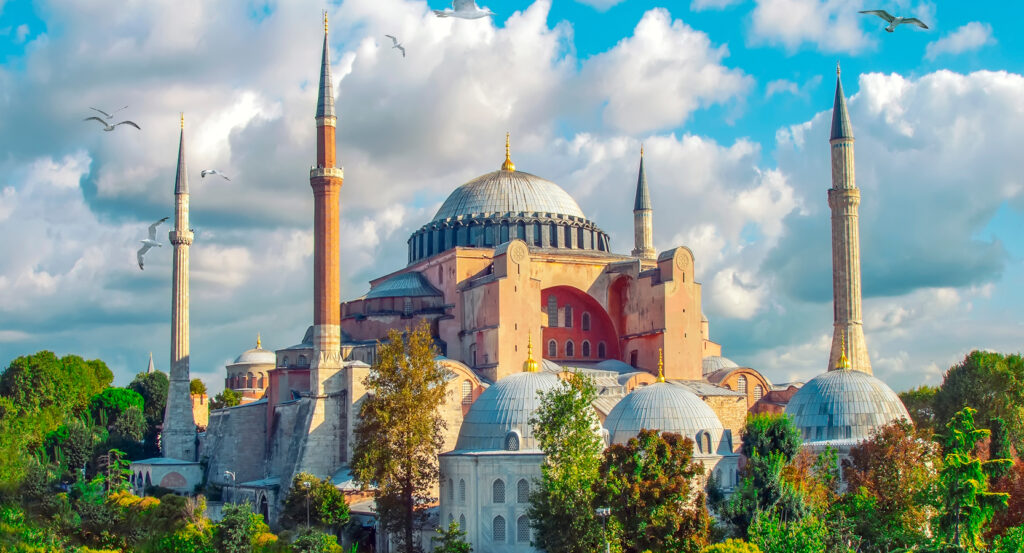
Why you should experience Upper Gallery at Hagia Sophia in Istanbul, Turkey.
The Upper Gallery Mosaics of Hagia Sophia are the cathedral's quiet revelation, a celestial gallery suspended above the noise of history.
From the upper level, light spills across gold tesserae that have witnessed empires rise and fall, faiths evolve, and beauty remain unchanged. Each mosaic glows not merely with color, but with presence, a radiance that feels alive. The faces of Christ Pantocrator, the Virgin and Child, and Byzantine emperors gaze outward with an intensity that bridges centuries. Standing before them, you sense the same wonder that awed pilgrims a thousand years ago. This is where the divine and the human meet in art so exquisite it transcends its own theology. To look upon these mosaics is to feel time collapse, to realize that faith, at its truest, was always another word for light.
What you should know about Upper Gallery at Hagia Sophia.
The mosaics of Hagia Sophia's upper gallery are not simply decorations, they are theology rendered in glass and gold.
Created between the 9th and 13th centuries, these works mark the rebirth of Byzantine art after the Iconoclast period, when religious images were banned and destroyed. Their survival is itself an act of resurrection. The Deësis Mosaic, the most famous, depicts Christ as Judge, flanked by the Virgin Mary and John the Baptist, a plea for mercy so intimate that the figures appear to breathe. Scholars believe the artists used infinitesimal variations of gold tesserae angles to catch light differently throughout the day, giving the illusion that the faces move as the sun shifts. The Empress Zoe Mosaic immortalizes imperial devotion and vanity alike, emperors offering gifts to Christ in exchange for eternal favor, their portraits subtly altered with each succession. Despite earthquakes, wars, and conversions, the mosaics endure with startling freshness. The Ottomans, recognizing their beauty, covered them with plaster instead of destroying them, an unintended act of preservation that allowed their rediscovery in the 20th century.
How to fold Upper Gallery at Hagia Sophia into your trip.
The upper gallery is not a place to rush, it's a sanctuary for silence and slow seeing.
After entering Hagia Sophia, ascend the long ramp that winds upward like a gentle pilgrimage. When you emerge into the upper level, pause at the marble balustrade and look down across the nave to the dome below, then turn toward the northern gallery where the mosaics await. Visit late morning or late afternoon when light grazes the walls, awakening the gold with living fire. Stand before the Deësis Mosaic and watch how the shimmer seems to breathe; then move to the Emperor's Door mosaic and trace the discussion between power and faith etched into glass. Don't photograph immediately, let your eyes adjust, your breath slow. Every flicker of gold holds a century. When you finally leave, look once more over the railing at the vast space below. You'll understand what the Byzantines meant when they said Hagia Sophia was not built, it descended.
Where your story begins.
Foresyte Travel reveals places that feel extraordinary long before you arrive.
Experience premium editorial crafted for luxury travelers.





































































































