
Why Hollywood Sign matters.
Hollywood Sign is a colossal hillside emblem where the Hollywood Hills' entertainment history meets nine white letters stretched across the steep southern face of Mount Lee.
Set high on Mount Lee above Beachwood Canyon and just east of Cahuenga Peak, the sign occupies a rugged Griffith Park slope whose elevation makes its lettering visible across wide sections of the Los Angeles Basin. Nine steel letters stand 45 feet high along uneven terrain, with their individual positions adjusted to the mountain contours and a service road climbing behind the structure. The letters are encountered as a distant composition across the city before hiking routes through Griffith Park reveal their immense individual scale and exposed structural backs from the ridge above. Mount Lee's chaparral, steep grades and communication towers preserve a striking physical contrast between the simple white inscription and the undeveloped mountainside carrying it. The result is an enormous piece of hillside construction whose staggered lettering, commanding elevation, exposed steelwork and relationship with Mount Lee have made nine letters inseparable from the geography of Los Angeles.
What defines Hollywood Sign.
Hollywood Sign is best known for beginning in 1923 as HOLLYWOODLAND, a temporary advertisement for an upscale residential development promoted by Los Angeles Times publisher Harry Chandler. The original installation cost $21,000 and comprised 13 letters, with individual characters 43 feet high and 30 feet wide assembled from 3-by-9-foot metal sections attached to an elaborate network of scaffolding, pipes, wires and telephone poles. Laborers hauled the components up Mount Lee on dirt paths, then fitted the sign with 4,000 20-watt bulbs spaced eight inches apart. A separate illuminated white dot measuring 35 feet across stood below the lettering, and the electrical sequence flashed “Holly,” “wood” and “land” before illuminating the entire name. The development itself had launched earlier in 1923, with 200 workers cutting seven miles of roads and moving 300,000 cubic yards of earth by June. Although the advertisement was intended to remain for only 18 months, the structure survived as Hollywood's motion-picture industry expanded its international reach. The Hollywood Chamber of Commerce assumed responsibility for the deteriorating sign in 1949, repaired it and removed LAND, leaving the nine-letter name associated with the wider district and entertainment industry. Los Angeles designated the Hollywood Sign as Historic-Cultural Monument No. 111 in 1973 after years of deterioration had left the hillside structure in increasingly precarious condition.
Mount Lee developed a separate technological history behind the letters as entrepreneur Don Lee pursued experimental television broadcasting in Los Angeles. Lee had entered radio through his 1926 purchase of KHJ, then financed television development and launched W6XAO in December 1931. The Don Lee Network purchased 20 acres behind the sign in 1938 from land jointly held by the Hollywoodland developer and silent-film director Mack Sennett, then constructed a television studio and transmission complex on the ridge. Completed in 1939, its 300-foot tower transmitted from more than 2,000 feet above sea level and held the highest elevation of any television transmission tower at that time. The station transmitted live coverage of Pasadena's Tournament of Roses Parade in 1940 through a radio-relay system connecting the remote broadcast with Mount Lee. Decades later, severe deterioration brought the sign itself close to collapse: the top of the D and the third O fell away, and fire damaged the second L. Alice Cooper pledged $27,700 toward a replacement letter in June 1978, followed by contributors including Warner Bros., Andy Williams, Gene Autry, Giovanni Mazza and Kelley Blue Book founder Les Kelley. Hugh Hefner hosted a fundraising event at the Playboy Mansion, and nine sponsorships ultimately financed a complete reconstruction. The old structure disappeared in August, 194 tons of concrete, enamel and steel went into its successor, and the rebuilt Hollywood Sign debuted in 1978 as the Hollywood Sign Trust began its long-term stewardship.
How Hollywood Sign fits.
Hollywood Sign works as the anchor for a Los Angeles outing connecting astronomical education, the city's long relationship with location filming and a century of outdoor musical performance.
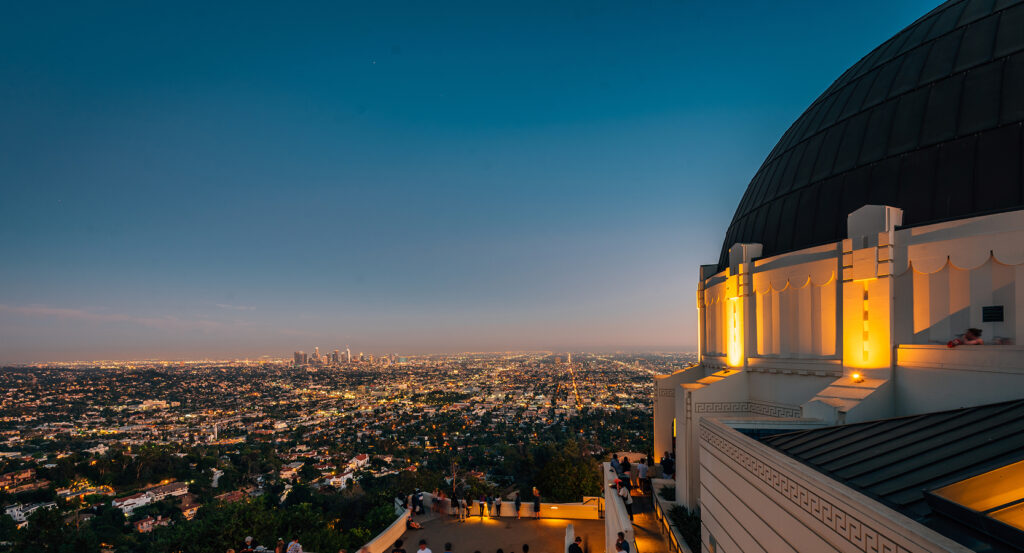
Begin at Griffith Observatory, the public astronomy institution created through the philanthropy of Griffith J. Griffith, who donated the surrounding parkland to Los Angeles in 1896 and later supplied funds for an observatory intended to make astronomy accessible to the public. The hilltop building opened in 1935, pairing astronomical instruments and exhibition spaces with an Art Deco exterior positioned above the Los Angeles Basin. Its Zeiss refracting telescope became a central instrument for direct public observation, placing scientific participation inside a municipal institution whose elevated site also developed into one of the city's most recognizable screen locations. Continue to Bronson Caves, where a former Union Rock quarry opened in 1903 left behind excavated rock faces and a short tunnel after quarrying ended about two decades later. Those industrial remnants became one of Griffith Park's enduring filming locations, appearing as the Batcave entrance in the 1960s Batman television series and in productions including John Ford's The Searchers, Frank Capra's Lost Horizon, Invasion of the Body Snatchers, Dick Tracy Returns and episodes of Gunsmoke, Bonanza and Star Trek: Voyager. Conclude at Hollywood Bowl, whose natural canyon setting was discovered by H. Ellis Reed and his father in 1919 before Artie Mason Carter helped develop it for outdoor music. Carter organized an Easter sunrise service there on March 27, 1921, drawing thousands into the canyon as the Los Angeles Philharmonic participated and singers carrying candles guided the audience across the undeveloped ground. The Bowl subsequently became an architectural laboratory for outdoor acoustics: Allied Architects produced a shell in 1926, Lloyd Wright answered with a pyramidal structure in 1927 and a tunable nine-panel wooden shell in 1928, and Allied Architects built the semicircular 1929 version that remained for 74 years. The present shell arrived in 2004, continuing a design lineage shaped by repeated attempts to reconcile orchestral sound with the canyon. The progression moves from public astronomy through a quarry repeatedly repurposed by filmmakers and culminates in a canyon transformed through music and architectural experimentation, joining three strands of Los Angeles cultural history beneath the Mount Lee letters.
Where your story begins.
Foresyte Travel reveals places that feel extraordinary long before you arrive.
Enjoy editorial crafted for luxury travelers.
Foresyte may earn a commission when you book.





































































































