
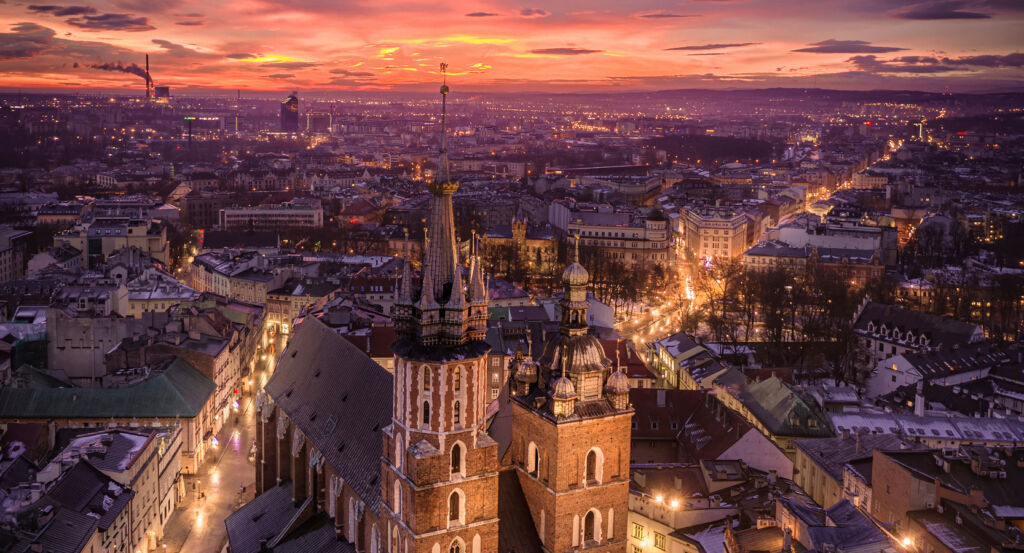
Why you should experience Hotel Polski Pod Białym Orłem in Kraków, Poland.
Hotel Polski Pod Białym Orłem is a heritage-anchored Old Town residence where Kraków's aristocratic past is not reenacted but inhabited, offering an experience that feels historically grounded, textured, and unmistakably rooted in place.
Set directly along the Royal Route near the Barbican and Florian Gate, the hotel occupies one of the most symbolically charged thresholds in the city, the point where Kraków historically opened itself to the world. That positioning matters. You are not simply near the Old Town; you are standing at its ceremonial entrance, where merchants arrived, kings processed, and centuries of civic life passed through stone and ritual. Arrival here feels weighty in the best sense. The exterior carries gravity without ostentation, and crossing inside feels like stepping into continuity rather than a curated museum piece. Public interiors are layered and dignified, favoring depth over display. High ceilings, classical proportions, and restrained detailing create an atmosphere that feels settled. Seating areas are designed for lingering, not as decorative lounges, but as places meant for conversation, reading, or quiet observation. Lighting is warm and deliberate, enhancing texture rather than flattening it, allowing the building's age to feel present without feeling heavy. Guest rooms continue this discussion between history and livability. Layouts are generous and composed, offering space to unpack, settle, and inhabit. Beds are built for deep, restorative sleep, and the visual language leans classical. Windows often overlook historic streets, courtyards, or the flow of the Royal Route, reinforcing the sense that you are not visiting Kraków from the outside, you are placed directly within its long narrative arc. Bathrooms are substantial and thoughtfully arranged, supporting daily rituals with ease. Throughout the hotel, the experience feels dignified, grounded, and quietly authoritative. Hotel Polski Pod Białym Orłem is ideal for travelers who want Kraków to feel historic in a lived way, not romanticized, not modernized away, but present and continuous.
What you should know about Hotel Polski Pod Białym Orłem.
Hotel Polski Pod Białym Orłem operates less like a hotel and more like a civic artifact that has learned how to host, and that distinction shapes how guests experience both the building and the city around it.
Unlike many heritage properties that lean into theatrical restoration or nostalgic storytelling, this hotel maintains a sense of historical continuity. Spaces are not overly polished or homogenized. Instead, materials, proportions, and layout retain subtle irregularities that signal age and authenticity. Circulation follows the building's original logic rather than being forced into modern symmetry, which creates a rhythm of movement that feels organic rather than engineered. This matters psychologically. You don't feel like you are moving through a brand environment, you feel like you are moving through time that has adapted. Acoustic conditions reflect this maturity. Exterior city sounds, footsteps on stone, carriage echoes of modern traffic, the low murmur of Old Town life, filter in softly rather than intrusively, maintaining context without overwhelming rest. Lighting avoids dramatic contrast. Instead of spotlighting history, it reveals it gently, allowing texture, patina, and depth to emerge. Service culture aligns with this sense of quiet authority. Interactions are professional, assured, and respectful of autonomy. Assistance is delivered with confidence rather than exuberance, reflecting an understanding that guests here are often seeking immersion, not explanation. Another understated strength of the hotel is how it supports presence. Because the environment does not compete for attention, your focus remains outward, on the city, its streets, its cadence. Returning after a full day doesn't feel like stepping into a managed hospitality product; it feels like returning to a place that already existed before you arrived and will continue after you leave. Over multiple nights, this creates resonant steadiness. Days feel anchored. Hotel Polski Pod Białym Orłem does not interpret Kraków for you. It stands within it, letting the city's meaning accumulate naturally through proximity and repetition.
How to fold Hotel Polski Pod Białym Orłem into your trip.
Hotel Polski Pod Białym Orłem works best when you treat it as a historical axis rather than a retreat, a place from which Kraków unfolds outward in layers rather than in loops.
Begin your mornings early and step directly onto the Royal Route while the city is still waking. From the hotel, Kraków's story reveals itself sequentially: Florian Gate, the Barbican, Market Square, and beyond. Walking these paths daily builds familiarity rather than performance, allowing architecture to register as lived space rather than attraction. Return midday. The hotel's composed interiors make these pauses restorative, offering a moment to sit, reflect, or simply exist outside the city's visual density before heading back out. Afternoons are well suited to deeper engagement, extended museum visits, long lunches near Market Square, or unhurried walks through Planty Park and Kazimierz, knowing your base remains symbolically central and emotionally steady. Evenings can unfold intuitively. Dine nearby, attend concerts or performances, or wander illuminated streets before returning to an environment that supports decompression. For longer stays, the hotel's historical grounding becomes increasingly powerful. Routes repeat, the city becomes legible, and Kraków reveals itself not as a series of highlights but as a coherent organism shaped by time. Business travelers benefit from the hotel's authority, centrality, and calm that supports focus. Leisure travelers gain something rarer: the feeling of staying within Kraków's long memory rather than observing it from a modern shell. Anchoring your stay at Hotel Polski Pod Białym Orłem allows Kraków to be experienced as continuity. The hotel does not modernize the city or romanticize it. It offers something quieter and more enduring, a place where history is not curated, but still in use.
Where your story begins.
Foresyte Travel reveals places that feel extraordinary long before you arrive.
Experience premium editorial crafted for luxury travelers.





































































































