
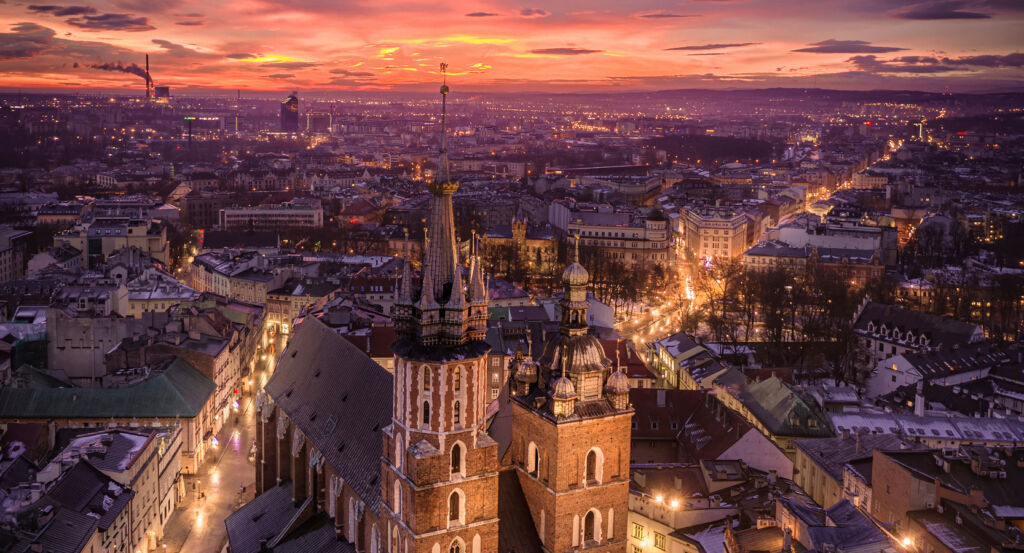
Why you should experience Hotel Stary in Kraków, Poland.
Hotel Stary is a deeply atmospheric Old Town residence where medieval architecture, contemporary restraint, and a sense of cultivated calm converge into a stay that feels intimate, intellectual, and unmistakably rooted in Kraków's layered history.
Set directly within the UNESCO-listed Old Town, the hotel occupies a meticulously restored historic building whose origins stretch back centuries. From the street, it feels quietly dignified rather than showy; once inside, the transition is immediate and absorbing. Stone walls, vaulted ceilings, and preserved architectural elements coexist with modern materials and lighting in a way that feels deliberate. The interiors do not attempt to recreate the past, they allow it to remain present. Public spaces are hushed and refined, arranged to encourage lingering. Seating areas feel like private salons rather than hotel lounges, and the overall atmosphere favors reflection over performance. Guest rooms deepen this experience. Each feels distinct, shaped by the building's historic bones. Exposed brick, heavy beams, or thick masonry walls appear naturally, balanced by contemporary furnishings that are clean, tactile, and understated. Beds are designed for true rest, not visual drama; lighting is layered to support long mornings, quiet afternoons, and soft evenings. Windows often open onto Old Town rooftops, inner courtyards, or narrow streets, reinforcing the sense that you are embedded within Kraków rather than observing it from a distance. Bathrooms continue the discussion between old and new, stone, glass, and modern fixtures arranged with clarity and comfort in mind. Throughout Hotel Stary, the experience is defined by density of meaning. Nothing feels rushed, overstated, or generic. This is a hotel for travelers who value depth, context, and a sense of place that unfolds slowly.
What you should know about Hotel Stary.
Hotel Stary is designed around architectural continuity rather than visual storytelling, and that choice has a profound effect on how guests inhabit both the hotel and Kraków itself.
Rather than layering on historical references, the hotel allows the original structure to guide spatial experience. Corridors follow the logic of the old building; ceilings rise and compress naturally; rooms are shaped by history. This creates an environment that subtly encourages slower movement and greater awareness. Guests often find themselves more attentive, to textures underfoot, to light shifting across stone, to the acoustics of footsteps in vaulted spaces. Sound is absorbed rather than amplified, creating a quietness that feels rare in such a central location. Even when the Old Town outside is busy, the interior maintains a sense of enclosure and calm. The hotel's wellness areas reinforce this philosophy. Located within the historic structure, they feel carved into the building. Pools, saunas, and relaxation spaces are atmospheric rather than glossy, encouraging immersion rather than stimulation. Service culture mirrors this restraint. Staff interactions are discreet, precise, and calm, assistance is offered thoughtfully. There is an implicit respect for privacy and autonomy that aligns with the hotel's overall character. Another understated aspect of Hotel Stary is how it manages psychological contrast. Stepping out into the energetic Old Town and then returning inside does not feel jarring; the transition is softened by layered thresholds, courtyards, staircases, lighting changes, that allow the mind to adjust gradually. Over multi-day stays, this has a cumulative effect. Energy is preserved, attention sharpens, and Kraków begins to feel legible. Hotel Stary does not attempt to entertain or impress; it provides an environment that allows the city's history, rhythm, and atmosphere to register fully.
How to fold Hotel Stary into your trip.
Hotel Stary works best when you let it act as a quiet counterbalance to Kraków's intensity rather than a base for constant movement.
Begin your mornings early, before the Old Town fills, stepping out into streets that still feel hushed and monumental. From the hotel, landmarks, churches, galleries, and cafés are all immediately accessible, allowing exploration to unfold organically. Return midday not out of necessity, but because the hotel invites pause, a swim, a rest, or time spent simply recalibrating before heading out again. Afternoons are ideal for deeper engagement: museums, long walks through Kazimierz, or extended meals that benefit from unhurried attention. Evenings can be shaped by instinct rather than schedule, concerts, quiet dinners, or nighttime walks through illuminated streets, with the assurance that your return will feel restorative rather than overstimulating. Over longer stays, the rhythm becomes deeply satisfying. You begin to move less and notice more. Routes repeat, details emerge, and Kraków reveals itself through familiarity. Business travelers benefit from the hotel's discretion and calm in a dense urban environment. Leisure travelers gain the rare sense of inhabiting history. Anchoring your stay at Hotel Stary allows Kraków to be experienced not as a checklist of medieval icons, but as a living, breathing city layered with time, texture, and quiet intensity, and the hotel does not narrate that experience. It holds space for it, patiently and with confidence.
Where your story begins.
Foresyte Travel reveals places that feel extraordinary long before you arrive.
Experience premium editorial crafted for luxury travelers.





































































































