
Why Andrassy Avenue matters.
The Andrássy Avenue is where Budapest's grandeur first greets the world, a perfect overture in stone and symmetry.
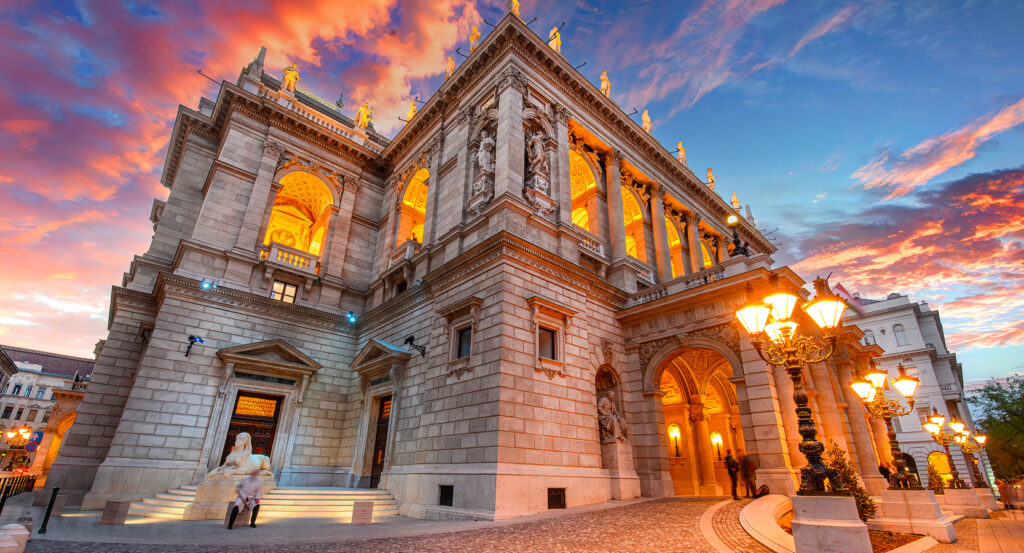
Standing proudly along the city's most elegant boulevard, the façade captures the confidence of a nation entering its golden age. Designed by Miklós Ybl in the 19th century, it rises in rhythmic arches, Corinthian columns, and sculpted allegories that seem to hum with anticipation, as though the walls are tuned to music. The marble lions guarding the entrance exude quiet strength, while the carved muses above the portico symbolize the eternal marriage of art and intellect. Every inch of the façade radiates balance, a harmony between Hungarian romanticism and Italian Renaissance inspiration. When sunlight spills across its sandstone surface, the details come alive: cherubs play among garlands, angels lift their trumpets to the sky, and the bronze doors gleam like polished instruments. By evening, the building transforms again, bathed in amber light that glows against the darkening Andrássy Avenue, a scene so cinematic it feels like the prelude to a dream.
What defines Andrassy Avenue.
The façade is more than architectural beauty, it's an encoded story of identity, ambition, and endurance.
Every statue and ornament reflects Hungary's 19th-century hunger for recognition within the Austro-Hungarian Empire. The figures flanking the main entrance, Erkel Ferenc and Liszt Ferenc, the fathers of Hungarian music, were placed deliberately at eye level, grounding the nation's cultural pride in homegrown genius. Above them, the frieze by Mór Than depicts the triumph of art over time, a motif echoing the spirit of the opera. The façade's sandstone blocks were sourced from Sóskút, chosen for their warm golden tone that mirrors the light of the city itself. During World War II, bomb damage scarred portions of the façade, but local artisans painstakingly restored every missing curl of stone and note of ornamentation, an act of devotion as much as preservation. The portico's columns were later reinforced with concealed steel, ensuring the façade would survive centuries of vibration from streetcars and traffic along Andrássy Avenue. Few visitors realize that beneath the steps lies an acoustic buffer chamber, an ingenious 19th-century solution to keep the rumble of carriages from disturbing performances within. The façade, in essence, performs its own symphony: strength, beauty, and grace in perfect tempo.
How Andrassy Avenue fits.
Pause here, truly pause, before stepping inside the opera house.
Stand at the edge of Andrássy Avenue, where the façade unfolds like a stage set before you. Watch how the morning light traces the reliefs, or how the twilight deepens the shadows between its arches. If you visit during the golden hour, linger as the lamps along the boulevard begin to glow; the entire street seems to hold its breath as the opera house emerges from dusk like a monarch returning to her throne. Consider joining a guided architecture tour, many begin outside the façade, explaining Ybl's design principles and the cultural politics of its creation. If you're attending an evening performance, arrive early to enjoy the façade at its most enchanting, when its balconies catch the last light and the chandeliers inside flicker through the windows. From this vantage, you'll understand why Andrássy Avenue was designated a UNESCO World Heritage Site, it is not merely a boulevard, but a living museum of elegance. The façade of the Hungarian State Opera House doesn't just welcome visitors; it reminds them that beauty, when built with conviction, can outlast empires.
Where your story begins.
Foresyte Travel reveals places that feel extraordinary long before you arrive.
Enjoy editorial crafted for luxury travelers.
Foresyte may earn a commission when you book.





































































































