
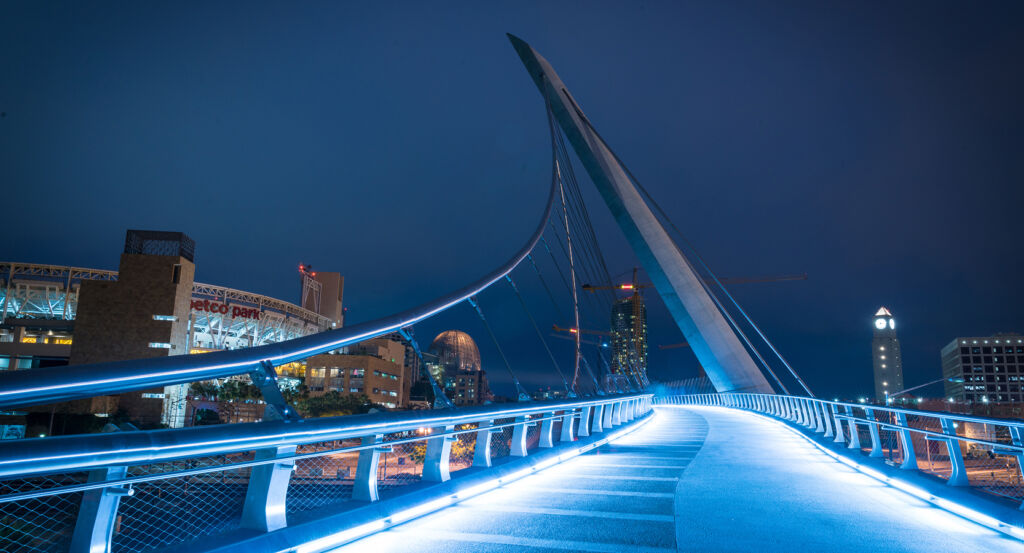
Why you should experience Imperial Avenue in San Diego, California.
Imperial Avenue is a resilient corridor where Logan Heights' cultural identity, industrial heritage, civic legacy, and community pride converge along one of southeastern San Diego's most consequential thoroughfares.
Running through Logan Heights between Barrio Logan and Grant Hill, the corridor links historic commercial blocks, longstanding civic institutions, industrial corridors, and established residential districts that collectively reflect more than a century of immigration, entrepreneurship, and neighborhood resilience. Early twentieth-century commercial buildings, Mid-century Modern storefronts, Mission Revival civic structures, mature jacarandas, California fan palms, and broad urban streetscapes establish an environment where commerce and community remain inseparable from San Diego's evolving history. Throughout the corridor, cultural continuity, entrepreneurial spirit, and generations of neighborhood stewardship reinforce an atmosphere shaped by enduring local identity. The result is an experience defined by authentic urban character, historical depth, and one of Logan Heights' most significant civic corridors.
What you should know about Imperial Avenue.
Imperial Avenue is best known for serving as the historic east-west spine of Logan Heights, a neighborhood established during the late nineteenth century following the arrival of the California Southern Railroad, whose transportation connections accelerated residential settlement, industrial investment, and commercial growth across southeastern San Diego. The corridor evolved through successive waves of immigration during the twentieth century, particularly among Mexican American families whose businesses, churches, civic organizations, and cultural institutions established Logan Heights as one of Southern California's most enduring centers of Chicano heritage. Commercial buildings lining the avenue introduced Mission Revival, Spanish Colonial Revival, Art Deco, and Mid-century Modern architectural influences distinguished by reinforced concrete construction, decorative brickwork, glazed terra-cotta detailing, steel storefront systems, and hand-crafted masonry that reflected changing periods of economic development. Jacarandas, California fan palms, coast live oaks, Anna's hummingbirds, monarch butterflies, western fence lizards, and drought-tolerant native plantings continue contributing to the corridor's established urban landscape. Together, these transportation milestones, immigration patterns, architectural traditions, construction materials, and ecological resources establish Imperial Avenue as a defining expression of Logan Heights' historical evolution.
Community organizations located along the corridor have supported generations of neighborhood advocacy through educational initiatives, cultural programming, public art, and local business development that reinforced Logan Heights' identity. Original reinforced concrete, structural steel framing, ornamental brick façades, prism-glass transoms, decorative tile, and traditional masonry remain visible across numerous early commercial buildings, preserving construction methods associated with the avenue's principal decades of development. Continued reinvestment has allowed historic commercial architecture and longstanding neighborhood institutions to coexist within an evolving urban environment while maintaining the corridor's deeply rooted cultural character. Together, these civic traditions, preserved construction techniques, and enduring architectural fabric demonstrate how Imperial Avenue developed into one of San Diego's most historically significant community corridors.
How to fold Imperial Avenue into your trip.
Imperial Avenue works as an exploration of Logan Heights' cultural heritage, artistic expression, and historical legacy.
Begin at Chicano Park, where nationally recognized murals and grand bridge pylons introduce the civic activism and artistic traditions that transformed the surrounding community. Continue to Mercado del Barrio, whose locally rooted businesses and gathering spaces deepen appreciation for the entrepreneurial spirit that continues shaping Logan Heights. Conclude at Coronado Bridge Viewpoint, where expansive views of San Diego Bay and the iconic bridge provide the historical payoff while illustrating the infrastructure that profoundly influenced the surrounding neighborhoods during the twentieth century. The progression moves naturally from community activism through contemporary neighborhood enterprise before culminating in one of San Diego's defining civic engineering achievements, revealing why Imperial Avenue remains one of Logan Heights' most meaningful corridors.
Where your story begins.
Foresyte Travel reveals places that feel extraordinary long before you arrive.
Experience premium editorial crafted for luxury travelers.





































































































