
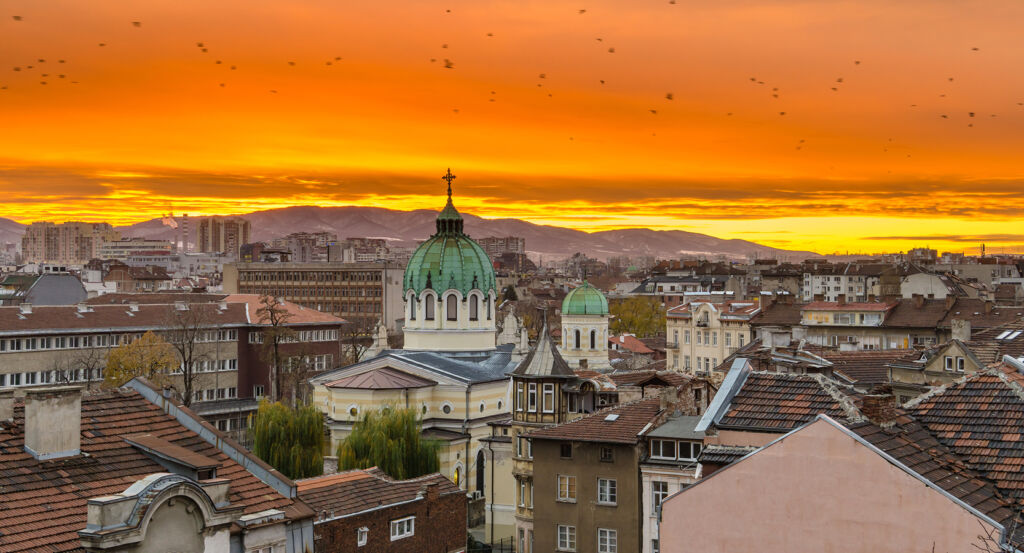
Why InterContinental Sofia matters.
InterContinental Sofia is a modern capital hotel where Bulgaria's political institutions, Orthodox architecture, academic culture and the distant slopes of Vitosha Mountain meet at the centre of Sofia.
Occupying 4 Narodno Sabranie Square beside Parliament Square, InterContinental Sofia stands between the National Assembly, Tsar Osvoboditel Boulevard and Sofia University, with the government district, cultural avenues and central business streets extending around the property. The hotel's position gives it direct views toward the golden domes and expansive façades that define Sofia's ceremonial centre. Tsar Osvoboditel Boulevard forms the primary urban approach, carrying movement past ministries, museums, gardens and national institutions before reaching the hotel's entrance. Club InterContinental, Floret Restaurant and Lounge and the hotel's event floor add a second layer of business, diplomatic and social activity within the same address. The result is a hotel whose political surroundings, cultural setting and contemporary international character concentrate Sofia's modern capital character within one city-centre property.
What defines InterContinental Sofia.
InterContinental Sofia originated in the transformation of an established Bulgarian hospitality institution into the country's first hotel operating under the InterContinental brand, connecting the capital's twentieth-century architectural development with a new period of international luxury investment. The property's earlier history extends to 1968, when the original hotel opened during a period of substantial urban modernization under Bulgaria's socialist government. Its subsequent evolution reflected the changing political and economic circumstances of the capital, particularly the transition from state socialism to a market economy following the collapse of communist rule in 1989. The building eventually became home to Radisson Blu Grand Hotel Sofia, establishing an international hospitality presence during the expansion of foreign investment and business travel in post-socialist Bulgaria. Its position within the city's principal governmental quarter gave the property a distinctive institutional character, connecting its commercial operations with the diplomatic, political and ceremonial life of the Bulgarian capital. The hotel's architectural character developed through successive adaptations of its original structure, preserving elements of the building's midcentury character alongside improvements associated with international hotel management. A decisive transformation began on February 25, 2016, when InterContinental Hotels Group announced an agreement with InterHotel Grand - Hotel Sofia AD to introduce its flagship luxury brand to Bulgaria. The management agreement established a substantial redevelopment program intended to reposition the existing property within the international luxury hospitality market. InterHotel Grand - Hotel Sofia operated within the portfolio of Galaxy Investment Group, whose investment interests extended across Bulgarian hospitality and real estate development. The project involved the comprehensive renovation of the original building and the construction of an additional wing, expanding the property's architectural footprint through a contemporary extension. The new wing introduced 54 additional accommodations, integrating modern hospitality infrastructure with the established urban structure. Interior renovations developed a visual language inspired by the architectural character of Sofia during the 1960s, connecting the property's historical origins with a contemporary interpretation of midcentury design. The renewed entrance introduced a sculptural representation of a girl blowing a dandelion, using the familiar botanical image to express hope and unity within the hotel's principal public interior. The redevelopment also established a dedicated conference level, strengthening the property's capacity to accommodate international business gatherings and formal institutional events. Its architectural program incorporated 635 square metres of meeting and conference facilities, including spaces designed for gatherings of up to 240 participants. InterContinental Sofia officially opened on March 22, 2018, marking the arrival of the brand in Bulgaria and its seventh hotel opening in Eastern Europe. The inauguration represented a significant milestone for the country's international hospitality sector, strengthening Sofia's position within the European luxury hotel market. The transformation also introduced Club InterContinental, extending the brand's personalized service philosophy into a dedicated hospitality environment for premium accommodations. The property's opening coincided with growing international interest in Sofia as a destination for business, culture and metropolitan tourism, reflecting the city's continued integration into European commercial networks. Its development represents a distinctive chapter in Bulgarian hospitality history through the adaptation of socialist-era architecture, the expansion of domestic hotel investment and the introduction of an internationally established luxury brand to the country's political capital.
InterContinental Sofia's hospitality character develops through the relationship between Bulgaria's ceremonial traditions, contemporary metropolitan design and the international service culture associated with the InterContinental brand. The property's transformation preserves an architectural connection with the capital's midcentury development, translating the geometric character of its original construction into interiors shaped by restrained contemporary furnishings and carefully composed decorative elements. The dandelion sculpture establishes a symbolic introduction to this philosophy, connecting the hotel's renewed character with an image of optimism that acquired particular resonance during Bulgaria's post-socialist transformation. Its public interiors express a contemporary interpretation of European metropolitan hospitality, balancing the formal character associated with international diplomatic travel with the welcoming social traditions of Bulgarian urban life. Club InterContinental develops this relationship through personalized reception, afternoon refreshments and evening gatherings, establishing a more intimate interpretation of the brand's established service philosophy. The dedicated lounge introduces a residential rhythm into the hotel's international hospitality program, connecting private conversation, professional interaction and attentive service within a coordinated environment. The property's culinary character provides another expression of Sofia's cultural evolution through ADOR Restaurant, whose approach combines contemporary international gastronomy with the agricultural and culinary traditions of southeastern Europe. Chef Dimitar Boyadzhiev directs a kitchen that draws upon premium meat, fresh seafood and Mediterranean influences, establishing a culinary style shaped by the relationship between regional ingredients and classical European technique. Bulgarian gastronomy derives considerable depth from its agricultural diversity, incorporating cultivated vegetables, aromatic herbs, fermented dairy products and carefully prepared meats into a culinary tradition influenced by Balkan, Ottoman and Mediterranean exchanges. Boyadzhiev's approach connects these established flavor relationships with contemporary restaurant craftsmanship, emphasizing the interaction between ingredient quality, controlled cooking and balanced seasoning. The kitchen's treatment of premium proteins develops richness through precise heat management, allowing the natural character of meat and fish to influence the composition of accompanying flavors. Mediterranean culinary influences contribute freshness through olive oil, citrus, seasonal vegetables and aromatic herbs, establishing a complementary relationship with the substantial savory character of Balkan cooking. ADOR's wine program extends this gastronomic character through an appreciation for European viticulture and the distinctive heritage of Bulgarian wine production. Bulgaria's Thracian Valley and Danubian Plain contribute important expressions of the country's agricultural character, supporting both international grape varieties and indigenous cultivars associated with longstanding regional winemaking traditions. The restaurant's terrace contributes a ceremonial dimension to dining through its relationship with Sofia's governmental and religious architecture, connecting contemporary gastronomy with the city's established civic identity. Floret Lounge Bar develops a complementary social philosophy through European cooking, carefully selected wines and contemporary cocktails, establishing an informal gathering environment within the hotel's public interiors. Its beverage program emphasizes fresh ingredients, aromatic balance and composed presentation, connecting international mixology with the metropolitan social traditions of Bulgaria's capital. The lounge's fireplace contributes a residential character, establishing a quieter setting for conversation and evening gatherings. The hotel's wellness facilities extend its hospitality philosophy through fitness and restorative services, complementing the demands of international travel with opportunities for physical renewal. Its conference and private-event programming sustains the property's institutional character through professional gatherings and ceremonial occasions, connecting the traditions of European grand hotels with the diplomatic and commercial functions of the Bulgarian capital. Together, these architectural, culinary and social traditions establish InterContinental Sofia as a distinctive expression of contemporary Bulgarian hospitality, shaped by the country's cultural inheritance, evolving gastronomic character and enduring relationship between metropolitan life and international diplomacy.
How InterContinental Sofia fits.
InterContinental Sofia works as a central base for tracing Sofia's development from Roman urbanism through Bulgarian archaeology and into the expansive public architecture of the modern capital.
Begin at St. George Rotunda, the oldest surviving building in Sofia and a fourth-century Roman structure built within the ancient city of Serdica. The cylindrical brick church stood inside a complex of Roman streets, courtyards and administrative buildings that formed the centre of the imperial settlement. Medieval frescoes survive beneath later layers of plaster, including paintings from the twelfth, thirteenth and fourteenth centuries. The monument's continued religious use connects Roman construction, medieval Christianity and the modern Bulgarian capital within a single architectural site. Its position among later buildings makes the rotunda a direct physical record of Sofia's repeated urban rebuilding. Continue to National Archaeological Museum, housed in the former Büyük Mosque, a fifteenth-century Ottoman building that became Bulgaria's principal archaeological institution after its creation in 1892. The collection spans prehistoric settlements, Thracian goldwork, Greek and Roman antiquities, medieval Bulgarian art and Ottoman artifacts, turning the building into a chronological record of the country's territory. The museum's holdings connect archaeological material from multiple civilizations with the formation of modern Bulgaria. Conclude at Sofia Central Mineral Baths, an expansive structure completed in 1913 by Friedrich Grünanger, Hovsep Markaryan and Haralampi Markov. Its architecture combines Viennese Secession, Bulgarian medieval and Byzantine decorative forms around Sofia's thermal-water tradition, linking public health, civic character and national architectural ambition. The building's decorative program transforms a practical bathing institution into one of the capital's principal civic monuments. The progression moves from Roman Sofia through the archaeological record of the Bulgarian lands and culminates in the civic architecture of the capital's mineral springs, connecting ancient urban foundations, national history, public health and modern Sofia's cultural identity.
Where your story begins.
Foresyte Travel reveals places that feel extraordinary long before you arrive.
Enjoy editorial crafted for luxury travelers.
Foresyte may earn a commission when you book.





































































































