
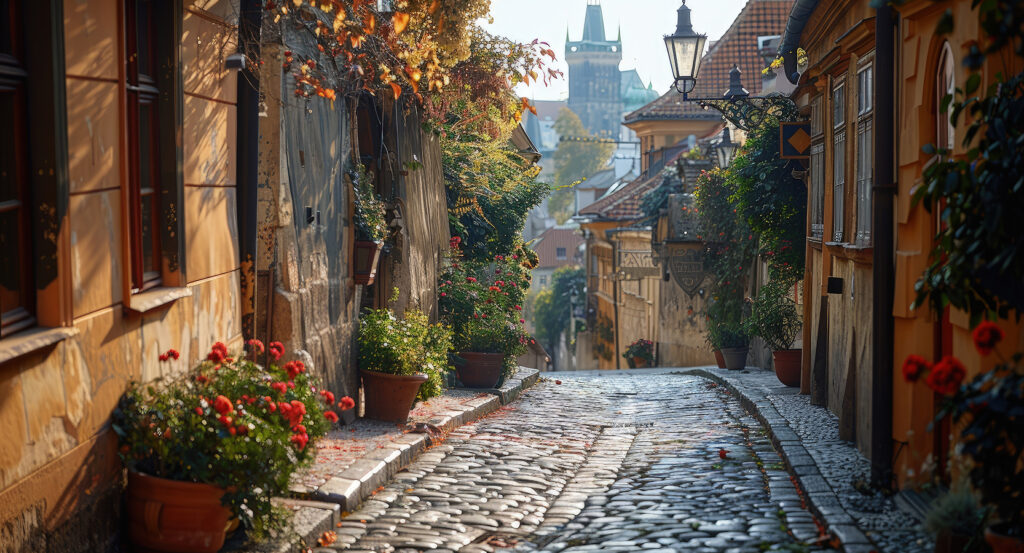
Why The Old-New Synagogue matters.
The Old-New Synagogue is not just the oldest active synagogue in Europe, it is the soul of Jewish Prague, a structure where centuries have gathered and refused to fade.
Step inside, and the air feels older than time itself: a silence filled with prayer, history, and the faint scent of wax and stone. The Gothic vaults rise like ribs of a living creature, their weight carried by slender columns darkened by candle soot and devotion. The benches creak softly, the light falls through narrow lancet windows, and Hebrew letters carved into the walls seem to whisper the stories of those who came before. Nothing here feels accidental; every imperfection has meaning, every mark a memory. To sit within these walls is to understand endurance not as survival, but as faith made permanent.
What defines The Old-New Synagogue.
Completed 1270, The Old-New Synagogue is among the earliest surviving Gothic buildings in Prague, older than much of the city itself.
Its name, paradoxically, refers to its time: it was “new” when built beside an even older synagogue that no longer stands, and “old” ever since. Legend claims its stones were brought by angels from the ruins of Solomon's Temple in Jerusalem, on the condition they be returned when the Messiah comes. The structure was commissioned under the rule of King Ottokar II, built by German stonemasons who adapted Christian Gothic design into a uniquely Jewish architectural form. Its double-nave interior, two narrow bays divided by a single column, remains one of the most distinctive in Europe. The women's gallery, added in the 15th century, hides behind thick Romanesque walls pierced by small openings, preserving modesty while allowing sound to pass through. During the Nazi occupation, the synagogue was miraculously spared, and its ritual objects preserved, intended for the macabre “Museum of an Extinct Race” that never came to be. Few realize that the synagogue's attic is said to conceal something more mythical: the resting place of the Golem, the clay protector created by Rabbi Judah Loew ben Bezalel in the 16th century. Whether legend or truth, the story lingers like dust in sunlight, proof that belief, too, leaves its traces.
How The Old-New Synagogue fits.
Begin your visit to Jewish Quarter early in the morning, before the crowds gather along Pařížská Street.
Approach the synagogue from Maiselova Street, its gabled façade rises humbly between the newer buildings, its age disguised until you stand before its iron-bound doors. Step inside slowly; the shift in light feels like stepping backward through time. Move along the walls and study the carvings, Hebrew inscriptions, medieval candle niches, the eternal lamp that has never been extinguished. Listen for the faint hum of prayer, still held in the stones. Attend a service; the chant of Hebrew scripture beneath Gothic arches is unlike any sound in the world, faith echoing across seven centuries. When you exit, pause in the courtyard and look back at the triangular gable that crowns the roofline. In sunlight, its layered tiles glimmer faintly, as if alive. The Old-New Synagogue is not a relic, it is continuity incarnate, a sanctuary where the human spirit still remembers how to endure.
Where your story begins.
Foresyte Travel reveals places that feel extraordinary long before you arrive.
Enjoy editorial crafted for luxury travelers.
Foresyte may earn a commission when you book.





































































































