
Why you should experience Keys in Los Angeles, California.
Keys is an immersive nightclub where the Sunset Strip's generations of music culture meet John Sofio's sound-inspired interiors, three levels of dancing and a contemporary electronic-music program engineered around unusually serious production.
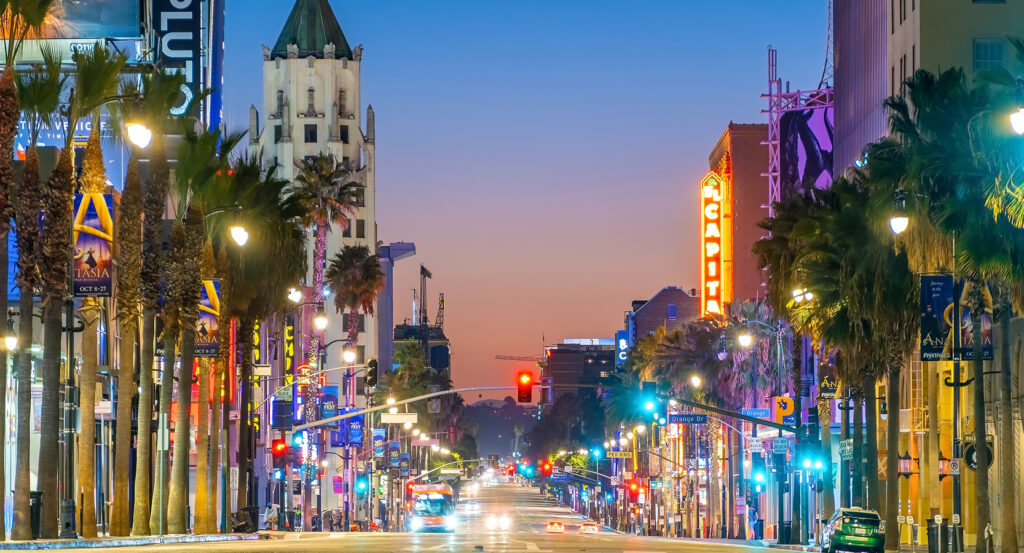
Set along Sunset Boulevard near Doheny Drive and just steps from The Roxy Theatre, the nightclub occupies the western Strip amid the tightly packed music venues, restaurants and illuminated façades that have sustained this stretch as a nighttime destination for generations. The 12,420-square-foot interior rises through three distinct levels, shifting from the principal dance floor into upper spaces with their own visual character. Built Inc. founder John Sofio developed the architecture around sound translated into color and shape, carrying oversized piano-key graphics across the walls and layering illumination through ceiling portals, haze and architectural fixtures. A 1.2-millimeter-pitch magnetic LED installation folds above the main DJ booth, placing high-resolution moving imagery directly within the principal performance zone. The result is a Sunset Strip nightclub whose vertical architecture, lighting and immense video surface place dancing inside a deliberately theatrical production environment.
What you should know about Keys.
Keys is best known for John Terzian and Brian Toll's 2024 return of large-scale nightlife to one of the Sunset Strip's most consequential music addresses through The h.wood Group, the hospitality company they founded in 2008. Their project opened on August 1 inside a building whose previous incarnation as the Key Club from 1998 to 2013 supplied both the new club's name and a direct connection with the property's musical past. That history reaches considerably deeper: Bill Gazzarri operated Gazzarri's at the site through the Strip's rock decades, presenting performers including The Doors, Van Halen, Mötley Crüe, Poison and Guns N' Roses before his death in 1991 and the club's closure in 1993. The Northridge earthquake badly damaged the structure in 1994, leading to demolition and construction of a new building that opened as the $9 million Billboard Live in 1996; the Key Club followed in 1998 and 1 OAK occupied the property after 2013. Terzian and Toll returned the address explicitly to music, positioning Keys around electronic dance programming and commissioning Built Inc. under John Sofio for the interior conception. Sofio's project won the Nightclub category at the 2024 LIV Hospitality Design Awards and subsequently received a 2025 BLT Built Design Award for hospitality interior design. The opening night connected that renewed musical purpose with a new generation through sets by Zack Bia, Elan Bia and Toon plus a violin performance by D Sharp. Kaytranada and Channel Tres shared a bill that November, and Wiz Khalifa appeared during the club's first Halloween season, quickly broadening the new operation beyond its opening program.
Demetrius Moore, longtime front-of-house engineer for Drake, designed the audio installation around L-Acoustics components with Clair Global's Eighth Day Sound handling integration. Three A15i enclosures per side drive the main floor, and eight SB18 IIi subwoofers sit inside the face of the DJ stage in four two-high stacks, concentrating low-frequency output at the physical center of the dance floor. X8 coaxial enclosures operate as delays and smaller 5XT units fill balconies and irregular areas, creating 360-degree coverage across a room whose geometry changes substantially with elevation. Twelve additional X8 units form the second level's left-right system beside SB18 IIi and SB15m subwoofers, with LA12X amplified controllers supplying the A15i arrays. Separate levels run independently for simultaneous musical environments or connect into one multi-story system, giving DJs and live performers different ways to command the building. Sofio's folded LED plane then places 1.2-millimeter-pitch imagery above the DJ booth as layered lighting penetrates haze around it, binding bass, video and illumination into the club's principal performance mechanism.
How to fold Keys into your trip.
Keys works as the final stop in a Sunset Strip night tracing three nearby institutions whose founders successively changed how Los Angeles musicians performed, socialized and built audiences.
Begin at Whisky a Go Go, opened in January 1964 by Elmer Valentine, Mario Maglieri and Phil Tanzini with Johnny Rivers onstage and DJ Joanie Labine playing between sets from a suspended booth. Labine began dancing inside the elevated booth, helping establish the go-go dancer as an internationally copied nightclub form, and The Doors later became the house band during the venue's formative 1960s period before subsequent decades brought artists spanning Janis Joplin, Led Zeppelin and Guns N' Roses. Continue to Rainbow Bar & Grill, established in 1972 by a partnership that included Valentine, Lou Adler and Mario Maglieri after the building's earlier life as Villa Nova, a restaurant once owned by Vincente Minnelli. An opening celebration for Elton John helped establish its relationship with the music business, and musicians including John Lennon, Ringo Starr, Keith Moon and Alice Cooper became associated with the restaurant as the adjoining Strip developed into an unusually concentrated social center for rock performers. Conclude at The Roxy Theatre, where Valentine and Adler joined David Geffen, Elliot Roberts and Peter Asher in 1973 to convert the former Largo strip club into a purpose-built environment for serious live music. Neil Young and the Santa Monica Flyers inaugurated the room, and Adler's insistence on first-rate sound, dressing rooms and artist treatment helped establish a 500-capacity theater capable of presenting emerging performers with production standards associated with much larger stages. The progression moves from Whisky a Go Go's fusion of live bands, recorded music and go-go dancing through the Rainbow's creation of a social headquarters for musicians into The Roxy Theatre's artist-centered performance model, establishing the nightlife lineage that still defines the western Sunset Strip.
Where your story begins.
Foresyte Travel reveals places that feel extraordinary long before you arrive.
Experience premium editorial crafted for luxury travelers.





































































































