
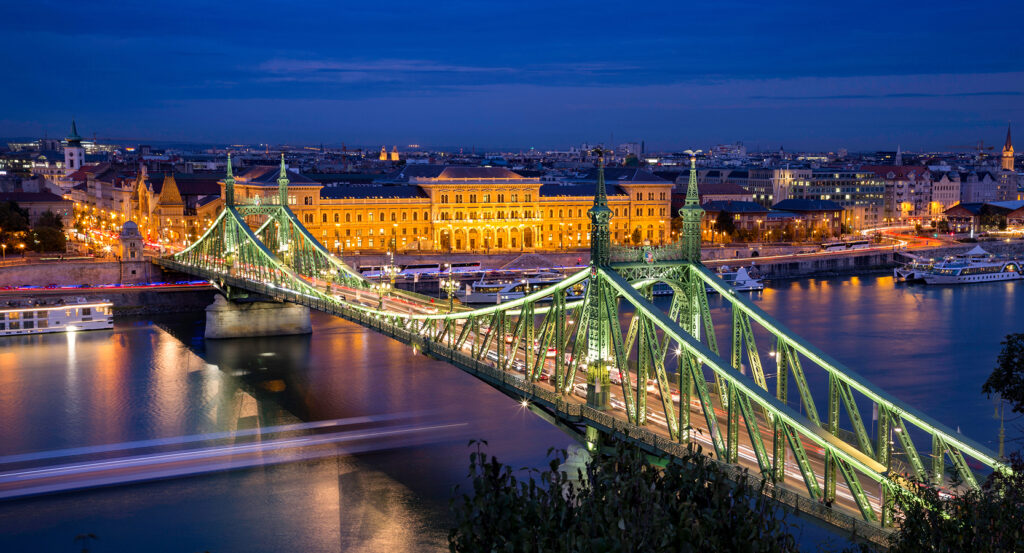
Why Liberty Bridge matters.
Liberty Bridge in Budapest isn't just a crossing over the Danube, it's a symbol of the city's resilience and beauty, uniting Buda and Pest with grace and strength.
Standing at the southern edge of the city's core, this Art Nouveau masterpiece gleams in its signature green, a color that somehow catches the light differently at every hour of the day. Built between 1894 and 1896 for the Millennium Exhibition, the bridge originally honored Emperor Franz Joseph, who himself hammered in the final silver rivet at its opening ceremony. Its iron latticework is a triumph of craftsmanship, crowned by ornate spires topped with the Turul bird, Hungary's mythical guardian. As you walk across, the hum of traffic fades beneath the rhythmic echo of your footsteps, replaced by the whisper of the Danube below and the lively pulse of trams gliding past. Liberty Bridge feels both elegant and alive, a bridge that doesn't just connect two sides of a river but two distinct spirits of a city: the historic quiet of Buda and the energetic modernity of Pest.
What defines Liberty Bridge.
Despite its refined design, Liberty Bridge carries the scars of history and the resilience of rebirth.
During World War II, retreating German forces blew up every bridge in Budapest, and Liberty Bridge was no exception. Its destruction severed a vital artery, symbolizing a city broken and divided. But after the war, this was the first bridge to be rebuilt, restored piece by piece by Hungarian engineers who used the original plans to bring it back to life. The restoration was completed by 1946, a tribute to Hungary's unshakable will to recover. What many don't realize is that Liberty Bridge is actually the shortest of Budapest's main Danube bridges, measuring just 333 meters. Yet it may be the most cherished. The bridge is periodically closed to cars during summer, transforming into a community gathering space where locals sprawl out with picnics, musicians perform at sunset, and yoga sessions stretch beneath the stars. The bridge has become a living symbol of Budapest's creativity, a monument that continues to evolve with its people.
How Liberty Bridge fits.
To experience Liberty Bridge at its most cinematic, time your visit around sunrise or sunset.
In the early morning, the city stirs slowly to life, and the soft pink light glows across the Danube, casting golden ripples beneath the iron beams. At sunset, the bridge becomes a vantage point like no other, framing Gellért Hill and the Liberty Statue in a silhouette of flame and gold. Start the walk on the Pest side, near the Great Market Hall, and take your time crossing toward the Buda end, where Gellért Baths await if you're craving a soak. From the bridge's center, pause to watch the boats drifting below or the Parliament building glowing in the distance. If you visit on a summer evening when the bridge is closed to traffic, linger, join the locals sharing wine and laughter as the skyline shimmers. For photographers, nighttime offers its own allure: the bridge's emerald structure lit softly against the reflections of the Danube, perfectly capturing Budapest's magic. Whether you stroll, cycle, or simply stand still, Liberty Bridge offers a quiet kind of freedom, a reminder that beauty and endurance often walk hand in hand.
Where your story begins.
Foresyte Travel reveals places that feel extraordinary long before you arrive.
Enjoy editorial crafted for luxury travelers.
Foresyte may earn a commission when you book.





































































































