
Why Loyola Marymount University matters.
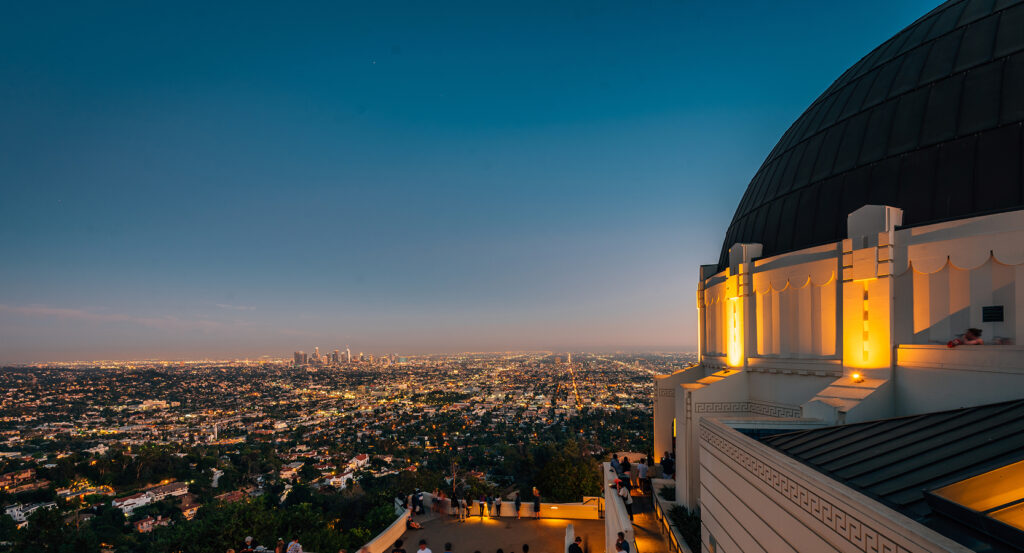
Loyola Marymount University is a distinguished hilltop institution where Westchester's collegiate character meets Spanish Gothic architecture, broad landscaped axes and commanding views from the Del Rey Hills toward the Los Angeles coastline.
Set along LMU Drive near Lincoln Boulevard and just steps from the bluff above Playa Vista, the 142-acre campus occupies an elevated plateau whose northern edge drops sharply toward the Ballona watershed and Santa Monica Mountains beyond. Red-tile roofs, pale masonry, arcades and towers organize the historic core around a long central axis terminating at Sacred Heart Chapel, with later academic and residential buildings extending across adjoining sections of the plateau. Moving through the grounds carries the encounter between formal lawns, shaded courtyards and pedestrian malls before the terrain reaches overlooks where the city grid gives way to the basin below. Mature planting, terraced edges and the pronounced separation between the level academic core and steep bluff add a second physical dimension, giving the campus both architectural order and an unusually dramatic geographic position. The result is a collegiate landscape whose buildings and topography preserve nearly a century of institutional development above Los Angeles' western coastal plain.
What defines Loyola Marymount University.
Loyola Marymount University is best known for joining three Catholic educational traditions whose institutional histories converged on its Westchester campus during the twentieth century. Its oldest lineage reaches to St. Vincent's College, founded by the Vincentian Fathers in 1865 as Southern California's first institution of higher learning and initially housed in the Lugo Adobe near the Los Angeles Plaza. After St. Vincent's closed in 1911, Jesuits opened the high-school division of Los Angeles College, moved the expanding school to Venice Boulevard in 1917 and incorporated it as Loyola College of Los Angeles the following year. President Joseph Sullivan, S.J., expanded instruction into commerce, finance and civil, mechanical and electrical engineering during the 1920s, then launched the campaign for a larger permanent home. Developer Harry Culver donated 100 acres in the Del Rey Hills, where construction produced St. Robert's Hall and Xavier Hall and classes commenced in 1929. The institution attained university status in 1930 as Loyola University of Los Angeles, only a year after reaching the new campus. World War II reduced enrollment to 100 students and left an Army military-training contract crucial to continued operation, before returning veterans using G.I. Bill benefits drove enrollment to 1,500 by 1948. Graduate education expanded after the war, with a formal Graduate Division established in 1950 and programs proliferating during the following decade. That institutional sequence carried a nineteenth-century Catholic college through repeated relocations, academic expansion, wartime contraction and postwar growth before the second major educational tradition arrived on the bluff.
The Marymount lineage began locally in 1923 when the Religious of the Sacred Heart of Mary came to Los Angeles at Bishop John Cantwell's request to educate women in Catholic faith and social justice. Marymount College opened in Westwood in 1933, began granting baccalaureate degrees in 1948 and subsequently transferred instruction to the Palos Verdes Peninsula. A partnership with St. Joseph College of Orange brought the Sisters of St. Joseph of Orange into Marymount governance, and Marymount moved onto Loyola's campus in 1968 under an affiliation negotiated by Marymount president Sister Raymunde McKay and Loyola president Father Charles Casassa. The two schools remained legally separate for five years even as students shared faculties and facilities, creating an unusual co-institutional arrangement between a Jesuit university for men and a women's college administered by two religious communities. Student governments united in 1971, electing a Marymount student as president and anticipating the institutional consolidation underway at the administrative level. Negotiations over the permanent university name became particularly consequential for the women's institution, with Sister Renée Harrangue defending retention of Marymount as recognition of the sisters' and female students' contribution. The merger took effect July 1, 1973 under president Donald Merrifield, S.J., with Harrangue becoming the new university's first provost and the Society of Jesus, Religious of the Sacred Heart of Mary and Sisters of St. Joseph of Orange continuing as its three sponsoring communities. The union transformed two institutions already sharing a campus into a single university whose name permanently preserved both educational lineages.
How Loyola Marymount University fits.
Loyola Marymount University works as the anchor for a Westside exploration connecting aerospace-era corporate design, environmental stewardship and the institutional preservation of Southern California aviation history.
Begin at Otis College of Art and Design, whose Westchester campus is anchored by a seven-story building completed in 1964 as IBM Aerospace Headquarters during Southern California's extraordinary aerospace expansion. Industrial designer Eliot Noyes collaborated with Los Angeles architects A. Quincy Jones and Frederick Emmons on the Mid-Century Modern structure, raising a rectangular volume on angled concrete piers and wrapping it in a precast skin punctured by hundreds of small windows. Their repetitive openings recall IBM punch cards, linking the architecture visually to the data-processing work performed inside as IBM supported companies developing aircraft, missiles and spacecraft. Otis, founded in 1918 as Los Angeles' first independent professional art school, relocated from MacArthur Park to the former IBM property during the 1996-97 winter break, named the new home the Elaine and Bram Goldsmith Campus and launched Toy Design and Digital Media programs alongside the move. Continue to Ballona Discovery Park, created through a partnership among Loyola Marymount University, Friends of Ballona Wetlands and Playa Vista and opened to the public in 2011 as an outdoor environmental-education site adjoining the surviving Ballona wetland system. Its Watershed Walk compresses the movement of water through mountains, urban terrain, freshwater habitat, salt marsh, mudflat, lagoon and ocean into a walkable interpretive sequence, and native demonstration gardens extend ecological instruction into living habitat. A reconstructed Gabrielino Tongva kiiy incorporates recorded Indigenous stories, and the 2021 Tongva Monument honors the people of Guashna, the village associated with this landscape before European colonization. LMU's participation extends into field science through its Center for Urban Resilience, continuing university research and education that previously placed students in the freshwater marsh for bird, wildlife, plant and water studies. Conclude at Flight Path Museum LAX, founded in 1995 as a nonprofit devoted to Southern California aviation and aerospace history and initially expressed through commemorative sidewalk plaques honoring the people and organizations behind the region's aviation development. Los Angeles airport commissioners authorized an educational museum inside the LAX Imperial Terminal in November 2002, and the organization refurbished the facility with support from Los Angeles World Airports before opening exhibitions timed to LAX's seventy-fifth anniversary and the centennial of powered flight. Its collections encompass airline uniforms, aircraft models, aerospace artifacts, photographs, documents and space-exploration holdings beside an active airfield, joining historical interpretation directly to contemporary aviation operations. The associated Flight Path Walk of Fame began with nine honorees and had expanded to 54 by 2018, preserving individual contributions to an industry that profoundly shaped Westchester's twentieth-century growth. The progression moves from an IBM building created for the aerospace age through a university-linked project preserving the ecological and Indigenous history beneath that development and culminates at an institution conserving the aviation heritage that transformed the surrounding district, revealing the technological, environmental and cultural forces that shaped Loyola Marymount University's western Los Angeles setting.
Where your story begins.
Foresyte Travel reveals places that feel extraordinary long before you arrive.
Enjoy editorial crafted for luxury travelers.
Foresyte may earn a commission when you book.





































































































