
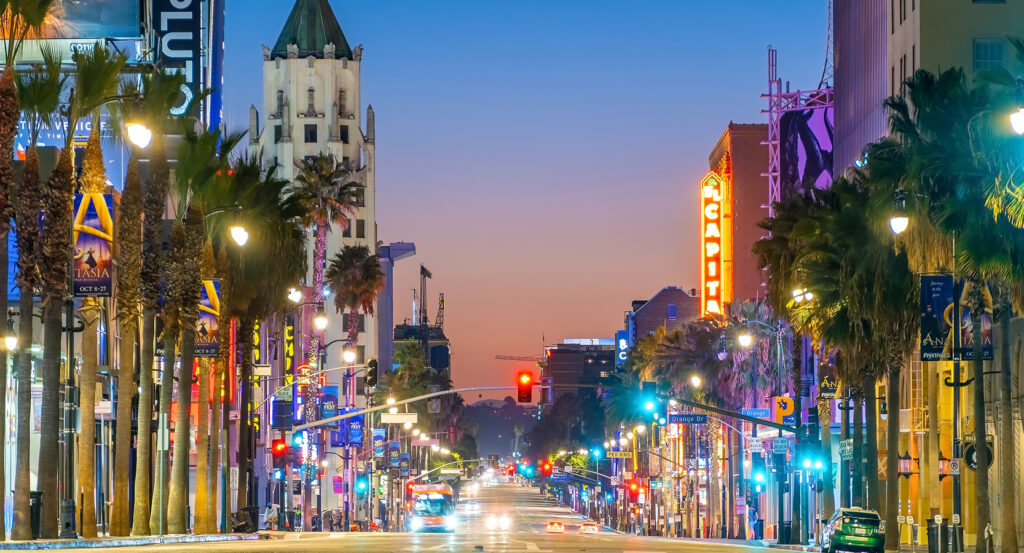
Why you should experience Sound Nightclub in Los Angeles, California.
Sound Nightclub is an intimate electronic-music club where Hollywood's entertainment district meets a sunken dance floor, reclaimed architectural elements and an elevated DJ booth designed to keep performance at the physical center of the room.
Set along North Las Palmas Avenue near Hollywood Boulevard and just steps from the Egyptian Theatre, the club occupies a dense Hollywood pocket shaped by movie palaces, production buildings and nearly a century of nighttime entertainment. The 8,000-square-foot interior combines knotty California redwood with industrial surfaces, incorporating refurbished wood paneling from Frank Sinatra's former home and stair railings salvaged from a Colorado railroad. An expansive sunken dance floor places the crowd beneath an elevated DJ booth, concentrating sightlines toward the performer across a relatively compact room. Recessed seating and oversized booths rise around that central floor, preserving the dance area as the dominant spatial feature even during packed nights. The result is a Hollywood club whose close physical relationship between booth and floor gives large-scale electronic production the immediacy of a substantially smaller room.
What you should know about Sound Nightclub.
Sound Nightclub is best known for Kobi Danan's role in turning a Hollywood club launched by Muse Lifestyle Group into the headquarters of Framework and one of Los Angeles's enduring platforms for underground house and techno. Danan developed the original venture alongside Rob Vinokur and Mikayel Israelyan, reopening the former Element space after an extensive renovation and introducing Sound around the turn of 2013 with Sander Kleinenberg among its earliest headliners. Early bookings established its musical direction quickly: Seth Troxler and resident Lauren Lane opened the February 2013 Find Your Sound series, followed by Martin Buttrich, Infinity Ink, Lee Foss, MK, Anabel Englund, Deniz Kurtel, Franck Roger, Droog and Guy Gerber within five consecutive Fridays. Danan formalized that direction in 2014 through Framework Fridays, created to give underground dance music a dedicated Los Angeles home during the commercial electronic-music boom. Framework subsequently grew far beyond its weekly residency, taking responsibility for Coachella's Yuma Tent and producing projects including Art of the Wild in Las Vegas, Afterlife at Los Angeles State Historic Park and a Hollywood Boulevard event with Fisher and Chris Lake that drew 12,000 people. By early 2020, Danan's operation was producing 220 shows annually, with 90 percent selling out, demonstrating how a 500-to-650-capacity club had become the foundation for a much larger promotion network. DJ Mag placed Sound in its Top 100 Clubs in 2022 and continued recognizing it through subsequent editions, with the club reaching No. 77 in 2025 and No. 86 in 2026. Danan extended the same artist-development model into The Spotlight in 2024, explicitly positioning the smaller Hollywood room as an incubator where performers would develop before advancing to Sound, the Shrine and festival stages.
Pioneer Pro Audio's GS-WAVE installation supplies the current acoustic centerpiece through the first five-way GS-WAVE system installed in North America. Two WAV-SUB cabinets establish the lowest frequencies, paired with two WAV-LOW sections, two WAV-LENS acoustic lenses and two WAV-TWPOD components to divide the frequency spectrum across purpose-built elements. The WAV-LENS units use paired two-inch coaxial neodymium compression drivers with 110-degree horizontal dispersion, directing high-frequency energy across the dance floor from a system developed specifically for large club environments. Projection screens distributed through the room add three-dimensional mapping and custom video content, allowing imagery to reshape surfaces around the crowd during individual productions. Lighting operates as another performance layer through a system developed with specialists including SJ Lighting, placing moving visual effects around the audio installation without displacing the DJ as the principal focus. High-output loudspeakers, controlled dispersion, mapped projection and lighting consequently converge around a compact dance floor, giving house and techno sets enough technical scale for touring artists without sacrificing physical proximity to the booth.
How to fold Sound Nightclub into your trip.
Sound Nightclub works as the late-night endpoint for an evening through Central Hollywood that follows the district from the invention of movie-premiere performance through the social institutions of the studio era and into the architecture of the recorded-music business.
Begin at Egyptian Theatre, completed in 1922 for showman Sid Grauman and developer Charles E. Toberman around a long open forecourt leading from Hollywood Boulevard into an Egyptian Revival movie palace. Douglas Fairbanks's Robin Hood inaugurated the theater on October 18, 1922 through Hollywood's first major red-carpet movie premiere; American Cinematheque acquired the closed building in 1996, and a later partnership with Netflix restored the auditorium while retaining its rare ability to project nitrate film. Continue to Hollywood Roosevelt, opened in May 1927 through a group that included Douglas Fairbanks, Mary Pickford, Louis B. Mayer and Sid Grauman, with Fisher, Lake & Traver designing the twelve-story Spanish Colonial Revival hotel. Its Blossom Ballroom hosted 270 attendees for the first Academy Awards on May 16, 1929, where Academy president Fairbanks presented twelve awards during a ceremony lasting fifteen minutes and Wings received the inaugural Best Picture honor. Conclude at Capitol Records Building, completed in 1956 as a thirteen-story circular office tower designed by Louis Naidorf of Welton Becket and Associates after EMI acquired Capitol Records in 1955. Capitol Studios incorporated eight subterranean echo chambers designed by guitarist and inventor Les Paul, and the tower's ninety-foot spire has flashed H-O-L-L-Y-W-O-O-D in Morse code since its opening, joining architecture and audio engineering in a headquarters created for the West Coast music business. The progression moves from Grauman's transformation of a film opening into public performance through the Roosevelt's institutionalization of Hollywood awards culture into Capitol Records Building's architectural and acoustic infrastructure for recorded music, establishing a century-long entertainment history before the night reaches Sound Nightclub.
Where your story begins.
Foresyte Travel reveals places that feel extraordinary long before you arrive.
Experience premium editorial crafted for luxury travelers.





































































































