
Why The Westin Warsaw matters.
The Westin Warsaw is a defining city hotel where Warsaw's rebuilt modern center meets Polish history, postwar reconstruction and the capital's expanding culture of business, art and public life.
Set along al. Jana Pawła II beside Warsaw's central business district, The Westin Warsaw occupies a position between the Palace of Culture and Science, Rondo ONZ, Saxon Garden and the routes leading toward the Old Town and Vistula River. Its distinctive physical setting combines a contemporary business hotel, high-rise offices, rebuilt boulevards, historic parks and the dense urban landscape of Central Warsaw. The city is encountered primarily through movement between the hotel, office towers, shopping streets, public squares, museums and the avenues connecting the modern center with the Royal Route and historic old city. A second atmosphere develops inside the property through restaurants, lounges, guest floors, fitness facilities, wellness spaces and event rooms that provide a composed refuge from Warsaw's active streets and changing continental seasons. The result is an exceptional urban hotel whose architecture and setting connect Warsaw's business culture, reconstructed history, civic institutions and contemporary European identity.
What defines The Westin Warsaw.
The Westin Warsaw is best known for its distinctive glass elevator tower and its role in the transformation of Warsaw's central business district during Poland's post-communist economic expansion. The hotel emerged from the Atrium development program, a commercial redevelopment initiative undertaken by Skanska and the City of Warsaw beginning in 1994 along Aleja Jana Pawła II. American developer Portman Holdings joined Skanska and Starwood Hotels & Resorts in advancing the hotel project, extending architect John Portman's international influence into the Polish capital. The development represented an investment of €79.5 million, supported by financing from the European Bank for Reconstruction and Development and France's Caisse des Dépôts et Consignations-IXIS. The involvement of these institutions connected the project to the international investment supporting Poland's transition toward a modern European commercial economy. Architectural responsibility brought together John Portman & Associates of Atlanta, Warsaw's Kazimierski & Ryba design office and Sweden's Skanska Teknik, combining international hotel development expertise with Polish architectural practice. Skanska Polska and Portman Holdings coordinated construction, translating the partnership's commercial ambitions into a prominent addition to Warsaw's expanding skyline. The hotel began welcoming guests in 2003 under the ownership of Hotel Atrium and the management of Starwood, becoming the company's second major Warsaw property following the Sheraton Warsaw Hotel & Towers. Its arrival strengthened the capital's infrastructure for international business travel during the period preceding Poland's accession to the European Union in 2004. The property subsequently underwent modernization that incorporated environmental improvements, achieving LEED Silver certification for an existing building and becoming the first hotel in Poland to receive that distinction. Another significant institutional transition followed in December 2016 when Skanska sold the hotel to Qatar's Al Sraiya Holding Group. The acquisition represented Al Sraiya's first investment in Poland and Central and Eastern Europe, bringing the property into a new international ownership structure. The Westin Warsaw reflects successive phases of Warsaw's commercial development, from the international financing of its early twenty-first-century expansion to the growing influence of global hospitality operators and foreign real estate investors.
John Portman's architectural conception gave The Westin Warsaw its defining physical character through a transparent cylindrical elevator tower positioned at the intersection of the building's two principal wings. The structure transforms vertical transportation into a conspicuous element of the cityscape, with three panoramic elevators traveling through a glass enclosure that rises above the surrounding hotel façades. ThyssenKrupp engineered the elevator system, whose observation cabins reach speeds of 3.5 meters per second and provide expansive views across Warsaw's western commercial districts. The illuminated cylinder establishes a recognizable nighttime landmark, extending the building's architectural presence beyond its principal entrance and into the surrounding streets. Portman's treatment of the elevator tower reflects his broader architectural interest in dramatic circulation spaces, a design philosophy developed through his influential American hotel and commercial projects. Wilson & Associates of Dallas developed the original interiors, introducing a contemporary international hospitality aesthetic that complemented the building's distinctive exterior engineering. A sculptural spiral staircase contributes another prominent architectural element within the lobby, reinforcing the relationship between movement, vertical space and the hotel's modernist composition. The property's original culinary program extended this international outlook through Fusion Restaurant, whose open kitchen brought Asian-inspired cooking techniques into a dining environment designed around visible preparation. JP's Café & Bar introduced a complementary social setting, connecting the hotel's business-oriented character with the informal gathering traditions of international urban hotels. The Westin brand's emphasis on wellness also influenced the property's hospitality program through its signature Heavenly Bed concept and organized fitness offerings, including guided running routes through Warsaw. Together, the transparent elevator tower, contemporary interiors and internationally oriented dining spaces establish an architectural and hospitality character closely associated with the capital's emergence as a major European business destination.
How The Westin Warsaw fits.
The Westin Warsaw works as the starting point for an exploration connecting Warsaw's wartime history, its expansive postwar reconstruction and the civic institutions that preserve the cultural character of modern Poland.
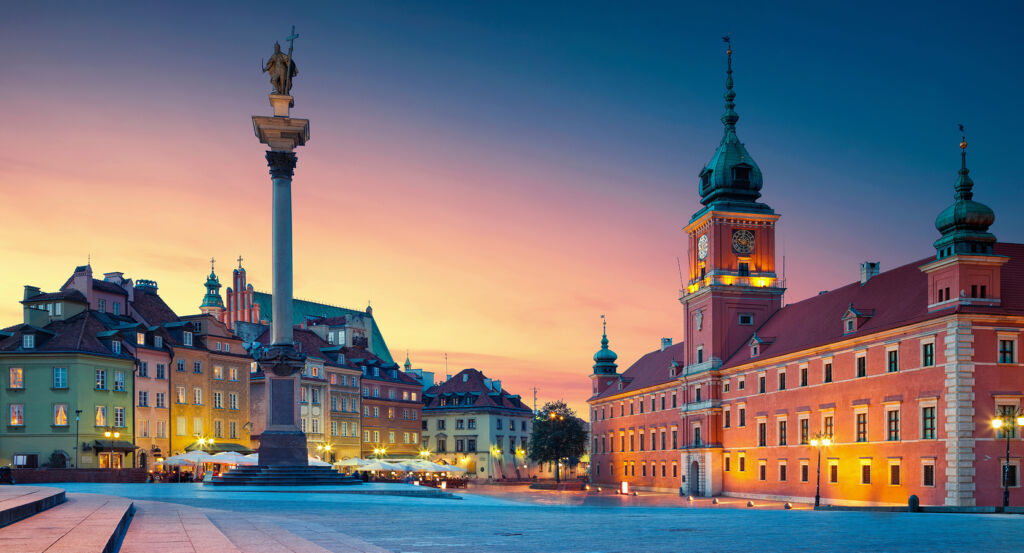
Begin at the Palace of Culture and Science, the expansive tower where grand halls, observation spaces, cultural venues and socialist-realist architecture establish one of Warsaw's most recognizable urban landmarks. Completed during the postwar reconstruction of the capital, the building occupies the center of the modern city and provides views across Warsaw's rebuilt streets, office towers, parks and distant river corridor. Its scale reveals the political and architectural ambitions that shaped the city after the destruction of the Second World War. Continue to Warsaw Uprising Museum, the major historical institution where photographs, personal objects, documents, reconstructed streets and multimedia exhibitions present the 1944 uprising and the experience of wartime Warsaw. The museum occupies a former tram power station in the Wola district and connects industrial architecture with the city's most significant modern historical memory. Its galleries reveal the human scale of occupation, resistance, destruction and reconstruction. Continue to Royal Castle, the historic residence where state rooms, galleries, courtyards and reconstructed interiors preserve Warsaw's royal and parliamentary traditions. The castle stands at the entrance to the Old Town beside Castle Square, linking the medieval city, the Royal Route and the Vistula escarpment. Its restored architecture demonstrates the extent to which Warsaw's historic center was rebuilt through the preservation of fragments, drawings, memory and civic determination. Conclude at POLIN Museum of the History of Polish Jews, the major cultural institution where galleries, architecture, documents, objects and personal histories present the thousand-year history of Jewish life in Poland. The museum stands within the former Jewish district near the Warsaw Ghetto memorial, connecting contemporary design with one of the city's most important sites of remembrance. Its exhibitions place Warsaw within the broader history of migration, urban life, religion, culture and destruction. The progression moves from the Palace of Culture and Science's postwar monumentality through Warsaw Uprising Museum's wartime memory, continues across Royal Castle's reconstructed royal landscape and concludes at POLIN Museum of the History of Polish Jews, where Warsaw's architecture, history, memory and civic character meet.
Where your story begins.
Foresyte Travel reveals places that feel extraordinary long before you arrive.
Enjoy editorial crafted for luxury travelers.
Foresyte may earn a commission when you book.





































































































