
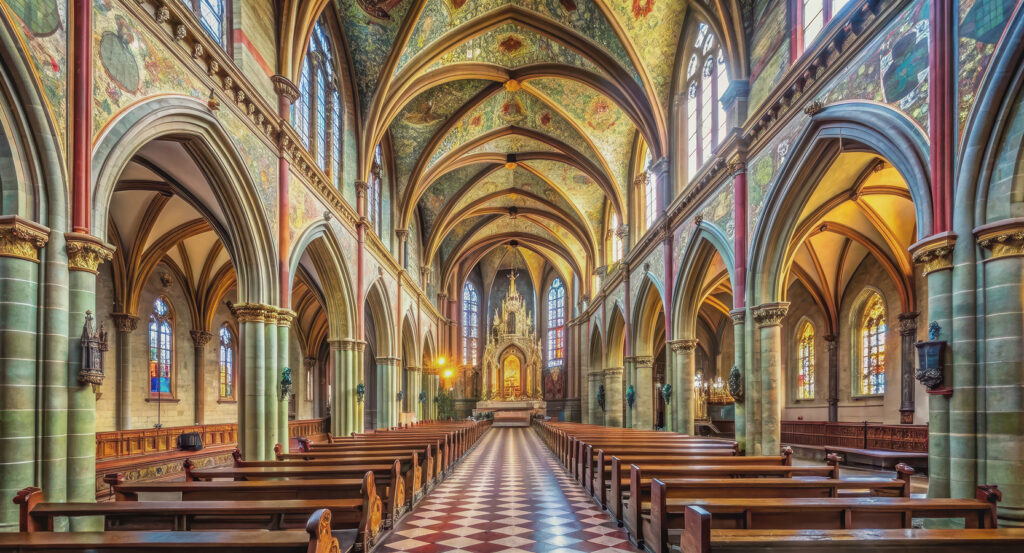
Why you should experience Vyšehrad Cemetery in Prague, Czechia.
Vyšehrad Cemetery is Prague's silent symphony, a resting place where the country's greatest voices still seem to sing.
Set beside the Basilica of St. Peter and St. Paul, the cemetery is less a place of mourning than one of reverent continuity. The pathways curve between ivy-draped tombs and sculpted angels; sunlight filters through chestnut trees; and the hum of the city fades into a hush so profound it feels like prayer. Here lie the artists, poets, musicians, and visionaries who shaped Czech identity, each grave a verse in the nation's unfinished song. To walk among them is to feel the pulse of history beneath your feet, steady and eternal. Vyšehrad Cemetery isn't just where Czech legends rest, it's where their spirits still gather.
What you should know about Vyšehrad Cemetery.
The cemetery was established in 1869, when the Vyšehrad Chapter sought to create a national pantheon, a sacred ground for the cultural and intellectual elite of the Czech lands.
Architect Antonín Wiehl designed its elegant arcades and colonnades, inspired by the Italian Renaissance and unified by a distinctly Czech aesthetic, ornate yet grounded in restraint. The most striking feature is the Slavín, a grand communal tomb at the cemetery's eastern end, built to honor the nation's greatest figures. Beneath its marble canopy rest composers Bedřich Smetana and Antonín Dvořák, writer Jaroslav Vrchlický, sculptor Josef Myslbek, and dozens more whose work defined the Czech spirit. Beyond the Slavín, individual graves tell their own stories: the Art Nouveau tomb of Alfons Mucha, adorned with the flowing lines he made famous; the simple headstone of Karel Čapek, whose words gave the world the word “robot”; and the lyrical epitaphs of poets like Jan Neruda and Vítězslav Hálek. Each monument bears a distinct artistic fingerprint, mosaics, bronze reliefs, or carvings of lyres, quills, and torches, symbols of genius that once illuminated a nation. Few realize that during the communist era, the cemetery was deliberately preserved as neutral ground, an apolitical sanctum where even forbidden artists could still be honored. Today, it remains a national shrine in spirit if not in name, a place where Czech history breathes in marble and light.
How to fold Vyšehrad Cemetery into your trip.
Enter through the gate beside the Basilica of St. Peter and St. Paul, and let your steps slow as the first row of monuments comes into view.
Move clockwise through the shaded paths, each turn reveals new artistry: stained-glass panels glowing in sunlight, angels with weathered wings, the glint of gold lettering among the vines. Begin with the Slavín memorial, its grandeur softened by the stillness around it. From there, wander freely, pause at Dvořák's grave and imagine the melodies that once filled Prague's concert halls, then trace the delicate Art Nouveau lines of Mucha's resting place. You'll notice small offerings, flowers, candles, and sometimes handwritten notes, left by locals who still visit as one might an old friend. Visit near dusk if you can; the fading light turns the marble amber, and the basilica's bells seem to answer the silence. When you leave, glance back through the iron gates, the twin spires of the church rising above the tombs like guardians of memory. Vyšehrad Cemetery is not about death; it's about permanence. A place where artistry, faith, and love for this city have been laid to rest, but never to sleep.
Where your story begins.
Foresyte Travel reveals places that feel extraordinary long before you arrive.
Experience premium editorial crafted for luxury travelers.





































































































