
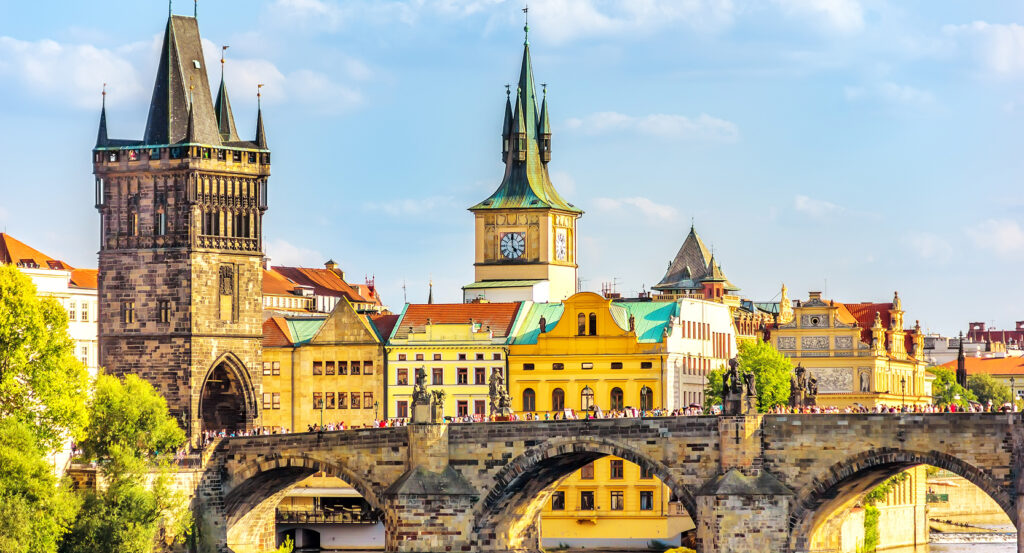
Why you should experience Hotel Bishops House in Prague, Czech Republic.
Hotel Bishops House is Prague lived from within its ancient stones, a hotel that does not imitate history as décor but inhabits it, allowing the city's layered past to become part of your everyday experience with clarity, calm, and a rare sense of presence.
Situated in the Old Town near Týn Church, Old Town Square, and the Jewish Quarter, this hotel stands at the architectural heart of Prague's medieval grid, where narrow lanes, heritage façades, and historic rhythm coexist. Arrival here does not feel like stepping into a hospitality template; it feels like entering a place shaped by centuries of life. The exterior, built directly into preserved medieval structures, signals continuity. Once inside, the interior unfolds with a kind of quiet authority: natural materials, restrained palettes, and thoughtful proportions create an environment of calm composure. Public spaces are scaled for human movement and psychological ease, with circulation that feels intuitive. There is a sense of familiar space rather than staged hospitality, as if the building knows both its origins and its visitor, a rare quality in a city so laden with history. Guest rooms extend this philosophy with coherence and intentionality. Each room feels resolved and calm, organized to support rest, work, and reflective pause. Beds are deeply comfortable, designed for restorative sleep after days spent walking cobbled streets, galleries, and historic precincts. Linens feel substantial and genuine. Windows frame Prague's rooftops, cathedral silhouettes, and narrow passages, making the city part of the room's composition. Furniture is functional and refined: desks scaled for real work, seating that invites lingering, and storage that allows you to unpack fully and feel settled. Lighting is layered and soft, enabling smooth transitions from bright morning plans to evening calm. Bathrooms are composed and efficient, with finishes chosen for tactile ease and everyday comfort. Everything in the room feels placed with purpose; nothing competes for attention. Dining and shared spaces at Hotel Bishops House are extensions of its residential logic. Breakfast is served in an environment that feels warm and social without noise or rush, encouraging genuine presence at the start of the day rather than physical acceleration. Lounges and sitting areas serve as intermediate spaces for reading, planning, reflection, or repose, not staged communal interaction but quiet support for your itinerary. Service at the hotel is one of its defining strengths. Interactions are attentive. Staff guide with local intelligence and personal awareness, offering recommendations and support in a way that feels genuinely situational. Whether you are tracing Gothic façades, exploring hidden courtyards, or moving toward riverside promenades, the hotel's service feels like a subtle reinforcement of your experience. The hotel attracts travelers who value depth over drama: cultural explorers, repeat visitors to Prague, couples seeking authenticity rather than cliché, and anyone who wants the city to feel navigable rather than overwhelming.
What you should know about Hotel Bishops House.
Hotel Bishops House occupies one of Prague's oldest surviving buildings, with layers of architectural history woven into its structure, from medieval foundations to Renaissance and later adaptations, making the building itself a living document of the city's urban evolution.
Unlike properties that graft contemporary hospitality language onto historic façades, this hotel highlights architectural continuity. Many original elements, thick stone walls, aged timber beams, irregular volumes, were preserved and integrated into the design. This intentional preservation gained structural and spatial significance: rooms and corridors follow the historic plan logic rather than a standardized grid, giving each space a distinct sense of character born from geography and history rather than branding. Interiors were crafted to support this condition. Materials like plaster, stone, and wood were chosen for their tactile resonance and ability to age gracefully under repeated use, creating an environment that feels settled. Guest room layouts were informed by the building's inherent geometry: rather than forcing uniform typologies, designers adapted each space to its structural context, resulting in rooms that feel resolved and intuitive rather than templated. Storage, lighting, and circulation were calibrated to accommodate lived use over multiple nights. Bathrooms were designed to align with this architectural integrity: generous circulation, surfaces that feel warm under touch, and fixtures that support daily comfort. Dining and common areas were conceived as inhabited spaces. Breakfast is offered in rooms where scale and proportion feel familiar, encouraging guests to inhabit them as part of the rhythm of the day. Lounges and sitting zones act as extensions of private rooms, providing calm support for rest or conversation. Operational culture reflects this deep architectural intention. Staff training emphasizes positional awareness, contextual guidance, and empathetic responsiveness. This results in interactions that feel genuinely helpful and situationally intelligent, reinforcing the hotel's character of support. Over time, Hotel Bishops House has developed a reputation among travelers who return not for performance but for continuity: those who want Prague to feel occupied, lived, and understood. In a city where every street corner whispers history, the hotel's distinction lies not in dramatizing that heritage, but in allowing you to inhabit it with clarity, calm, and resonant presence.
How to fold Hotel Bishops House into your trip.
Hotel Bishops House works best when you treat it as an anchor for deep engagement with Prague rather than a backdrop you use between sights.
Begin mornings with a calm ritual, breakfast that feels like part of your day rather than a separate event, then step directly into the Old Town's stratified streets. Walk toward Old Town Square, Church of Our Lady before Týn, or the Jewish Quarter with the ease that comes from proximity and orientation. Midday returns to the hotel are restorative. Rest, read, plan, or sit quietly in shared spaces before continuing, allowing the calm of the interior to reset your rhythm rather than detach you from the city. Afternoons are best spent in unhurried exploration: hidden courtyards, lesser-known galleries, and refined local cafés reward curiosity. The hotel's position makes it easy to pivot, return for a pause then step back out. Evenings unfold with coherence. Choose dinner spots that reward depth over performance, attend concerts, wander the river as lights deepen, or simply walk the city as it softens into night. Returning late is never abrupt because the hotel's atmosphere absorbs energy. Hotel Bishops House pairs especially well with itineraries that value meaning over motion: extended stays, cultural immersion, slow travel, and trips where resonant presence matters as much as location. By the time you leave, the hotel will feel less like a place you visited and more like a recurrent point of grace that allowed Prague's layers to unfold with clarity, calm, and a profound sense of being inside the city. In Prague, a metropolis woven from centuries of human presence, that kind of grounded experience becomes its own rare form of luxury.
Where your story begins.
Foresyte Travel reveals places that feel extraordinary long before you arrive.
Experience premium editorial crafted for luxury travelers.





































































































