
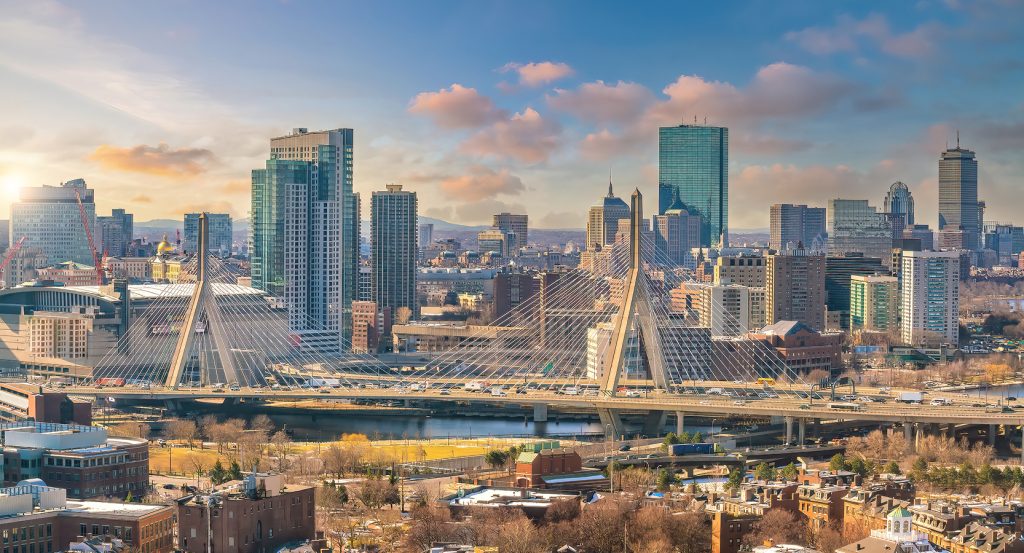
Why you should experience Melcher Street in Boston, Massachusetts.
Melcher Street is an enterprising corridor where Fort Point's industrial heritage, architectural character, creative culture, and waterfront legacy create one of Boston's most distinctive urban streets.
Running through Fort Point between the Seaport District and Downtown, the corridor follows a compact historic alignment framed by imposing brick warehouses, granite loading docks, cast-iron details, and broad cobbled streets that preserve the neighborhood's industrial scale. Each successive block heightens the experience as Romanesque masonry, weathered granite, expansive loft windows, timber-framed buildings, and increasingly expressive warehouse architecture reveal the craftsmanship that supported one of New England's foremost commercial districts. The defining moment arrives as the corridor's preserved warehouse landscape, intimate street proportions, and enduring relationship with Fort Point Channel reveal how commerce, industry, and creative enterprise continue sharing the same historic setting. The result is an experience defined by architectural authenticity, industrial legacy, and one of Fort Point's most distinctive corridors.
What you should know about Melcher Street.
Melcher Street is best known for extending through the Fort Point Channel Landmark District, where Boston's wholesale produce, wool, sugar, tea, and manufacturing industries established one of the city's most important warehouse districts between the late nineteenth and early twentieth centuries. Development surrounding the corridor accelerated after extensive filling of the Fort Point tidal flats created new commercial land, allowing architects and engineers to construct substantial Romanesque Revival, Classical Revival, and Chicago School warehouse buildings distinguished by heavy timber framing, load-bearing brick walls, granite foundations, and expansive industrial sash windows. Railroad sidings, freight houses, nearby Commonwealth Pier facilities, and direct access to Fort Point Channel integrated Melcher Street into a sophisticated distribution network serving regional and international commerce. Preservation of granite loading platforms, original freight entrances, masonry detailing, and historically scaled warehouse blocks continues expressing the corridor's commercial character more than a century after its principal era of development. Collectively, the district's industrial expansion, engineering achievement, commercial architecture, and maritime connections established Melcher Street as one of Fort Point's defining historic corridors.
Creative enterprise became the defining thread shaping the corridor as the Fort Point Arts Community, established during the 1970s, introduced one of New England's largest concentrations of working artists into the district's vacant warehouse buildings, reinforcing Melcher Street's character through studios, galleries, and collaborative cultural activity. That artistic presence expanded through organizations including the Fort Point Arts Community Gallery, whose exhibitions, public programming, and neighborhood initiatives strengthened the corridor's reputation as a center for contemporary visual expression while remaining rooted within its historic warehouse environment. Architects, preservation specialists, brick masons, and timber conservators sustained that evolution by retaining original brick façades, heavy wood structural systems, granite dock features, and steel industrial elements that continue distinguishing Melcher Street's architectural character. Together, these cultural organizations, artistic traditions, and preservation efforts demonstrate how Melcher Street evolved into a corridor where industrial craftsmanship and contemporary creative practice reinforce one another across successive generations.
How to fold Melcher Street into your trip.
Melcher Street works as an exploration of Fort Point's industrial architecture and waterfront culture.
Begin at Boston Children's Museum, where the neighborhood's family-oriented cultural environment establishes the setting before naturally leading toward Melcher Street's historic warehouse blocks. Continue to Institute of Contemporary Art, where contemporary exhibitions deepen appreciation for Boston's evolving creative landscape while extending the experience along the waterfront. Conclude at Fan Pier Park, where sweeping views across Boston Harbor provide the historical payoff by revealing the maritime setting that sustained the commerce and shipping activity defining Melcher Street for generations. The progression moves naturally from cultural discovery to artistic expression before concluding at the harbor that gave the corridor its enduring commercial purpose.
Where your story begins.
Foresyte Travel reveals places that feel extraordinary long before you arrive.
Experience premium editorial crafted for luxury travelers.







































































































