
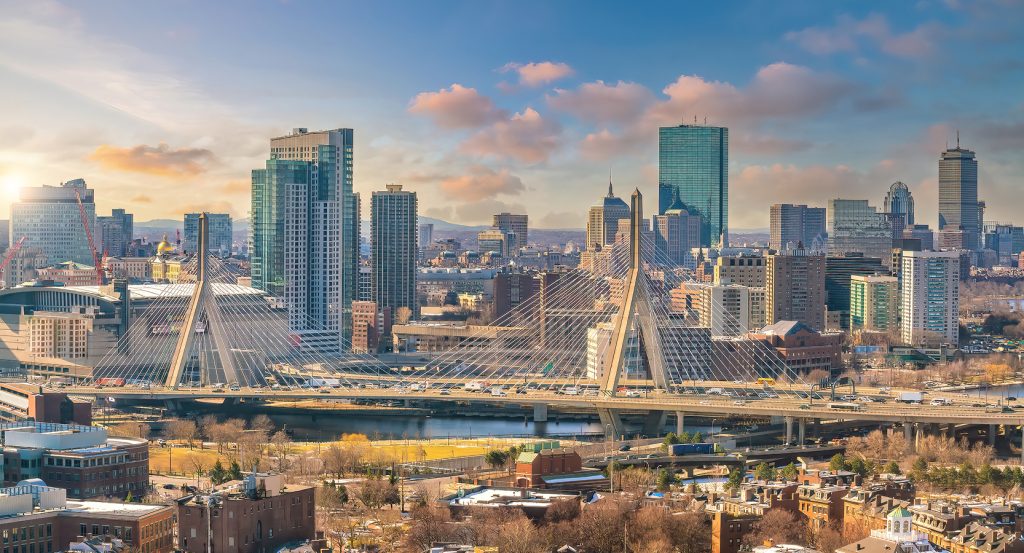
Why you should experience Rutherford Avenue in Boston, Massachusetts.
Rutherford Avenue is an enterprising corridor where Charlestown's maritime heritage, engineering achievement, civic history, and enduring connection to Boston's waterfront shape one of the city's most consequential thoroughfares.
Running through Charlestown between the Navy Yard and Bunker Hill, the corridor connects historic waterfront districts, grand civic spaces, enduring transportation infrastructure, and neighborhoods whose evolution reflects centuries of Boston's commercial and military history. Each successive stretch heightens the experience as expansive harbor views, historic brick architecture, granite monuments, and increasingly prominent civic landmarks reveal the remarkable relationship between Charlestown's colonial origins and Boston's modern urban landscape. The corridor reaches its defining moment where maritime legacy, engineering ambition, and revolutionary history converge into an unmistakably Boston experience. The result is an experience defined by historical significance, waterfront character, and one of Charlestown's most distinctive corridors.
What you should know about Rutherford Avenue.
Rutherford Avenue is best known for serving as Charlestown's principal north-south corridor, occupying a route fundamentally reshaped by construction of the elevated Central Artery during the 1950s before later becoming a centerpiece of Boston's post-Big Dig transportation transformation. The avenue bears the name of John Rutherford, a nineteenth-century Charlestown civic leader, while the surrounding corridor reflects more than two centuries of urban evolution from an independent port town into an integral part of metropolitan Boston following Charlestown's annexation in 1874. Its alignment has long connected the Mystic River crossing with Downtown, reinforcing the corridor's enduring importance within regional commerce, harbor transportation, and metropolitan circulation. Modern reconstruction introduced generous landscaped medians, expanded pedestrian facilities, and improved neighborhood connections while preserving Rutherford Avenue's longstanding function as Charlestown's principal gateway. Collectively, the corridor's transportation evolution, Charlestown's annexation, regional connectivity, and contemporary boulevard design established Rutherford Avenue as one of Boston's defining urban corridors.
Maritime commerce remained a defining influence as nearby wharves, shipyards, ropewalks, and marine industries sustained Charlestown's economy for generations before gradually giving way to diversified commercial and residential activity. Industrial brick buildings constructed during the late nineteenth and early twentieth centuries continue expressing the corridor's commercial heritage through durable masonry construction, large segmental-arched windows, and utilitarian architectural detailing characteristic of Boston's waterfront economy. Public investments in streetscape improvements introduced broad sidewalks, street trees, ornamental lighting, and landscaped public spaces that strengthened Rutherford Avenue's role as Charlestown's primary civic boulevard while respecting its longstanding urban character. Together, these maritime traditions, preserved industrial architecture, and thoughtfully integrated public spaces demonstrate how Rutherford Avenue evolved from a working commercial artery into one of Charlestown's most historically significant streets.
How to fold Rutherford Avenue into your trip.
Rutherford Avenue works as an exploration of Charlestown's revolutionary history, maritime legacy, and waterfront identity.
Begin at USS Constitution Museum, where exhibitions interpreting naval innovation establish the historical foundation before naturally leading toward Rutherford Avenue and Charlestown's waterfront. Continue to Charlestown Navy Yard, where preserved dry docks, granite infrastructure, and centuries of naval engineering deepen appreciation for the neighborhood's maritime importance while advancing the experience. Conclude at Bunker Hill Monument, where the memorial to one of the Revolutionary War's defining battles provides the historical payoff that places Rutherford Avenue within the broader story of Charlestown's national significance. The progression moves naturally from naval heritage to working waterfront history before concluding with the defining event that secured Charlestown's place in American history.
Where your story begins.
Foresyte Travel reveals places that feel extraordinary long before you arrive.
Experience premium editorial crafted for luxury travelers.







































































































