
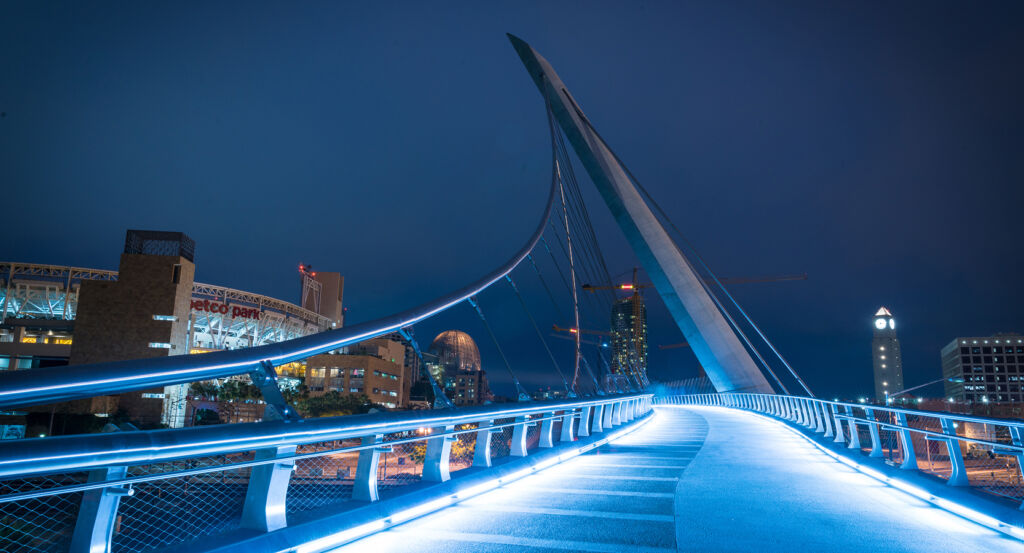
Why you should experience Albatross Street in San Diego, California.
Albatross Street is a graceful corridor where Bankers Hill's architectural distinction, cultural sophistication, hillside landscapes, and enduring elegance unfold along one of Central San Diego's most memorable streets.
Running through Bankers Hill between Hillcrest and Downtown, the corridor ascends gently across landscaped blocks lined with historic residences, contemporary condominiums, mature trees, and neighborhood institutions that collectively reflect more than a century of thoughtful urban development overlooking Balboa Park and San Diego Bay. California Craftsman homes, Spanish Colonial Revival residences, Moderne apartments, Contemporary architecture, jacarandas, Canary Island date palms, coast live oaks, and ornamental gardens establish a streetscape where historic craftsmanship and modern design coexist. Throughout the corridor, artistic expression, architectural preservation, and generations of neighborhood investment reinforce an atmosphere shaped by refinement and cultural continuity. The result is an experience defined by architectural richness, elevated views, and one of Bankers Hill's most distinguished residential corridors.
What you should know about Albatross Street.
Albatross Street is best known for extending through Bankers Hill, whose modern character emerged during the late nineteenth century as San Diego's expanding professional class established substantial hillside residences overlooking Balboa Park and San Diego Bay following the city's population boom of the 1880s. Residential development surrounding the corridor accelerated between the 1900s and 1940s, introducing enduring collections of California Craftsman, Prairie School, Spanish Colonial Revival, Mission Revival, and Streamline Moderne architecture distinguished by redwood framing, clinker brick chimneys, hand-finished stucco, decorative tilework, art-glass windows, exposed rafter tails, and locally quarried stone retaining walls adapted to the neighborhood's steep topography. The corridor evolved alongside the growth of nearby medical institutions, professional offices, and cultural organizations that established Bankers Hill as one of San Diego's most architecturally accomplished urban neighborhoods while preserving its residential scale. Jacarandas, Canary Island date palms, coast live oaks, Allen's hummingbirds, western gulls, monarch butterflies, western fence lizards, and native coastal sage scrub continue reinforcing the corridor's ecological character. Together, these development milestones, architectural traditions, construction methods, institutional influences, and natural landscapes establish Albatross Street as a defining expression of Bankers Hill's historical evolution.
Nearby Marston House, completed in 1905 to designs by William Sterling Hebbard and Irving Gill for department store founder George W. Marston, established one of Southern California's finest examples of the Arts and Crafts movement while influencing the architectural character experienced throughout the surrounding neighborhood. The nearby Villa Montezuma, completed in 1887 for musician Jesse Shepard, introduced an exuberant Queen Anne residence featuring stained glass, elaborate woodwork, and richly ornamented interiors that exemplified San Diego's Victorian-era ambition during the same period that Albatross Street was developing. Original residences lining the corridor continue displaying handcrafted millwork, decorative brick masonry, leaded-glass casements, carved wood entry doors, exposed beam construction, and ornamental ironwork that preserve the craftsmanship defining Bankers Hill's principal era of residential growth. Together, these celebrated residences, influential architects, and enduring architectural details demonstrate how Albatross Street developed within one of San Diego's most historically significant hillside neighborhoods.
How to fold Albatross Street into your trip.
Albatross Street works as an exploration of Bankers Hill's architecture, urban landscapes, and cultural heritage.
Begin at Balboa Park, where formal gardens, grand architecture, and expansive cultural institutions introduce the landscape that has shaped Bankers Hill's character for more than a century. Continue to The San Diego Museum of Art, whose Spanish Colonial Revival architecture and internationally renowned collections deepen appreciation for the artistic traditions that complement the surrounding neighborhood. Conclude at California Tower, where panoramic views across San Diego provide the historical payoff by revealing the relationship between Bankers Hill, Balboa Park, downtown, and the natural harbor that fueled the city's growth. The progression moves naturally from the park that defines the neighborhood through one of its premier cultural institutions before culminating in the city's most celebrated architectural panorama, revealing why Albatross Street remains one of Bankers Hill's defining corridors.
Where your story begins.
Foresyte Travel reveals places that feel extraordinary long before you arrive.
Experience premium editorial crafted for luxury travelers.





































































































