
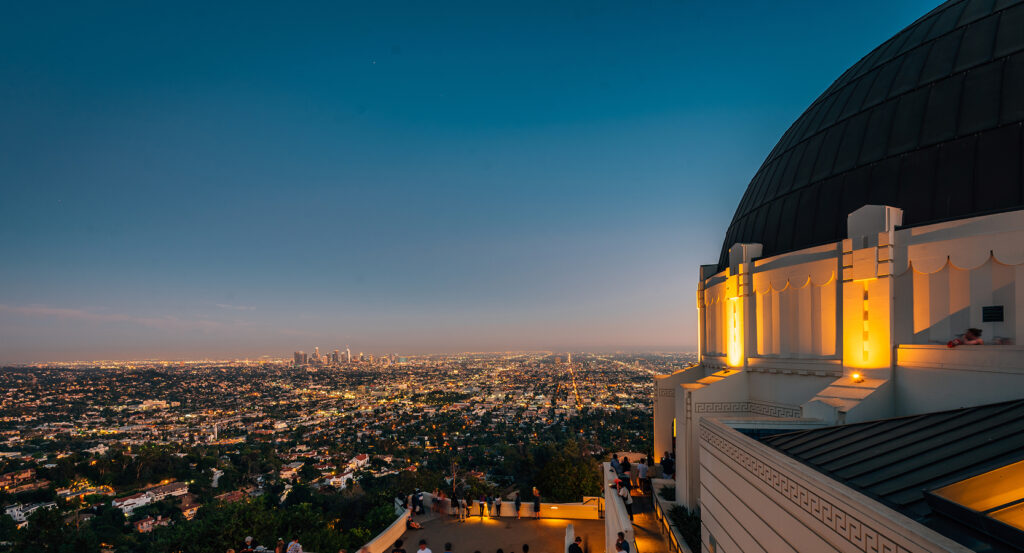
Why Ascot Hills Park matters.
Ascot Hills Park is a rugged hillside park where El Sereno's Eastside character meets rolling grassland, native habitat and panoramic terrain rising above the Los Angeles Basin.
Set along Multnomah Street near Bowman Boulevard and just steps from Woodrow Wilson High School, the park occupies a chain of steep hills and interior valleys east of Downtown, with ridgelines opening toward the San Gabriel Mountains, the San Rafael Hills and the metropolitan basin. Dirt trails climb sharply through grass-covered slopes before reaching exposed crests with broad sightlines across Northeast Los Angeles. Southern California black walnut woodland, coastal sage scrub and valley grassland create distinct plant communities across the changing elevations. A restored stream cuts through lower terrain beneath the ridges, shifting the park between dry upland slopes and a narrow riparian corridor. The result is a 93-acre hillside landscape whose steep trails, native vegetation, elevated ridges and enclosed valleys preserve an uncommon expanse of open terrain within the Eastside.
What defines Ascot Hills Park.
Ascot Hills Park is best known for converting land held for Los Angeles water infrastructure into a major Eastside nature park after decades of proposals, local advocacy and delayed development. An earthen dam constructed during the late 1920s created a seven-acre open reservoir in the hills, and additional parcels acquired around the water property through the 1950s kept substantial surrounding acreage free from urban development. The reservoir left service in 1987 after decades within the municipal water network, and a covered 30.7-acre-foot storage tank completed in 1990 replaced the earlier open basin. Landscape architect Jerry Schneider supplied a decisive new direction in 1998 through a graduate thesis proposing that the unused reservoir property become an open-space nature park. Schneider subsequently joined residents Raymond Rios and Val Marquez in a sustained campaign to secure public access to the hills, with North East Trees becoming a major partner in the developing landscape. An initial portion opened in 2006 with little more than a gravel driveway and rudimentary seating, leaving the larger vision unfinished. Los Angeles later pursued development of 100 acres as a natural park with trails, outdoor learning areas and vista points through its Proposition K program. Construction on the expanded property began in 2010 after repeated delays, and the Great Recession disrupted the timetable as California withheld funding during its fiscal crisis. The completed second phase received its dedication on June 25, 2011, creating a 92-acre public landscape with new trails, an outdoor amphitheater and a restored stream. The decades separating the reservoir era from the 2011 dedication turned land long closed behind water-utility boundaries into one of the largest open-space parks on Los Angeles's Eastside.
Ecological restoration subsequently became another major chapter as North East Trees, the Ascot Hills Park Green Team and Loyola Marymount University expanded native vegetation across former grassland and disturbed slopes. A watershed greening project approved in 2015 targeted 40 acres, including 14 acres of native habitat restoration, two stormwater infiltration areas, 950 trees and 5,000 shrubs, backed by a $989,000 state grant within a broader $1.65 million project. North East Trees planted Southern California black walnuts during 2015 and 2016, establishing young woodland on the East Hillside that matured through the following decade. Loyola Marymount University ecologist Demian Willette later developed Ascot Hills into a field site for long-term work with students, community partners and the Park Advisory Board. Fourteen years of restoration between 2011 and 2025 increased native woody plant cover by 93.3 percent, quantifying the cumulative effect of sustained planting across the park. Another intervention arrived in January 2024 when Katherine Pakradouni designed a 10,000-square-foot micro forest containing 850 native trees, shrubs and herbaceous perennials on a south-facing slope. The park nursery extends the same work through seeds collected on the property and propagated by North East Trees for future planting. Southern California black walnut, coast live oak, elderberry, arroyo willow, cottonwood, purple needle grass and narrow-leaf milkweed now belong to a restoration program spanning woodland, riparian habitat and valley grassland. Ascot Hills Park has developed from a newly opened hillside into a long-running urban ecology project shaped by sustained collaboration among landscape practitioners, university scientists and local stewards.
How Ascot Hills Park fits.
Ascot Hills Park works as the anchor for a daytime outing connecting Victorian-era preservation, Charles Fletcher Lummis's handmade Arroyo Seco residence and the museum he created above Mount Washington.
Begin at Heritage Square Museum, founded in 1969 as Los Angeles was losing nineteenth-century buildings to demolition and redevelopment. The museum assembled eight historic structures moved from different neighborhoods, creating a concentrated architectural chronology of Southern California between 1850 and 1950. The Longfellow-Hastings Octagon House represents the eight-sided domestic form promoted nationally during the nineteenth century, and the William Perry House preserves the more elaborate residential architecture associated with prosperous Victorian Los Angeles. Palms Depot adds a transportation chapter through a former Southern Pacific railroad building, and a 1909 Denver & Rio Grande boxcar extends the collection into early twentieth-century rail history. Continue to Lummis House, the stone residence Charles Fletcher Lummis began constructing after selecting the Arroyo Seco property in 1895 for its immense sycamore, El Alisal. Lummis, an author, editor, photographer, librarian and preservation advocate, designed the house with architect Sumner Hunt and built much of it through years of hand labor using stone gathered from the Arroyo Seco. His 1895 formation of the Landmarks Club placed the house within a broader campaign to preserve California's deteriorating Spanish missions. El Alisal subsequently became both Lummis's home and a repository for the cultural objects accumulated through his work across the Southwest, joining domestic architecture with the collecting interests that shaped his later institutional ambitions. Conclude at Southwest Museum, which Lummis founded through the Southwest Society and first opened in Downtown in 1907 before creating a purpose-built home for its collections on Mount Washington. Sumner Hunt and Silas Burns developed the Mission Revival building between 1912 and 1914, placing the institution prominently above the Arroyo Seco on a site chosen for visibility, seclusion and access to the expanding city. A 115-foot tower rose above the hillside complex, and the museum became Los Angeles's first purpose-built institution devoted to the history, art and cultures of the American Southwest. Gordon B. Kaufmann designed the Caroline Boeing Poole Wing of Basketry completed in 1941, extending a campus whose Native American holdings grew into one of the country's major collections. The progression moves from Heritage Square Museum's rescue of nineteenth-century Los Angeles architecture through Lummis House's union of handmade construction and preservation advocacy and culminates at Southwest Museum, where Charles Fletcher Lummis translated those interests into a permanent cultural institution above the Arroyo Seco.
Where your story begins.
Foresyte Travel reveals places that feel extraordinary long before you arrive.
Enjoy editorial crafted for luxury travelers.
Foresyte may earn a commission when you book.





































































































