
Why Barnsdall Art Park matters.
Barnsdall Art Park is a visionary civic arts campus where East Hollywood's creative character meets hilltop landscape design, early California Modernism and Aline Barnsdall's dramatic conception of publicly accessible culture.
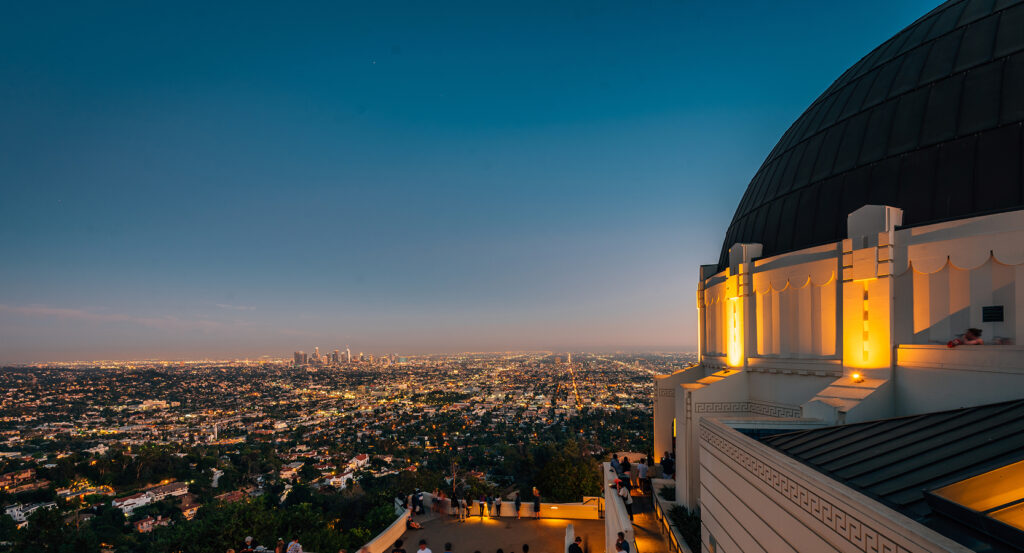
Set along Hollywood Boulevard near Vermont Avenue and just steps from Kaiser Permanente Los Angeles Medical Center, the 11.5-acre park occupies the crown of Olive Hill above a dense urban corridor linking Hollywood with the eastern neighborhoods of Central Los Angeles. Terraced lawns, olive trees and low architectural volumes step across the summit, opening broad views toward the Hollywood Hills and the city basin from an elevated landscape distinct from the surrounding street grid. Moving through the grounds brings architecture and planted terrain into close physical succession as paths climb between lawns, courtyards, retaining walls and buildings distributed across the crest. Sloping edges and surviving olive groves deepen the hilltop character, preserving traces of the agricultural landscape that preceded the cultural campus. The result is a compact public park whose topography and architectural composition make artistic activity inseparable from one of Central Los Angeles's most distinctive elevated sites.
What defines Barnsdall Art Park.
Barnsdall Art Park is best known for Aline Barnsdall's conversion of Olive Hill into an experimental arts project and her subsequent gift of its surviving core to the City of Los Angeles. Barnsdall, an oil heiress, theater producer, art collector and patron of avant-garde performance, approached Frank Lloyd Wright in 1915 with the initial ambition of commissioning a theater, then purchased the 36-acre Olive Hill property in 1919 as that ambition expanded into a far larger cultural complex. Wright planned a theater, cinema, artist residences, shops, guest houses and Barnsdall's own residence across the property, with construction proceeding during a period when he was simultaneously working on Tokyo's Imperial Hotel. Financial and artistic disputes ended their collaboration in 1921 before the complete plan was realized, leaving the principal residence and a limited group of associated structures from the larger scheme. Barnsdall subsequently offered part of Olive Hill to Los Angeles, and in 1927 the city accepted 11.56 acres with provisions dedicating the property to public enjoyment and restricting future construction to artistic purposes. She made the gift in memory of her father, Theodore Barnsdall, converting a private patronage project into a municipally held cultural property. The transfer preserved the central portion of an experiment conceived years before Los Angeles possessed the extensive network of civic arts institutions that later developed across the metropolis.
Municipal stewardship gradually expanded Barnsdall's original public-arts mandate through a sequence of educational, exhibition and performance programs occupying the hill. Adult instruction began in 1946 in the Arts and Craft Center, creating a city-operated teaching program devoted to disciplines that eventually encompassed drawing, painting, ceramics, jewelry, fiber art and photography. Los Angeles created its Municipal Art Gallery in 1954 under director Kenneth Ross, initially housing exhibitions in a temporary hall before making the program permanent in 1957; presentations during its early years ranged across Vincent van Gogh, Rembrandt van Rijn and Henri de Toulouse-Lautrec alongside Pablo Picasso, Jackson Pollock, John McLaughlin and Ed Kienholz. Youth education gained its own institution with the Junior Arts Center in 1967, extending municipal instruction to children and young people. A new 10,000-square-foot Municipal Art Gallery designed by Dennis Wehmueller and Arthur Stephens opened in 1971 along with the Barnsdall Gallery Theatre, adding purpose-built exhibition and performance facilities to the campus. Josine Ianco-Starrels redirected the gallery program after becoming director in 1975, increasing attention to Los Angeles artists, women and artists of color; subsequent exhibitors included Eleanor Antin, John Baldessari, David Hammons, Barbara Kruger, Kerry James Marshall, Senga Nengudi, Catherine Opie and Ed Ruscha. The creation of the Barnsdall Art Park Foundation in 2003 added nonprofit support for conservation, infrastructure and cultural programming, extending the civic arts mission embedded in Barnsdall's 1927 gift across successive generations of Los Angeles artists and students.
How Barnsdall Art Park fits.
Barnsdall Art Park works as the anchor for an east-side cultural sequence tracing the development of theatrical performance, independent intellectual inquiry and transnational spiritual practice across institutions created during Los Angeles's twentieth-century expansion.
Begin at Vista Theatre, the 1923 single-screen venue originally known as the Lou Bard Playhouse or Bard's Hollywood and designed by theater architect Lewis A. Smith. Its exterior followed Spanish Colonial Revival architecture already prevalent across Southern California, but the discovery of Tutankhamun's tomb in 1922 arrived late enough in the design process to redirect the unfinished interior toward Egyptian ornament. The resulting combination surrounded an auditorium originally seating 838 people, where vaudeville shared the program with silent motion pictures during the theater's early years. An Egyptian-themed box office joined the property in 1942, and later alterations reduced seating to 400 while preserving the theater as an operating single-screen cinema. Continue to Philosophical Research Society, founded in 1934 by Canadian-born scholar Manly Palmer Hall as a center devoted to philosophy, comparative religion and the study of wisdom traditions. Hall had published The Secret Teachings of All Ages in 1928 and subsequently assembled rare books, manuscripts, artworks and esoteric objects during extensive international travel, forming the basis of a specialized library that now contains more than 30,000 rare volumes. The Society acquired its Los Feliz property in 1935, and architect Robert Stacy-Judd designed a campus whose first building incorporated offices, a print shop, bindery and library. A second structure arrived in 1950, followed by an auditorium dedicated in 1959, giving Hall's publishing and lecture enterprise a permanent architectural center that continued his work after his death in 1990. Conclude at Self-Realization Fellowship Hollywood Temple, opened and dedicated by Paramahansa Yogananda on August 30, 1942 as the oldest surviving Self-Realization Fellowship temple in the United States. Yogananda had founded the organization in 1920 and used the Hollywood property as a center for meditation, Kriya Yoga teaching and public services, personally leading Sunday programs during the final decade of his life. The complex expanded in 1950-51 when monks working under his direction constructed India Center beside the temple; Yogananda formally dedicated it on April 8, 1951, and the growing campus incorporated India Hall, monastic residences and meditation gardens. His Autobiography of a Yogi, published in 1946 during the temple's formative years, extended the organization's reach internationally and became the best-known literary work associated with his teachings. The progression moves from a silent-era theater shaped by the Egyptian Revival through Manly Palmer Hall's institution for comparative philosophical study and culminates at Yogananda's Hollywood center, connecting three independent cultural enterprises that expanded Los Angeles's intellectual and artistic life beyond conventional civic institutions.
Where your story begins.
Foresyte Travel reveals places that feel extraordinary long before you arrive.
Enjoy editorial crafted for luxury travelers.
Foresyte may earn a commission when you book.





































































































