
Why you should experience Medusa Heads at Basilica Cistern in Istanbul, Türkiye.
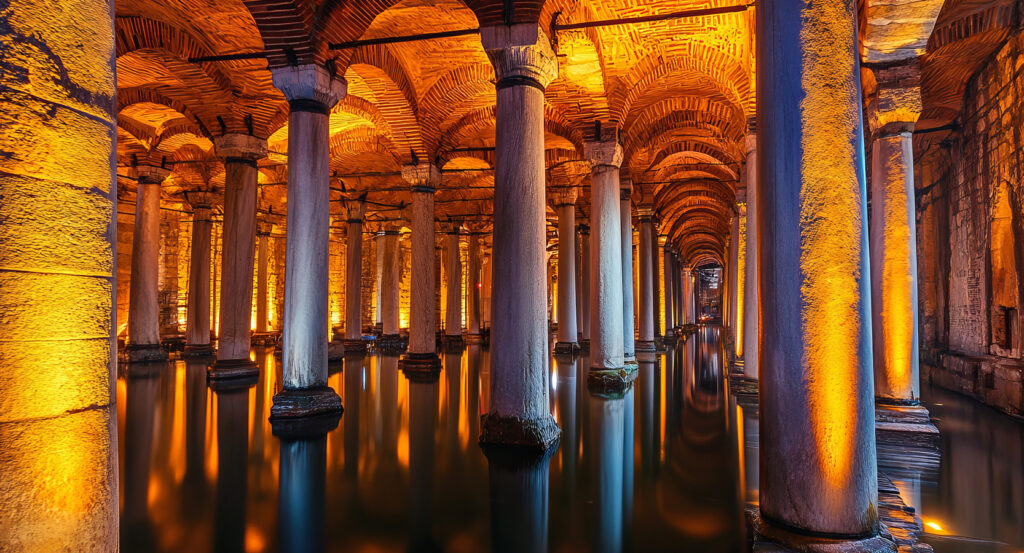
Deep beneath Istanbul's streets, in the shadowed heart of the Basilica Cistern, lie the two stone faces of Medusa Heads that have outlived gods, empires, and myth itself.
Medusa Heads, carved from ancient marble and set as column bases, are among the most haunting and unique relics in the city. One rests sideways, the other upside down, their blank eyes half-immersed in the cistern's shallow waters. In the dim glow of amber light, they seem to float between worlds, part of the Roman past, part of Byzantine reinvention, and now forever part of Istanbul's legend. Standing before them, the stillness feels almost sacred. The sound of dripping water echoes through the cavern, and time itself seems to pause, just long enough for you to realize you are looking into a mystery that no historian has ever fully solved.
What you should know about Medusa Heads at Basilica Cistern.
Medusa Heads are relics of transformation, both literal and symbolic.
No one knows exactly where they came from, but scholars believe they were salvaged from a late Roman temple, dedicated to Apollo or Artemis, and repurposed during Emperor Justinian's construction of the cistern in the 6th century. Their placement is deliberate yet enigmatic: one head lies sideways, the other inverted, to neutralize the gorgon's petrifying gaze or to symbolize the triumph of Christianity over pagan myth. Another interpretation suggests pure practicality, the builders simply used them as sturdy bases. Yet in Byzantium, even practicality carried poetry. The reuse of pagan icons as support for imperial infrastructure reflected the empire's ability to absorb and redefine the world it conquered. The marble itself, weathered and faintly luminescent, bears the marks of centuries of immersion, algae traces, mineral veins, and hairline cracks that glimmer like veins of gold under the water's glow. Their presence turned the utilitarian cistern into a crypt of myth, transforming the functional into the eternal.
How to fold Medusa Heads at Basilica Cistern into your trip.
Find them in the far northwest corner of the Basilica Cistern, but don't rush there.
First, let your eyes adjust to the half-light of the columns and water reflections. Medusa Heads are best approached slowly, emerging from the shadows like something alive. When you reach them, pause, step close enough to see how the marble ripples under the surface, yet far enough to take in the symmetry of their strange positioning. Visit in the late afternoon or early evening when the lighting softens, giving the sculptures an ethereal, almost breathing quality. Photograph them sparingly, no view can capture the quiet pulse of myth that fills this corner of the cistern. Then step back and look once more at the endless forest of columns around you, realizing how two forgotten stones from the pagan world became the spiritual anchor of an empire's hidden underworld. Medusa Heads aren't just curiosities, they're metaphors in marble, proof that history doesn't erase the past; it absorbs it.
Where your story begins.
Foresyte Travel reveals places that feel extraordinary long before you arrive.
Experience premium editorial crafted for luxury travelers.





































































































