
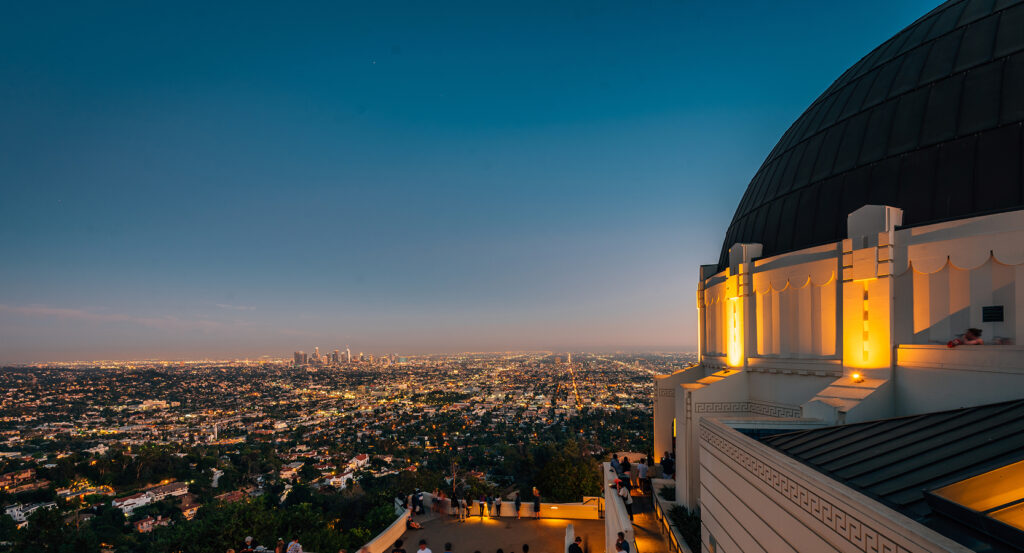
Why Brentwood matters.
Brentwood is a verdant enclave where West Los Angeles's foothill character meets broad residential avenues, canyon-cut slopes and early twentieth-century subdivisions conceived around landscaped streets between the Santa Monica Mountains and the coastal plain.
Positioned between Pacific Palisades, Westwood, and Sawtelle, the neighborhood occupies rising ground extending north from Wilshire Boulevard through the San Vicente corridor into a succession of ridges and canyons below the Santa Monica Mountains. Broad setbacks, mature tree cover and houses spanning Spanish Colonial Revival, Tudor Revival, American Colonial, Ranch and Modern design establish a residential fabric that changes steadily with elevation. San Vicente Boulevard supplies the primary encounter through a wide linear corridor whose central planting divides commercial blocks before continuing west through lower-density residential territory. Smaller streets climb from the boulevard into irregular foothill parcels, where deep gardens, winding roads and canyon edges replace the more rectilinear geometry of the lower district. The result is a neighborhood whose planted avenues, changing elevations and century of residential architecture preserve the physical ambitions of an early Westside suburb across terrain stretching from metropolitan boulevards into mountain foothills.
What defines Brentwood.
Brentwood is best known for emerging from Rancho San Vicente y Santa Monica through a sequence of streetcar subdivisions that transformed open mesa land west of the National Home for Disabled Volunteer Soldiers into an affluent Los Angeles suburb. Francisco Sepulveda received the rancho in 1839, and most of its 31,000 acres passed to Robert S. Baker in 1872 for $55,000 before Baker joined Nevada senator John P. Jones in developing Santa Monica and its rail connection with Los Angeles. Robert Gillis, working through the Santa Monica Land and Water Company, began subdividing Westgate in 1905 beside the western entrance to the Soldiers' Home, followed by Westgate Acres, Westgate Gardens and Westgate Heights. San Vicente Boulevard was graded that year, and Los Angeles and Pacific Railroad tracks placed along its center connected the new tracts with Los Angeles. Western Pacific Development Company purchased 350 acres in 1906 and created Brentwood Park, carrying the Brentwood name into a tract extending north from San Vicente beyond Sunset Boulevard with Bristol Avenue as its principal north-south axis. Its original plan incorporated dozens of planted circles and oval islands, generous parcels and unusually deep setbacks intended to create a woodland residential environment across the gently rising site. The financial panic of 1907 halted Western Pacific's campaign, and Herman Janss acquired a substantial interest in 1909 as the district entered another development phase. Residents voted for annexation to Los Angeles in 1916, bringing the early Westgate and Brentwood subdivisions into the city before major house construction accelerated during the 1920s. Pacific Electric, which had absorbed the earlier railway operation in 1911, ended streetcar service 1942, and five miles of coral trees subsequently occupied the former tracks along San Vicente Boulevard.
Brentwood Country Mart supplied the postwar community with a commercial counterpart deliberately scaled to the residential district surrounding it. Louis M. Sentei and A.L. Levin commissioned architect Rowland Crawford to create the property as a one-stop shopping center, and the Baruch Corporation completed the project within six months before its November 18, 1948 opening. Crawford organized red board-and-batten buildings around courtyards, drawing upon early American and English country marketplaces and his earlier Town and Country Market concept. Gambrel roofs, divided-light windows and barn-like forms gave the 30,000-square-foot complex an architectural relationship to a district where horseback travel remained visible even after World War II. Twenty-six businesses initially occupied the property, combining food merchants with neighborhood services under a merchandising concept promoted at the time as a concentrated alternative to dispersed shopping streets. A post office, shoe repair business, barber and Reddi Chick became long-running components of the property as Brentwood developed around them. Hollywood figures also adopted the complex during its early decades, placing a deliberately rustic commercial center within the social geography of the increasingly affluent Westside. The property changed hands in 2003, beginning another period of rehabilitation that retained Crawford's courtyard organization and country-market architecture. Brentwood Country Mart preserved a postwar commercial form whose intimate scale grew directly from the residential community created along San Vicente during the preceding four decades.
How Brentwood fits.
Brentwood works as the anchor for an outing connecting a Victorian veterans' chapel, a Jewish cultural campus embedded in the Santa Monica Mountains and Richard Meier's hilltop center for art, architecture and scholarship.
Begin at Wadsworth Chapel, completed in 1900 within the Pacific Branch of the National Home for Disabled Volunteer Soldiers, an institution established in 1887 on donated Santa Monica ranch land. Architect J. Lee Burton designed a vivacious late-Victorian building containing separate Catholic and Protestant sanctuaries divided by a double brick wall, allowing two congregations to occupy the same structure through independent entrances. Its towers, varied window patterns and shingled surfaces belonged to a larger Victorian campus that largely disappeared as veterans' medicine expanded during the twentieth century. The chapel survives as the oldest standing building on Wilshire Boulevard and entered the National Register of Historic Places in 1972, preserving the architectural core of the federal institution whose presence helped stimulate Brentwood's earliest subdivisions. Continue to Skirball Cultural Center, conceived during the early 1980s by Rabbi Uri D. Herscher with initial support from Jack and Audrey Skirball. Herscher selected a 15-acre hillside site and commissioned Moshe Safdie, whose work there became his first cultural project in the United States. The institution opened in April 1996, bringing the Skirball Museum collection into a larger cultural center after that collection had developed from Hebrew Union College holdings reaching back to the nineteenth century and relocated to Los Angeles in 1972. Safdie directed four construction phases across the campus, arranging building clusters, courtyards, arcades and landscaped ravines along the steep site beneath stainless-steel vaulted roofs. The collection now encompasses more than 30,000 objects associated with Jewish life, art, religion and history. Conclude at Getty Center, where the J. Paul Getty Trust turned a 110-acre Santa Monica Mountains site into a complex uniting museum galleries with conservation, scholarship and research institutions. Getty purchased the hilltop property in 1982, invited 33 architects to submit qualifications and selected Richard Meier in 1984. Construction began in 1989, survived an interruption after the 1994 Northridge earthquake and culminated with the center's public opening in December 1997. Meier organized the campus through steel, glass and cleft-cut travertine, joining architecture to long views across the Los Angeles Basin. Robert Irwin received the Central Garden commission in 1992 and created a 134,000-square-foot work containing more than 500 plant varieties, establishing an independent artistic composition within Meier's larger architectural order. The progression moves from the veterans' institution that helped initiate Brentwood's suburban growth through Safdie's mountain cultural campus and culminates in Meier and Irwin's immense center for art and scholarship, tracing more than a century of institutional architecture across the neighborhood's foothill geography.
Where your story begins.
Foresyte Travel reveals places that feel extraordinary long before you arrive.
Enjoy editorial crafted for luxury travelers.
Foresyte may earn a commission when you book.





































































































