
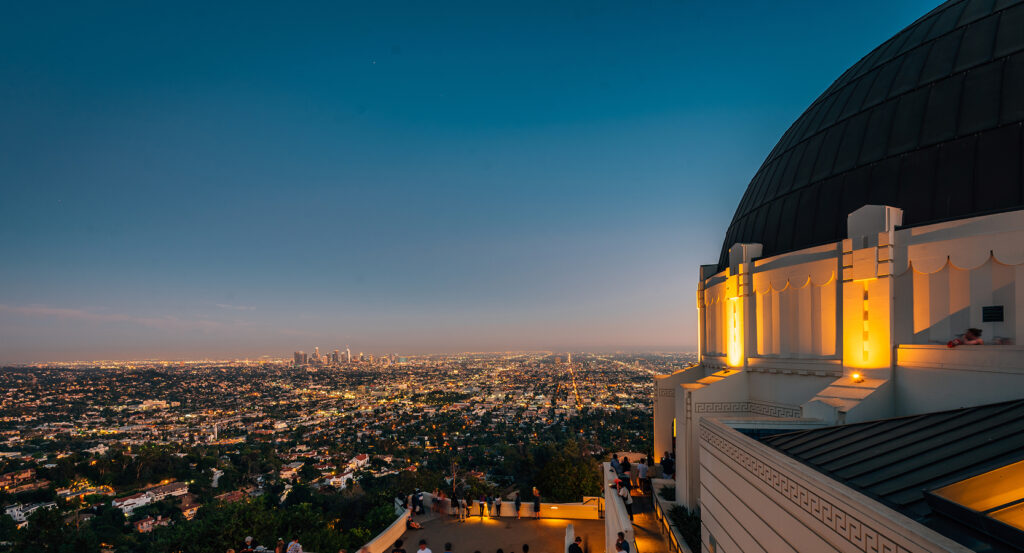
Why West Los Angeles matters.
West Los Angeles is a connective enclave where the Westside's metropolitan character meets low-rise residential blocks, long commercial corridors and a central position between the Pacific-facing communities and the denser employment centers surrounding Westwood and Century City.
Positioned between Sawtelle, Rancho Park, and Mar Vista, the neighborhood occupies a broad section of the Central Westside where level terrain carries an unusually regular street grid between larger boulevards running toward Santa Monica, Culver City and the eastern basin. Detached houses, duplexes, courtyard apartments and compact multifamily buildings establish a predominantly low-rise fabric that gains height and commercial intensity along the principal east-west corridors. Olympic Boulevard supplies the primary encounter through a continuous urban cross-section of neighborhood businesses, apartment buildings and side streets extending deep into residential blocks. Barrington Avenue creates a secondary north-south passage where the district's flatter interior gradually connects the commercial intensity near major boulevards with quieter streets farther from them. The result is a neighborhood whose significance comes from its position inside the Westside itself, joining residential Los Angeles with several of the region's strongest commercial, cultural and institutional districts across an unusually compact geography.
What defines West Los Angeles.
West Los Angeles is best known for growing from territory surrounding the independent community of Sawtelle into a central piece of the twentieth-century Westside as rail transportation, agriculture and suburban expansion successively remade the land west of the older city. The western branch of the National Home for Disabled Volunteer Soldiers opened immediately north of the area in 1888, creating an employment center around which an early settlement formed. Two entrepreneurs organized the Pacific Land Company in 1896 and acquired 225 acres south of the institution, where inexpensive lots drew veterans, hospital employees and their families. An interurban railway arrived that same year along the route now followed by Santa Monica Boulevard, connecting the settlement eastward with Hollywood and Beverly Hills and westward with Santa Monica. A one-room schoolhouse, church, commercial cluster and public meeting hall were operating around the turn of the century as the community acquired the functions of a small independent town. Agricultural ground remained extensive farther south, producing potatoes, barley, strawberries and substantial lima-bean crops supported by a cannery near Santa Monica Boulevard and Missouri Avenue. The Soldiers' Home became a stop on Pacific Electric's Balloon Route in 1904, placing the settlement on the company's celebrated excursion circuit through western Los Angeles. Residential construction increasingly displaced farming during the 1910s, and the independent municipality eventually consolidated with Los Angeles in 1922. Westward metropolitan growth then accelerated during the automobile era, carrying development across former fields and joining the old settlement to the expanding residential districts that came to define the Westside.
Walter Armacost Nursery helped open a separate chapter when its extensive growing grounds near Armacost and La Grange avenues drew Japanese nationals and Issei horticulturalists into western Los Angeles during the early twentieth century. Farming, gardening and nursery work became important sources of livelihood, and by the 1920s a substantial Japanese American commercial concentration had developed along Sawtelle Boulevard south of Santa Monica Boulevard. O.K. Nursery began operating in 1928 and later became Hashimoto Nursery, joining businesses whose long tenure preserved direct connections with the community's prewar horticultural economy. Japanese American residents planted a public garden at Stoner Park in 1931, incorporating landscape traditions that also appeared in residential gardens throughout surrounding streets. Wartime incarceration removed Japanese American families from the district, disrupting businesses and households built across the preceding decades. Families returning after World War II revived the commercial community, with Harada Nursery, Yamaguchi Bonsai Nursery, Tempura House and other enterprises strengthening the corridor again. Construction of the San Diego Freeway during the 1950s severed the district physically and destroyed scores of houses, followed by further losses near the Santa Monica Freeway. The surviving concentration of nurseries, gardens and businesses preserved one of Los Angeles's most substantial Japanese American communities outside Little Tokyo, giving western Los Angeles a cultural continuity extending from agricultural settlement through wartime rupture and postwar rebuilding.
How West Los Angeles fits.
West Los Angeles works as the anchor for an outing connecting a university museum built from a private industrialist's collection, a global arts institution created through UCLA's interdisciplinary holdings and a hilltop cultural campus conceived for one of the world's largest visual-arts organizations.
Begin at Hammer Museum, founded by Occidental Petroleum chairman Armand Hammer and opened in November 1990 inside a building designed by Edward Larrabee Barnes. Hammer died three weeks after the opening, leaving portions of the institution unfinished, and UCLA entered negotiations to assume operations in 1992 before finalizing the partnership in 1994. The Wight Art Gallery and Grunwald Center for the Graphic Arts subsequently moved their collections and staffs into the museum, substantially broadening an institution originally centered on Hammer's European and American holdings. Ann Philbin became director in 1999, the Hammer Contemporary Collection followed in 2005 and architect Michael Maltzan directed successive architectural interventions that included the Billy Wilder Theater and a long-term reworking of the building. Continue to Fowler Museum at UCLA, founded in 1963 when the university brought multicultural collections together within a single institution devoted to global arts and cultures. Chancellor Franklin D. Murphy played a central role in its creation, envisioning a museum capable of organizing UCLA holdings from cultures across the world for scholarship and public presentation. The institution moved into its present building in 1992 and subsequently received the Fowler name in recognition of the family of Francis E. Fowler Jr. Its holdings encompass more than 150,000 works of art and 600,000 archaeological objects, with particular depth across Africa, Asia, the Pacific and the Americas. Conclude at Getty Center, whose 110-acre Santa Monica Mountains site became the permanent campus for the J. Paul Getty Trust after Richard Meier was selected as architect in 1984. Construction began later in the decade, Robert Irwin received the Central Garden commission in 1992 and the complex opened in December 1997 after nearly fifteen years of development. Meier organized twelve buildings across the hilltop around a central arrival plaza, extensive Italian travertine surfaces and carefully controlled natural light, bringing the Getty Museum together with the Getty Research Institute, Getty Conservation Institute, Getty Foundation and Trust administration. Irwin's 134,000-square-foot Central Garden added more than 500 plant varieties to the architectural composition, extending the campus through a major artist-designed landscape. The progression moves from Hammer's private collection transformed through UCLA stewardship through the Fowler's globally scaled university holdings and culminates at Meier and Irwin's hilltop Getty campus, connecting three distinct models for building cultural institutions across the Westside.
Where your story begins.
Foresyte Travel reveals places that feel extraordinary long before you arrive.
Enjoy editorial crafted for luxury travelers.
Foresyte may earn a commission when you book.





































































































