
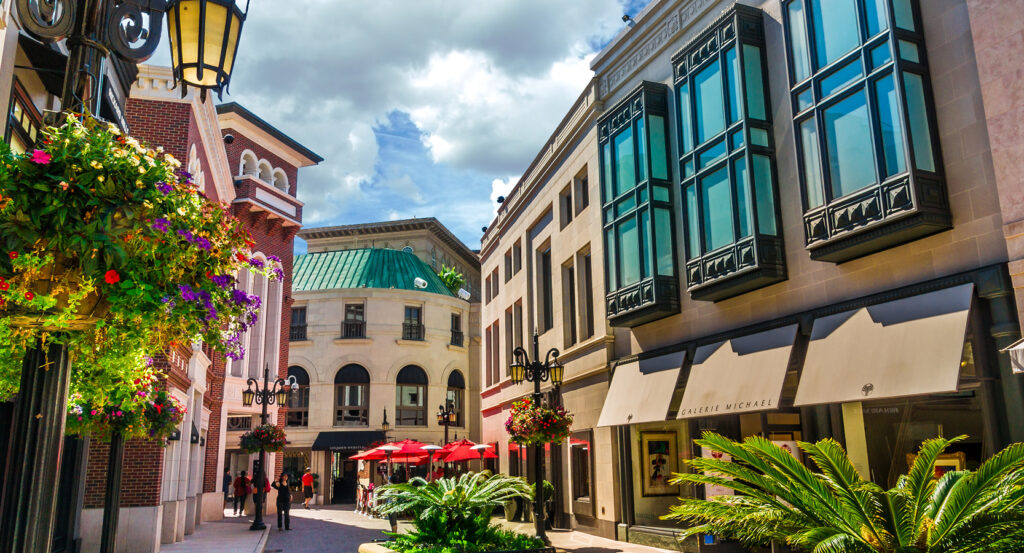
Why Beverly Hills matters.
Beverly Hills is a storied enclave where the Westside's residential grandeur meets early Hollywood wealth, internationally recognized commercial streets and a century of architecture shaped by Southern California's most ambitious patrons.
Positioned between West Hollywood, Holmby Hills, and Century City, the neighborhood occupies a broad section of the Los Angeles basin extending through Sunset Boulevard, Santa Monica Boulevard and Wilshire Boulevard before climbing into winding foothill streets along its northern edge. Formal avenues, mature palms and deep residential parcels establish a spacious scale north of the commercial core, where the flatter terrain gives way to increasingly curved streets as the land rises toward the Santa Monica Mountains. Movement through Beverly Hills shifts between the concentrated storefront blocks surrounding Rodeo Drive and residential avenues where walls, hedges and long approaches place substantial houses within carefully composed streetscapes. The southern districts change that scale through tighter blocks, apartment buildings and continuous commercial frontage along Wilshire Boulevard, producing a denser counterpart to the estates farther north. The result is a neighborhood whose commercial concentration, landscaped residential streets, architectural range and foothill geography compress several distinct versions of metropolitan Los Angeles into an unusually coherent urban fabric.
What defines Beverly Hills.
Beverly Hills is best known for growing from Rancho Rodeo de las Aguas, a 4,500-acre Mexican-era cattle ranch centered on the well-watered ground where Franklin, Coldwater and Benedict canyons descended toward the basin. María Rita Valdez and Vicente Valdez held the rancho during the nineteenth century, and several later owners attempted agricultural settlement and subdivision before a new venture fundamentally redirected the property. Burton Green and his partners acquired the tract for the Amalgamated Oil Company in 1900, expecting petroleum beneath land then known as Morocco, but repeated drilling produced little commercial oil. The investors reorganized their holdings as the Rodeo Land and Water Company in 1906 and turned from extraction toward residential development, with Green adapting the name Beverly Farms, Massachusetts, into Beverly Hills. Landscape architect Wilbur D. Cook laid out the community through broad curving streets shaped around the terrain, and Rodeo, Canon, Crescent, Carmelita, Elevado and Lomitas appeared among the first streets constructed in 1907. Development remained slow enough that fewer than six permanent residences stood north of Santa Monica Boulevard by 1910, leaving the promoters with an elegant street plan but little population to sustain it. Construction of a major hotel in 1912 helped change that trajectory, and Beverly Hills incorporated two years later as the emerging settlement gained the institutional and residential weight needed to survive independently. Film wealth accelerated the next phase after Douglas Fairbanks and Mary Pickford acquired a hunting lodge in 1919 and remade it as Pickfair, drawing a succession of actors, directors and studio figures into the surrounding hills. Charlie Chaplin, Harold Lloyd, Buster Keaton, Gloria Swanson, Rudolph Valentino, Harry Cohn, Jack Warner and Marion Davies joined a concentration of entertainment figures whose houses linked the young community with the expanding motion-picture industry only a few years after its speculative beginnings.
A different force reshaped the southern portion during the 1920s after an immense banked wooden racetrack occupied close to a quarter of Beverly Hills and carried automobile racing into national broadcasts. The Beverly Hills Speedway became a center for motor competition and aviation during its brief existence, placing machines and mass spectatorship on acreage soon destined for urban development. Developer Walter G. McCarty and associates purchased 194 acres for $2 million in 1923, acquiring the Speedway property and dismantling the track the following year as Beverly Vista replaced racing with streets, houses, apartments and commercial buildings. McCarty incorporated substantial concentrations of multifamily housing into the tract, and architects including Milton J. Black, James E. Dolena and S. Charles Lee joined builders Walter Bollenbacher, Joe Eudemiller and Albert Rothenberg in filling the former Speedway acreage. Sales across McCarty's Beverly Hills developments exceeded $7.5 million by 1929, part of a larger career that generated more than $20 million in local sales by the end of the decade. The same period tested Beverly Hills politically when a 1923 proposal sought annexation into Los Angeles, with access to the larger city's water supply forming a central argument for consolidation. Mary Pickford, Will Rogers and other residents campaigned against annexation, and voters rejected the proposal 507 to 337, preserving Beverly Hills as an independent city just as its population, entertainment connections and real-estate values were accelerating. Commercial prestige gained another dimension decades later when Fred Hayman and George Grant opened Giorgio Beverly Hills on Rodeo Drive in 1961, bringing designers including Halston, Diane von Furstenberg, Chloé and Zandra Rhodes to a street still far from its later global retail stature. Hayman bought Grant's interest the following year, and Giorgio's celebrity clientele, Rolls-Royce service and highly personalized retail culture helped reposition Rodeo Drive before European fashion houses expanded along the corridor. The Rodeo Drive Committee formed in 1972 as the street entered a new phase of international luxury commerce, completing a century-long change from failed oil prospect to residential venture, entertainment enclave and globally recognized commercial address.
How Beverly Hills fits.
Beverly Hills works as the anchor for a daytime outing connecting an early hillside estate, Frank Lloyd Wright's only Southern California retail commission and an Art Deco theater created during the rise of Wilshire Boulevard.
Begin at Virginia Robinson Gardens, where Virginia and Harry Winchester Robinson established one of Beverly Hills's earliest great residential properties between 1908 and 1911. Virginia's father, architect Nathaniel Dryden, designed the Beaux Arts residence on what was originally a twenty-acre hillside property when surrounding Beverly Hills remained dominated by open fields. Horticulture became Virginia Robinson's lifelong pursuit, and extensive planting transformed ground that she remembered as holding only a single elderberry bush into terraced gardens threaded by brick stairs, eucalyptus, Italian cypress and a substantial palm grove. A playhouse pavilion completed in 1924 deepened the estate through Palladian and French influences, with Tuscan columns, a reflecting swimming pool and a theatrical relationship between architecture and garden terraces. The property matured across decades under Robinson's direction, preserving an early residential world created before Beverly Hills became synonymous with large private estates. Continue to Anderton Court, the 1954 Frank Lloyd Wright commission at 332 North Rodeo Drive that brought one of twentieth-century architecture's central figures into a commercial street still years away from its international fashion reputation. Wright organized the small retail complex around an angular ramp rising through an open central court, allowing circulation itself to shape the building's composition across multiple levels. The project became his final Los Angeles-area design and his only Southern California retail building, placing a compact work from the closing phase of his career directly within Rodeo Drive's later commercial transformation. Its geometric massing and upward route create an architectural interruption among the surrounding storefronts, preserving evidence of the street before luxury retail became its dominant association. Conclude at Saban Theatre, opened as the Fox Wilshire Theatre on September 19, 1930 inside an Art Deco complex designed by S. Charles Lee for the Fox West Coast Theatres circuit. Lee was still early in a career that eventually encompassed 400 theaters, and the Beverly Hills building arrived only months before his Los Angeles Theatre opened downtown. The 2,500-seat auditorium paired a wide proscenium with a silver, black and coral interior, and opening night placed the Marx Brothers' Animal Crackers on its screen. The unusually broad screen later supported extended engagements of widescreen productions including The Sound of Music in 1965, carrying the house from the studio-era premiere circuit into another generation of film exhibition. Conversion to stage use followed in 1980, Temple Shalom for the Arts acquired the building in 2005 and the Saban name arrived in 2009 as restoration returned major elements of Lee's original design. The progression moves from Virginia Robinson's early hillside estate through Frank Lloyd Wright's compact Rodeo Drive commission and culminates inside S. Charles Lee's Art Deco theater, connecting domestic patronage, modern architecture and motion-picture culture across three distinct chapters of Beverly Hills.
Where your story begins.
Foresyte Travel reveals places that feel extraordinary long before you arrive.
Enjoy editorial crafted for luxury travelers.
Foresyte may earn a commission when you book.





































































































