
Why West Hollywood matters.
West Hollywood is a cosmopolitan enclave where Central Los Angeles County's metropolitan character meets dense apartment neighborhoods, internationally prominent entertainment corridors and an unusually compact urban form positioned between Hollywood and Beverly Hills.
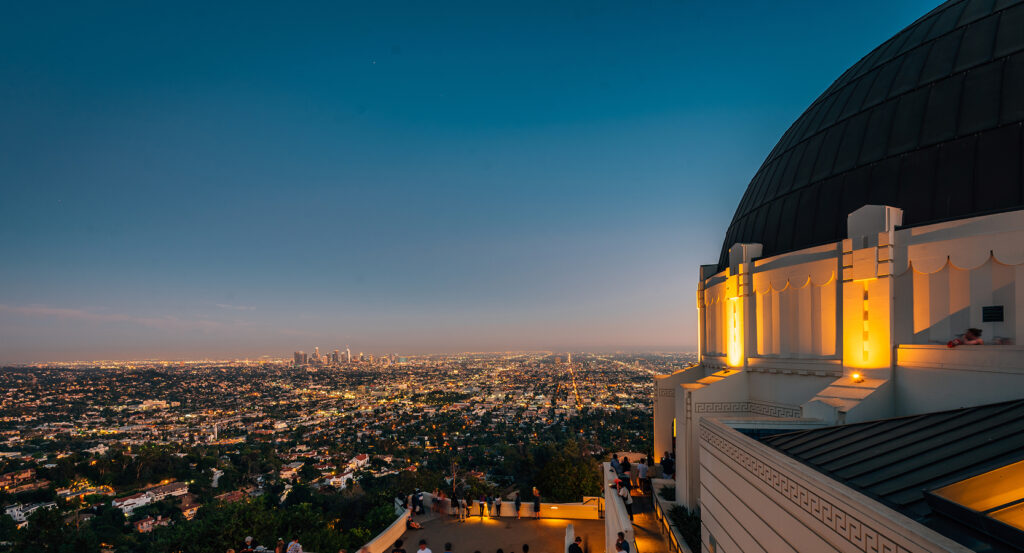
Positioned between Beverly Grove, Hollywood Hills West, and Beverly Hills, the neighborhood occupies 1.9 square miles along the southern foot of the Santa Monica Mountains, where an irregular municipal outline stretches from La Brea Avenue toward Doheny Drive through some of metropolitan Los Angeles's densest residential and commercial terrain. Courtyard apartments, Spanish Colonial Revival complexes, Streamline Moderne storefronts, Art Deco towers and postwar buildings create abrupt architectural shifts across short blocks, with lower residential streets rising toward larger structures along the northern edge. Santa Monica Boulevard supplies the primary encounter through a long east-west spine whose storefronts, nightlife venues and neighborhood institutions connect districts developed during different periods of the twentieth century. Sunset Boulevard creates a secondary passage across higher ground, where larger hotels, entertainment properties and steep northward streets establish a more dramatic relationship with the Hollywood Hills immediately above. The result is a neighborhood whose compressed geography joins residential density, architectural variety and internationally significant entertainment corridors within an urban territory measuring less than two square miles.
What defines West Hollywood.
West Hollywood is best known for becoming an independent city in 1984 through a coalition of renters, older residents and LGBTQ activists who organized as Los Angeles County prepared to end its rent protections. The territory had remained unincorporated through most of the twentieth century despite its position between Los Angeles and Beverly Hills, leaving county government responsible for an increasingly dense population with substantial numbers of long-term tenants. 85 percent of residents rented their homes when incorporation arrived, making housing security central to the campaign for municipal independence. Voters approved cityhood, and West Hollywood formally incorporated on November 29, 1984 as the 84th city in Los Angeles County. The first City Council became the first municipal governing body in the United States with an openly gay majority, placing LGBTQ representation at the center of the new municipality during the AIDS crisis. Rent protections followed in 1985, accompanied during the city's opening years by measures addressing discrimination against people with HIV and AIDS, domestic partnerships and employment discrimination based on sexual orientation. Social-service funding also began in 1985, directing municipal resources toward older residents, people living with HIV and AIDS, people with disabilities and members of the LGBTQ community. These founding constituencies gave the new city an unusually direct connection between the demographic composition of its residents and the institutions created after incorporation.
Jewish immigrants leaving the Soviet Union created a separate demographic chapter beginning during the 1970s, when changes in Soviet emigration policy brought families through Europe and Israel before many resettled in the United States. Jewish Family Service assisted newcomers arriving in Los Angeles, and comparatively accessible housing near the organization helped concentrate substantial numbers in the territory that later became West Hollywood. By the time cityhood arrived, the area had become the principal center of the Los Angeles region's Russian-speaking population. Successive arrivals came from across the former Soviet republics, including Ukraine, Armenia, Georgia, Belarus, Latvia and Uzbekistan, giving the community a background extending far beyond the Russian Federation itself. Plummer Park became an important gathering place for this population, eventually hosting cultural programming, language activities and commemorations tied to communities originating across the former Soviet Union. The city created a Russian-speaking advisory body in 2000, and annual cultural programming developed during the following years around visual art, performance, language and historical memory. Current city figures place residents identifying a former Soviet region as their primary ancestry near 11 percent of West Hollywood's population, preserving one of the municipality's most distinctive demographic concentrations more than half a century after the first major wave arrived.
How West Hollywood fits.
West Hollywood works as the anchor for an outing connecting an early experiment in California modernism with two estates that trace the emergence of Beverly Hills from open land into one of Southern California's great concentrations of residential architecture.
Begin at Schindler House, designed and built in 1922 by Austrian-born architect R. M. Schindler for himself, Pauline Schindler and Clyde and Marian Chace as a cooperative live-work dwelling for two couples. Schindler organized the residence around studios and garden courts, using tilt-up concrete slabs, redwood, glass and canvas to dissolve conventional distinctions between domestic interiors and outdoor living; sleeping baskets on the roof carried the experiment further. Artists, architects, writers and musicians gathered around the Schindlers during subsequent decades, and Friends of the Schindler House acquired the property in 1980 before establishing a partnership with Vienna's MAK in 1994 that made the house headquarters of the MAK Center for Art and Architecture. Continue to Greystone Mansion & Gardens, created after oil entrepreneur Edward L. Doheny gave his son Ned Doheny 12.58 acres in 1926 and commissioned Gordon B. Kaufmann to design the estate. Construction began in February 1927, and the Doheny family moved into the residence in September 1928; the full property cost $3,166,578.12, including $1,238,378.76 for the mansion. Kaufmann used steel-reinforced concrete faced with Indiana limestone beneath Welsh slate, producing a 46,054-square-foot residence with 55 livable rooms, and landscape architect Paul G. Thiene developed the surrounding grounds. Beverly Hills acquired the remaining 18.3-acre property in 1965 and dedicated it as a public park in 1971. Conclude at Virginia Robinson Estate and Garden, begun in 1908 for Harry Winchester Robinson and Virginia Dryden Robinson and completed in 1911, when Beverly Hills still consisted largely of barley fields and undeveloped ground. Virginia's father, architect Nathaniel Dryden, designed the Beaux-Arts residence, which became the first house constructed in Beverly Hills. Harry Robinson inherited the department-store enterprise developed by his father, J. W. Robinson, connecting the estate to the commercial fortunes generated by early metropolitan Los Angeles. The property's completion at the opening of Beverly Hills's residential era gives it a chronological position preceding the grand estates that subsequently transformed the surrounding foothills. The progression moves from Schindler's dramatic 1922 rethinking of collective domestic life through the immense Doheny commission and culminates at the Robinson residence from Beverly Hills's formative years, connecting three sharply different expressions of private architecture surrounding West Hollywood.
Where your story begins.
Foresyte Travel reveals places that feel extraordinary long before you arrive.
Enjoy editorial crafted for luxury travelers.
Foresyte may earn a commission when you book.





































































































