
Why Olympic Boulevard matters.
Olympic Boulevard is a metropolitan corridor where Mid-Wilshire's architectural character meets the legacy of the 1932 Olympic Games, interwar transportation engineering and an east-west route assembled from once-disconnected streets across Los Angeles.
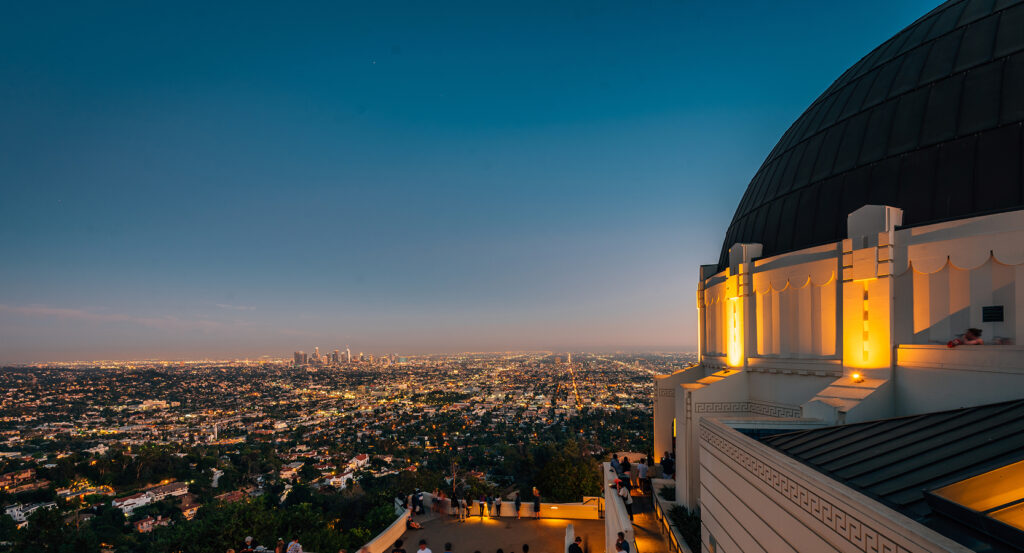
Running through Mid-Wilshire between Koreatown and Century City, the metropolitan corridor follows a broad east-west line across Western Avenue, Crenshaw Boulevard, La Brea Avenue, Fairfax Avenue and La Cienega Boulevard before entering Beverly Hills and the western Westside. Central stretches pass between apartment districts, commercial frontage and Period Revival neighborhoods, with long blocks and a broad roadway emphasizing the immense scale of the Los Angeles basin. Traveling west brings lower residential development around Carthay and increasingly substantial commercial buildings near Beverly Hills, followed by the office towers of Century City rising beyond the street. Hundreds of surviving Olympic Special streetlights reinforce the roadway's continuity, their ornamented poles carrying fruit, floral forms and stylized dragon arms across miles of otherwise changing urban fabric. The result is a corridor whose exceptional length, broad proportions, changing architectural scale and distinctive street lighting turn a cross-city arterial into one of Los Angeles's clearest physical transects.
What defines Olympic Boulevard.
Olympic Boulevard is best known for emerging from the reconstruction of 10th Street around the era of the 1932 Olympic Games, when Los Angeles converted a fragmented local road into a major cross-city artery. The late nineteenth-century version of 10th Street extended only about eight blocks between Main and Figueroa streets, but transportation planners during the early 1920s selected the route for a much larger traffic project. Property owners pursued a widening from 60 to 100 feet and extensions toward the eastern and western city limits, with Beverly Hills and Santa Monica planning corresponding links toward the Pacific. A proposal to adopt the Olympic name surfaced in July 1929, three years before Los Angeles hosted the Games, and portions of Country Club Drive received the designation before the old 10th Street name disappeared across the principal route. Construction remained difficult because the separate roadway sections failed to align cleanly: discontinuities persisted near Figueroa, Alvarado, Hoover and Arlington, and the city abandoned several costly property-acquisition projects in 1933 before reviving the work later in the decade. State highway funding changed the scale of the undertaking after the corridor entered Legislative Route 173 and became signed Route 26 in 1937. By 1938, engineers had removed the Figueroa jog, realigned sections around Alvarado, Hoover and Arlington, widened former Country Club Drive and extended the roadway through the 20th Century Fox studio property. Those interventions converted a collection of local streets into a continuous transportation project carrying an Olympic name across the center of Los Angeles.
Completion required another decade of construction as the western reaches crossed existing neighborhoods, studio property and municipal boundaries. Fox dedicated right-of-way through its studio in 1937, allowing the boulevard to bisect the property and adjoining parcels as engineers pushed the alignment westward. World War II interrupted further work, leaving significant gaps that survived into the postwar years. New links between Crenshaw Boulevard and Lucerne Boulevard and between Centinela Avenue and Lincoln Boulevard opened in 1948, with the Santa Monica section built as a landscaped divided parkway. The completed boulevard subsequently carried Route 26 between Santa Monica and the eastern metropolitan basin, becoming a principal surface connection before freeway construction redirected regional traffic. During the 1940s and 1950s, Los Angeles even altered its lane distribution by time of day, assigning four lanes eastbound during the morning and four westbound during the afternoon. Freeway construction gradually displaced that role: the Santa Monica Freeway reached the Harbor Freeway in 1962, Route 26 disappeared during California's 1964 highway renumbering and Olympic Boulevard had been relinquished from the state system by 1967. The surface street survived as the physical product of a transportation campaign spanning the pre-Olympic city, Depression-era road building, wartime interruption, postwar completion and the arrival of the freeway age.
How Olympic Boulevard fits.
Olympic Boulevard works as the anchor for an outing connecting a survivor-founded Holocaust institution, an independent museum descended from an experimental craft gallery and a state-supported museum created through sustained advocacy for African American art and history.
Begin at Holocaust Museum LA, founded in 1961 after Holocaust survivors meeting in Los Angeles discovered that several had photographs, documents and personal objects carried from Europe and decided those possessions required a permanent home. Their initiative created the oldest Holocaust museum in the United States founded by survivors, joining preservation of personal artifacts with commemoration of relatives murdered during the Holocaust and education for later generations. A permanent home opened in Pan Pacific Park on October 14, 2010 in a building by Hagy Belzberg whose partially subterranean form places much of the institution below the surrounding landscape. Architectural honors followed from the American Institute of Architects and the Los Angeles Cultural Affairs Commission, extending a project begun nearly five decades earlier by survivors into a purpose-built institution. Continue to Craft Contemporary, whose institutional ancestry reaches to November 1, 1965, when painter Edith Robinson Wyle opened The Egg and the Eye inside a 1930 neo-Georgian building by Gilbert Stanley Underwood. Wyle combined a gallery devoted to international craft with a restaurant centered on egg dishes, then converted the enterprise into the Craft & Folk Art Museum in 1973. Patrick Ela assumed leadership in 1975 and later directed a renovation by architects Hodgetts & Fung completed in 1995. The museum's archive eventually reached 246.5 linear feet plus 56 oversize boxes at UCLA Library Special Collections, preserving decades of activity from an institution created as culturally specific museums were gaining greater prominence across Southern California. Trustees adopted the Craft Contemporary name in 2018, placing contemporary making at the center of the institution's next chapter. Conclude at California African American Museum, founded in 1977 after a multiyear campaign for a state institution devoted to African American art, history and culture in the American West. Formal operations began in temporary quarters in 1981 under first director Aurelia Brooks, and the museum's first acquisition was Richmond Barthé's bronze bust of civil-rights leader Mary McLeod Bethune. A permanent 44,000-square-foot building by architects Jack Haywood and Vince Proby opened in Exposition Park in 1984. Its inaugural exhibition, The Black Olympians 1904-1984, was curated by Lonnie Bunch and debuted as Los Angeles prepared for the Games of the XXIII Olympiad, creating a direct connection between the institution's permanent home and the city's second Olympic era. The collection has since grown to 5,000 objects spanning art, historical objects and print holdings with particular emphasis on California and the American West. The progression moves from survivors preserving personal evidence of European catastrophe through Wyle's conversion of international craft collecting into an independent museum and culminates in a state institution whose 1984 permanent home opened with an exhibition linking African American athletic history to Los Angeles's second Olympic Games.
Where your story begins.
Foresyte Travel reveals places that feel extraordinary long before you arrive.
Enjoy editorial crafted for luxury travelers.
Foresyte may earn a commission when you book.





































































































