
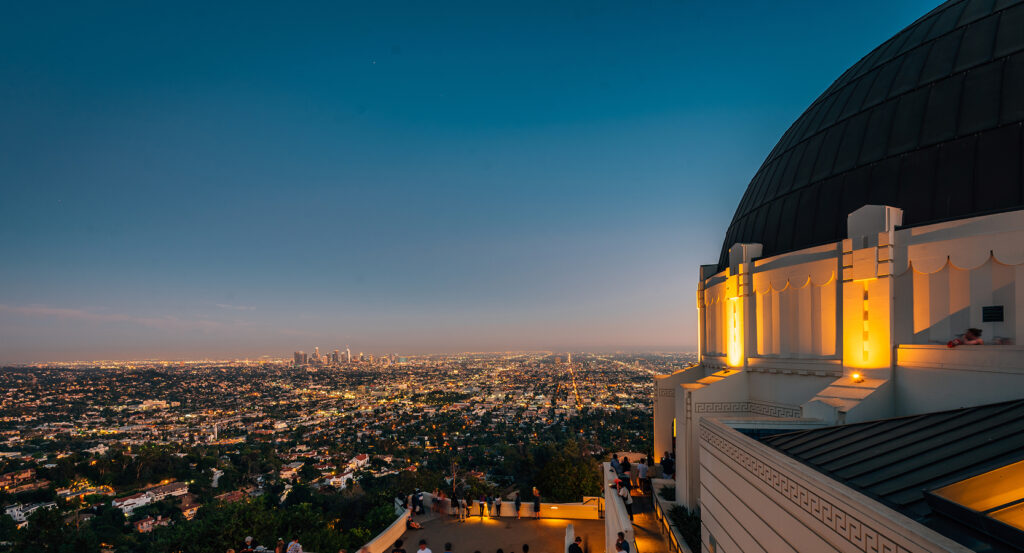
Why Mid-Wilshire matters.
Mid-Wilshire is a storied enclave where Central Los Angeles's metropolitan character meets automobile-era commercial architecture, architect-designed residential districts and a broad boulevard that redirected the city's twentieth-century expansion westward.
Positioned between Koreatown, Fairfax, and Mid-City, the neighborhood occupies a broad section of the Los Angeles Basin extending through Wilshire Boulevard, Olympic Boulevard and La Brea Avenue across the level ground west of the older central city. Apartment buildings, commercial blocks and office towers line the principal corridors, shifting into lower residential streets filled with bungalows, duplexes and Period Revival houses across the interior blocks. Movement through Mid-Wilshire follows long east-west boulevards crossed by major north-south avenues, producing a highly legible grid punctuated by taller concentrations around Wilshire and the district's busiest intersections. Hancock Park and neighboring residential tracts introduce a contrasting scale through broad setbacks, mature trees and substantial houses occupying quieter streets immediately north of the commercial spine. The result is a neighborhood whose boulevard architecture, dense residential fabric, formal subdivisions and distributed commercial centers capture the westward movement of twentieth-century Los Angeles across the basin.
What defines Mid-Wilshire.
Mid-Wilshire is best known for the creation of Miracle Mile, where developer A. W. Ross converted an undeveloped stretch of Wilshire Boulevard into an automobile-oriented commercial district during the 1920s. Ross acquired eighteen acres between La Brea and Fairfax avenues for $54,000 in 1921, when the surrounding landscape still contained oil wells, barley fields and little established retail activity. He anticipated continued westward expansion from Downtown and recognized that affluent communities including Westlake, Hollywood and Beverly Hills placed a substantial customer base within driving distance. Major buildings were deliberately separated by a block or more, distributing commercial activity along Wilshire and giving motorists repeated destinations across the corridor. Retailers increasingly paired prominent street façades with automobile access at the rear, allowing Wilshire to retain a strong architectural edge as parking became integral to commercial development. Bullock's Wilshire brought that approach to exceptional architectural maturity in 1929, placing an imposing rear entrance beside a parking area occupying two-thirds of its property and raising a tower above the boulevard for visibility from passing cars. Wilshire Tower followed the same year, the E. Clem Wilson Building rose between 1929 and 1930 and the Pellissier Building arrived in 1930 and 1931, creating a sequence of Art Deco towers that converted individual commercial structures into long-distance visual markers. Ross's speculative corridor had become a new metropolitan business center within a decade, demonstrating that Los Angeles retail no longer required the concentrated pedestrian geography of Downtown.
Residential development north and south of Wilshire advanced through a separate wave of subdivision that gave Mid-Wilshire an unusually broad collection of interwar domestic architecture. G. Allan Hancock developed Hancock Park during the 1920s on land descended from Rancho La Brea, which his father Major Henry Hancock had purchased in 1863. Construction began along Rossmore Avenue in 1920 and moved west toward Highland Avenue, with Arthur Letts Jr. among the early property owners on Rossmore that year. Hancock insisted on fifty-foot setbacks across much of the tract, leaving substantial front lawns before residences designed in Tudor, English, Spanish Colonial, Mediterranean, Monterey and American Colonial Revival forms. Stiles Clements, Roland Coate, Elmer Grey, Gordon Kaufmann, Hunt & Burns and Paul Revere Williams were among the architects whose commissions concentrated exceptional residential design within the subdivision. Farther southwest, J. Harvey McCarthy began Carthay Center in 1923 across 136 acres, organizing curving residential streets around a proposed commercial center and giving roads names drawn from early California history. Miracle Mile's adjoining residential tracts filled heavily during the 1920s, 1930s and 1940s with Spanish Colonial Revival, Tudor Revival, Mediterranean Revival and French Revival houses alongside multi-unit buildings south of Olympic Boulevard. Mid-Wilshire developed through two parallel forms of private investment, one producing a linear commercial center built for motorists and another filling surrounding acreage with carefully composed residential districts whose architecture gave the new western city a domestic counterpart to Wilshire's towers.
How Mid-Wilshire fits.
Mid-Wilshire works as the anchor for a daytime outing connecting one of the world's richest Ice Age fossil deposits, an art institution created during Los Angeles's mid-century cultural expansion and an automotive museum occupying a former department store at the western end of Miracle Mile.
Begin at La Brea Tar Pits, where asphaltic deposits preserve tens of thousands of years of life beneath one of metropolitan Los Angeles's most intensively developed districts. William Denton published the first scientific mention of Rancho La Brea fossils in 1875, and geologist W. W. Orcutt recognized extinct animals among the deposits after encountering fossils during oil exploration in 1901. University of California paleontologist John C. Merriam subsequently pursued the site, and G. Allan Hancock granted Los Angeles County exclusive excavation rights for two years beginning in 1913. Museum crews worked across ninety-six sites between 1913 and 1915 and recovered more than 750,000 specimens of plants and animals. Hancock donated twenty-three acres in 1924 with the requirement that the fossil deposits receive permanent protection and public exhibition. Excavation resumed at Pit 91 in 1969, and the George C. Page Museum opened in 1977 inside a building by Frank Thornton and Willis Fagan with a fiberglass Ice Age frieze by sculptor Manuel Paz. Continue to Los Angeles County Museum of Art, whose independent institutional history began in 1961 when the art division separated from the Los Angeles County Museum of History, Science, and Art in Exposition Park. William L. Pereira and Associates received the commission for a new Wilshire campus in 1960, working with landscape architects Thomas Dolliver Church and Robert Herrick Carter on three principal pavilions. The Ahmanson Gallery, Lytton Gallery and Leo S. Bing Center opened in March 1965, creating a dedicated art museum on a scale then unprecedented in the western United States. Expansion continued with the Anderson Building in 1986 and Bruce Goff's Pavilion for Japanese Art in 1988. Los Angeles County Museum of Art acquired the neighboring May Company building in 1994, and later additions included Renzo Piano's Broad Contemporary Art Museum in 2008 and Resnick Exhibition Pavilion in 2010. The David Geffen Galleries opened in 2026 as the institution's new home for its permanent collection. Conclude at Petersen Automotive Museum, founded by magazine publisher Robert E. Petersen and his wife Margie on June 11, 1994. The museum occupies a 1962 department store building originally designed by Welton Becket, connecting its automotive mission with a commercial structure created during Miracle Mile's later retail era. A $90 million reconstruction completed in 2015 transformed the exterior through Kohn Pedersen Fox's sweeping stainless-steel ribbons and reorganized the interior around automotive exhibitions. More than 150 vehicles occupy twenty-five rotating exhibitions inside the building, with a separate collection housed beneath the principal galleries. The progression moves from prehistoric animals preserved beneath Rancho La Brea through the creation of a major art museum and culminates inside an institution devoted to the machine that fundamentally altered Mid-Wilshire's commercial geography.
Where your story begins.
Foresyte Travel reveals places that feel extraordinary long before you arrive.
Enjoy editorial crafted for luxury travelers.
Foresyte may earn a commission when you book.





































































































