
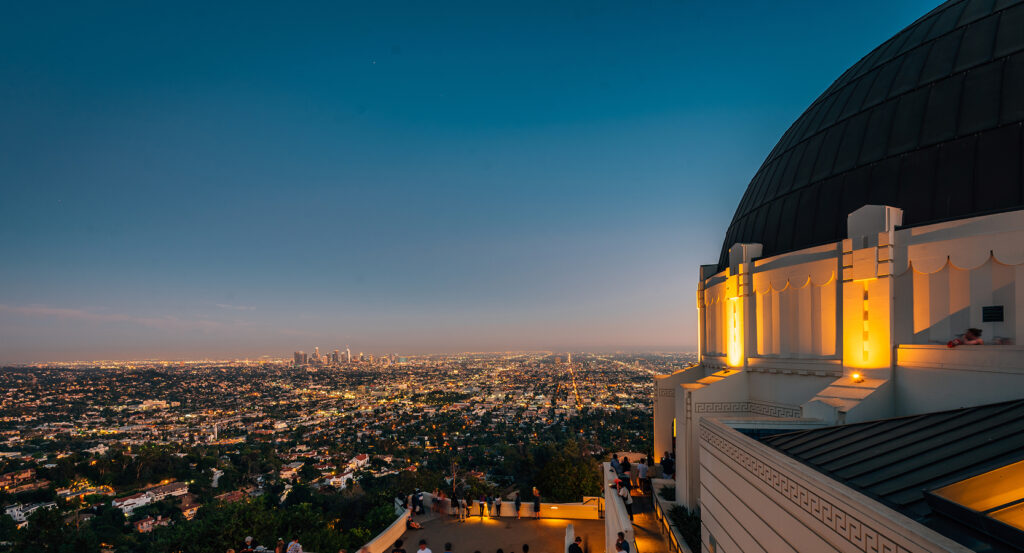
Why Western Avenue matters.
Western Avenue is a far-reaching corridor where Koreatown's immigrant-commercial character meets one of Los Angeles's longest continuous streets, early metropolitan boundary geography and a north-south cross-section extending from the foothills to the Pacific.
Running through Koreatown between Hollywood and South Los Angeles, the urban corridor follows an exceptionally long north-south line from Los Feliz Boulevard toward San Pedro, crossing Hollywood Boulevard, Wilshire Boulevard, Olympic Boulevard, the Santa Monica Freeway and dozens of successive neighborhoods before reaching the Palos Verdes Peninsula. Northern stretches descend from the eastern Santa Monica Mountains into Hollywood before the roadway enters the denser apartment districts and commercial blocks surrounding Wilshire. Traveling south carries the street through Mid-City, South Los Angeles and Gardena before lower-density South Bay development and the rising Palos Verdes terrain alter its proportions near the harbor. The route spans 28 miles, and its physical character changes repeatedly through high-rise commercial intersections, compact storefront districts, residential stretches, industrial areas and hillside neighborhoods. The result is a corridor whose extraordinary length, repeated changes in urban scale and passage from mountain-edge Los Angeles toward the Pacific create one of the clearest north-south transects through the metropolis.
What defines Western Avenue.
Western Avenue is best known for preserving the geography of an earlier Los Angeles, when the street marked the western edge of a city that had not yet expanded across the Westside. Its importance grew as electric railways extended development beyond the nineteenth-century urban core and converted former agricultural districts into streetcar suburbs. The Western-Franklin line began passenger service in early 1908, running north from Santa Monica Boulevard along Western Avenue to Franklin Avenue before turning toward Argyle Avenue and Vine Street. A single narrow-gauge car initially operated at half-hour intervals, providing eastern Hollywood with another direct transportation connection as its population expanded. Farther south, Western became part of a much larger electric-rail geography that concentrated shops and services around major crossings during the opening decades of the twentieth century. Santa Monica Boulevard and Western developed into an especially important transfer point served by five Pacific Electric routes and a Los Angeles Railway line, with tracks associated with the Balloon Route already present by 1895. Commercial construction accelerated around that intersection after 1919 as masonry storefronts replaced remnants of the earlier semi-rural landscape. Western's former boundary function had disappeared as Los Angeles annexed territory farther west, yet the street retained the continuous alignment that had first given it metropolitan importance. Its eventual extension toward the harbor transformed an obsolete municipal edge into one of Southern California's longest urban corridors.
Korean immigration reshaped a central section of Western Avenue during the 1970s and 1980s as a new commercial district developed around Olympic Boulevard. Hi Duk Lee arrived in Los Angeles in 1968 with $50 and opened Olympic Market soon afterward, creating one of the early Korean grocery businesses in the district. His success led to Young Bin Kwan, also known as VIP Palace, in 1975 and VIP Plaza in 1979, where 10,000 blue roof tiles imported from Korea gave the complex one of the city's earliest commercial designs using explicitly Korean architectural elements. Lee also helped develop the annual Korean heritage festival and participated in the campaign that secured official recognition of the Koreatown name in 1982. Investment spread through Western Avenue, 8th Street, Olympic Boulevard and Wilshire Boulevard as Korean-owned businesses occupied storefronts, mini-malls and larger retail complexes. The district remained ethnically complex throughout this change, with substantial Latino, Japanese, Filipino, African American and Anglo populations living within the surrounding neighborhoods. Korean real-estate transactions in the district reached $20 million across 200 properties by 1980, demonstrating the scale of capital entering an area that had experienced declining investment. Western Avenue became one of the principal commercial spines of this emerging Korean American center, placing a major immigrant business district directly onto the former metropolitan boundary line.
How Western Avenue fits.
Western Avenue works as the anchor for a Los Angeles sequence connecting an early inclusive cemetery with an automobile-age commercial complex and Frank Lloyd Wright's first Los Angeles commission, revealing three radically different responses to the city's expansion across the districts surrounding the corridor.
Begin at Angelus-Rosedale Cemetery, founded as Rosedale Cemetery in 1884 on 65 acres of rolling land then lying beyond the dense urban center. The institution broke with prevailing burial restrictions by admitting people across racial and religious lines, creating one of the city's earliest inclusive burial grounds. Its landscape adopted the lawn-cemetery form, using curving circulation, trees, shrubs, flowers and sculptural monuments to organize the grounds as a park-like environment. Rosedale opened a crematory in 1887, the first west of the Rocky Mountains, and subsequently received generations of Angelenos spanning political, artistic, military and immigrant history. Phineas Banning, Hattie McDaniel, Anna May Wong, Allen Allensworth and jazz singer Ivie Anderson are among the figures interred within the property, concentrating strikingly different strands of Los Angeles history inside the same nineteenth-century landscape. Continue to Chapman Plaza, opened in 1929 as Chapman Park Market and conceived as one of the western United States' early commercial centers designed specifically around automobile access. Morgan, Walls & Clements gave the complex a Spanish Colonial Revival composition with thick concrete walls, Churrigueresque corner towers and a grand entrance arch through which motorists drove into an interior courtyard surrounded by food merchants. A rooftop sign addressed drivers traveling along nearby Wilshire Boulevard, making automobile visibility part of the architecture itself. The market formed part of a larger Chapman Park development that included the neighboring studio building and a hotel that no longer survives. Developer Wayne Ratkovich and architect Brenda Levin later restored the complex, carrying a pioneering drive-in market into the commercial culture of modern Koreatown. Conclude at Hollyhock House, constructed between 1919 and 1921 on Olive Hill for oil heiress and arts patron Aline Barnsdall. Frank Lloyd Wright conceived the residence as the centerpiece of Barnsdall's proposed artists' colony, using an abstract hollyhock pattern derived from her favorite flower across the building's ornament. The commission brought Wright into Los Angeles for the first time and drew his son Lloyd Wright and Rudolf Schindler into its construction, creating an important point of convergence among architects who subsequently shaped Southern California modernism. Barnsdall donated the property to Los Angeles in 1927 for an art park, converting her private estate into a civic cultural site. Hollyhock House joined seven other Wright buildings on the UNESCO World Heritage List in 2019, making it the only Los Angeles property carrying that international designation. The progression moves from Rosedale's nineteenth-century experiment in inclusive burial through Chapman Park Market's architecture for automobile commerce and culminates in Barnsdall and Wright's arts complex on Olive Hill, connecting social reform, metropolitan consumption and architectural modernism across Western Avenue's Central Los Angeles geography.
Where your story begins.
Foresyte Travel reveals places that feel extraordinary long before you arrive.
Enjoy editorial crafted for luxury travelers.
Foresyte may earn a commission when you book.





































































































