
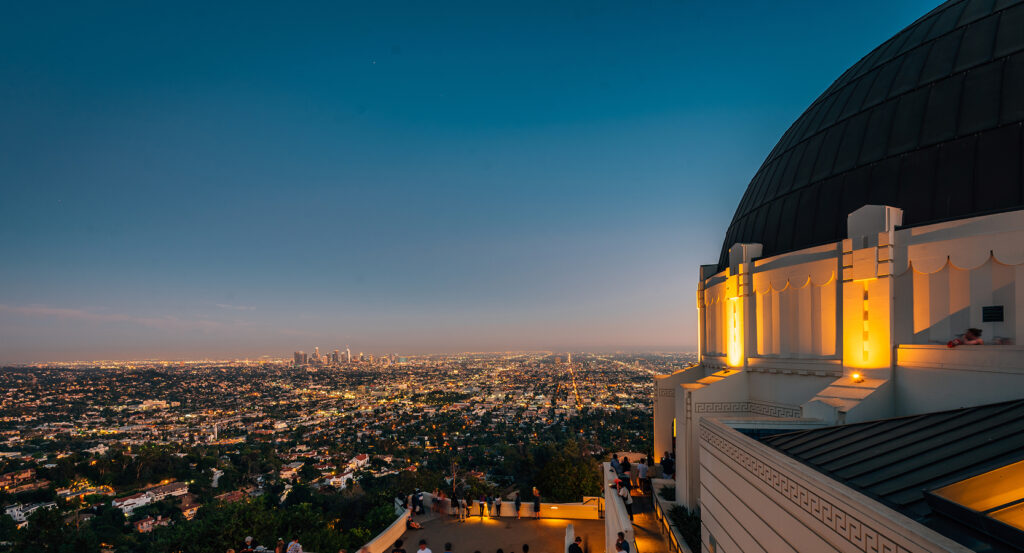
Why South Los Angeles matters.
South Los Angeles is a foundational enclave where the Los Angeles Basin's metropolitan character meets successive migrations, streetcar-era neighborhoods and cultural institutions central to the city's Black and Latino history.
Positioned between West Adams, Downtown, and Inglewood, the neighborhood occupies a broad swath of the southern basin where long north-south avenues intersect commercial boulevards, residential grids and districts developed across radically different periods of Los Angeles expansion. Craftsman bungalows, Spanish Colonial Revival houses, apartment courts and low-rise commercial blocks create a predominantly horizontal built fabric punctuated by institutional complexes and denser corridors. Crenshaw Boulevard supplies the primary encounter through western districts whose residential streets open periodically onto commercial nodes and long-established cultural centers. Vermont Avenue creates a secondary passage farther east, crossing neighborhoods whose architecture shifts repeatedly as the corridor extends from the older inner city toward the flatter southern basin. The result is a neighborhood whose immense geographic range contains multiple chapters of Los Angeles urban history, giving migrations, architectural change and cultural production a physical continuity across the southern city.
What defines South Los Angeles.
South Los Angeles is best known for becoming the principal center of Black cultural, commercial and political life in Los Angeles during the first half of the twentieth century, with Central Avenue forming the spine of a community shaped under restrictive housing conditions elsewhere in the city. Black Angelenos had initially concentrated nearer Downtown before settlement moved south along Central Avenue after 1900. By the 1920s, the corridor had developed into a major center of Black-owned businesses, churches, entertainment and civic life, reinforced by the Central Avenue streetcar and expanding residential settlement around it. Musicians arriving through national touring circuits joined local performers in clubs along the avenue as Los Angeles developed a jazz culture connected with the broader artistic flowering occurring in Black communities across the United States. Defense-industry employment during World War II brought another major migration into southern Los Angeles, substantially enlarging the community. Paul Revere Williams served as chief architect for Pueblo del Rio, created in 1940 at 52nd Street and Long Beach Avenue to house Black defense workers. Restrictive covenants lost their legal enforceability after the U.S. Supreme Court's 1948 Shelley v. Kraemer decision, opening residential possibilities farther west and contributing to the movement of Black households beyond the older Central Avenue concentration. Golden State Mutual Life Insurance Company relocated from Central Avenue to West Adams Boulevard in 1949, occupying a new headquarters designed by Williams as the company grew into the largest Black-owned insurance enterprise in the western United States. The geographic expansion of Black Los Angeles carried cultural and institutional life toward West Adams, Crenshaw and neighboring districts, turning South Los Angeles into a far larger cultural geography than the original Central Avenue community.
The name South Central itself originated with South Central Avenue and gradually followed the Black population westward as residential patterns changed after the 1950s. Immigration from Mexico and Central America reshaped the region during the closing decades of the twentieth century, adding another major population movement to communities already transformed by Black migration from the American South and Southwest. The 1992 civil unrest began at Florence and Normandie avenues on April 29 after the acquittal of Los Angeles police officers charged in the beating of Rodney King, then spread across South Los Angeles and other parts of the metropolitan area. Images of the destruction intensified the association between the South Central name and urban crisis in national popular culture, extending a geographic term far beyond the Central Avenue district from which it had originated. Vermont Square resident Helen Johnson subsequently pressed for a different designation, arguing that the broad South Central label obscured the individual communities contained within southern Los Angeles. Councilwoman Jan Perry advanced the proposal, and the Los Angeles City Council voted unanimously on April 9, 2003 to replace South Central Los Angeles with South Los Angeles on municipal signs and official usage. The change formalized a geographic name encompassing numerous distinct communities without eliminating the older South Central designation from music, film, local memory or everyday speech. South Los Angeles carries two overlapping geographic histories: one rooted in Central Avenue and the expansion of Black Los Angeles, the other created through a twenty-first-century effort to name a much broader and increasingly Latino part of the city with greater geographic precision.
How South Los Angeles fits.
South Los Angeles works as the anchor for an outing connecting an individual work of sculptural architecture in Watts, a state institution devoted to African American art and history and the museum created to preserve the natural and cultural history of Southern California.
Begin at Watts Towers, where Italian immigrant Sabato Rodia began constructing Nuestro Pueblo after settling in Watts in 1921 and spent 33 years creating seventeen interconnected sculptural structures from steel reinforcement, mortar, tile, glass, clay, shells and stone. Rodia worked without a welded internal armature, tying steel bars together with wire before covering them by hand, and the tallest tower eventually rose 100 feet. Bill Cartwright and Nicholas King acquired the threatened property in 1959, joined preservation advocates in proving the structures' stability and helped establish the cultural center that grew beside them; Los Angeles designated the Towers as one of its earliest Historic-Cultural Monuments in 1965. Continue to California African American Museum, founded in 1977 after a sustained campaign for a state-supported institution dedicated to African American art, history and culture. Formal operations began in 1981 under founding director Aurelia Brooks, and Richmond Barthé's bronze bust of Mary McLeod Bethune became the first acquisition for the permanent collection. CAAM moved into its 44,000-square-foot Exposition Park building by architects Jack Haywood and Vince Proby in 1984, opening there with The Black Olympians 1904-1984, curated by Lonnie Bunch as Los Angeles hosted the Games of the XXIII Olympiad. Its collection has since grown to 5,000 objects emphasizing African American life in California and the American West alongside work extending across the African diaspora. Conclude at Natural History Museum of Los Angeles County, whose original Beaux-Arts building opened in Exposition Park in 1913 as the Los Angeles County Museum of History, Science and Art. The institution began with combined natural history, historical and artistic collections before the art division separated and ultimately developed into the Los Angeles County Museum of Art. Successive additions expanded the Exposition Park complex as paleontology, zoology, anthropology and regional history became central to an institution whose collections now extend across billions of years of natural history and thousands of years of human culture. The progression moves from Rodia's distinctive handmade construction through a museum created around African American cultural stewardship and culminates in an institution whose century-long development places the human and natural history of Southern California within a far broader temporal scale.
Where your story begins.
Foresyte Travel reveals places that feel extraordinary long before you arrive.
Enjoy editorial crafted for luxury travelers.
Foresyte may earn a commission when you book.





































































































