
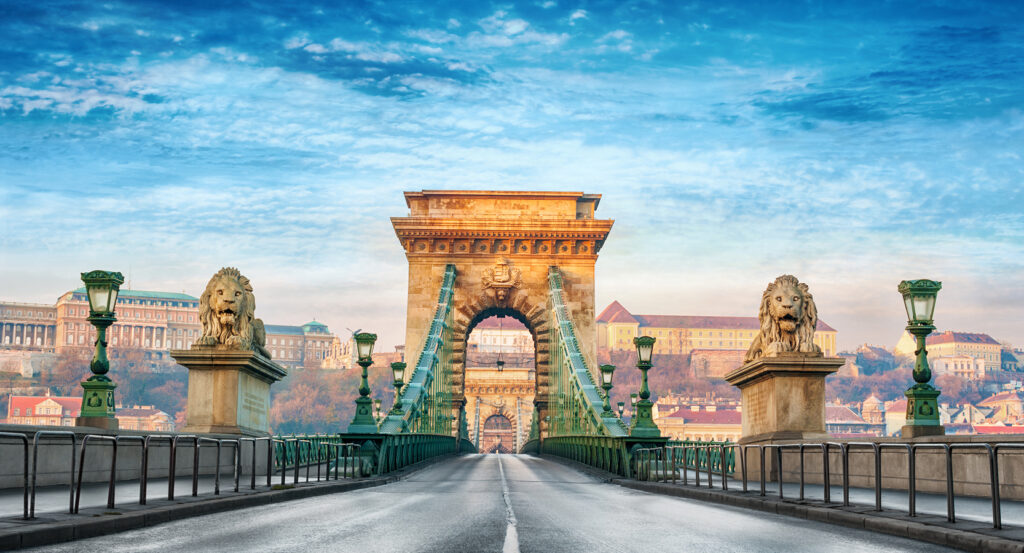
Why you should experience Chain Bridge Lion Statues in Budapest, Hungary.
The Chain Bridge Lion Statues are more than sentinels of stone, they are Budapest's eternal guardians.
Standing proudly at each end of the bridge, their granite gazes have watched empires rise, crumble, and rise again, silently witnessing the pulse of history flow across the Danube. Sculpted by János Marschalkó in 1852, these lions embody power without aggression, strength balanced by serenity, confidence without roar. In the morning mist, they appear spectral and watchful; by sunset, their features glow with the warmth of the city's amber light. Every traveler crossing between Buda and Pest passes beneath their calm eyes, unaware that these creatures have become woven into the mythos of the city itself. They don't merely guard the bridge, they consecrate it, transforming a feat of engineering into a passage of poetry.
What you should know about Chain Bridge Lion Statues.
The lions were unveiled three years after the bridge's completion, crafted with an anatomical precision that astonished contemporaries.
Marschalkó, trained in Vienna and inspired by classical symmetry, carved them from limestone blocks weighing over ten tons each. The statues' design was so exacting that legend claims the sculptor fell into despair when a critic pointed out that the lions appeared to lack tongues. In truth, they do, small and carefully recessed, invisible from street level but carved nonetheless, a masterstroke of perspective that became one of Budapest's enduring tales. These lions survived wars, floods, and even the bridge's total destruction in 1945, when explosives reduced everything around them to rubble, yet the lions remained. Their endurance turned them from ornament into symbol: examples of the city's unbroken will. Today, restorers clean them with meticulous care, preserving the patina of time. Each faint scratch, each weathered mark, speaks of resilience older than memory.
How to fold Chain Bridge Lion Statues into your trip.
To truly feel their power, approach the lions slowly, on foot, from Széchenyi Square or Clark Ádám Square.
Pause before them, where traffic hums and the Danube glints below, and take a moment to meet their gaze. It's not imagination, there's presence in their stillness, a quiet communication between stone and soul. At dawn, fog curls around their paws like incense; at night, the glow of the bridge lamps gives them an almost living breath. Photograph them if you must, but linger afterward, the longer you stand, the more you'll feel the weight they bear and the peace they project. After crossing the bridge, visit the small plaques nearby that recount their history, or continue up the hill to Buda Castle, where the lions' silhouettes are visible from above, facing eternity. The Chain Bridge Lion Statues aren't just details in a cityscape, they are Budapest's heartbeat carved in stone, watching forever over the river that connects its past, present, and soul.
Where your story begins.
Foresyte Travel reveals places that feel extraordinary long before you arrive.
Experience premium editorial crafted for luxury travelers.





































































































