
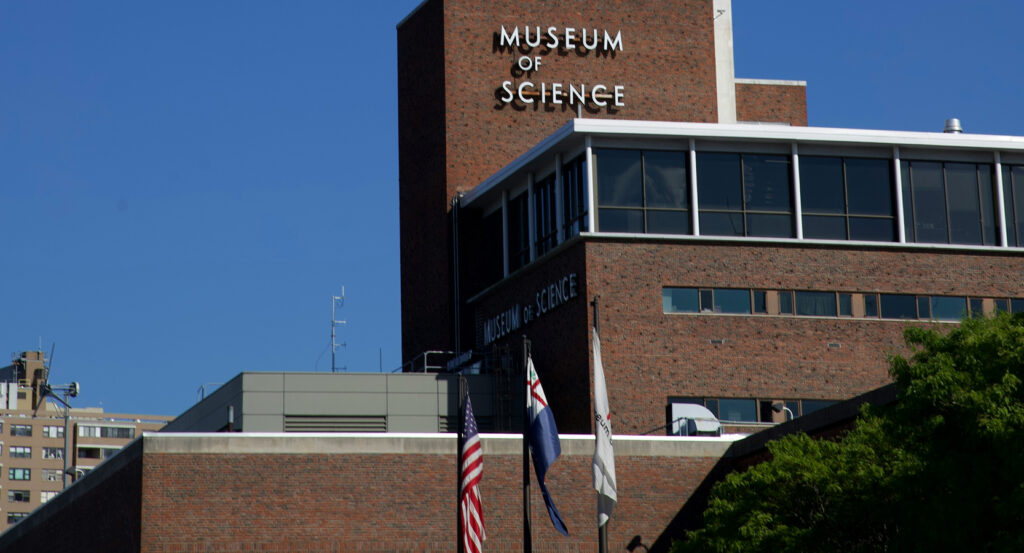
Why you should experience Cosmic Light at Museum of Science in Boston, Massachusetts.
Cosmic Light is an immersive astronomy exhibition where Science Park's space science, astronomical discovery, interactive exploration, and breathtaking celestial imagery reveal the extraordinary scale of the universe.
Set along Charles River Dam Road near Monsignor O'Brien Highway and just steps from the Charles Hayden Planetarium, this captivating gallery combines grand astronomical photography, immersive space displays, a towering scale model of the Sun, authentic meteorites, interactive planetary comparisons, and contemporary astrophysics that transform distant cosmic phenomena into tangible scientific experiences. Brilliant imagery, enormous differences in scale, and hands-on exploration encourage visitors to appreciate both the immensity of the universe and humanity's place within it. The result is an experience defined by scientific discovery, astronomical wonder, and exceptional educational design.
What you should know about Cosmic Light.
Cosmic Light is best known for demonstrating how nearly everything astronomers know about the universe is derived from studying light, using authentic astronomical observations across the electromagnetic spectrum to explain the birth and death of stars, the structure of the Milky Way, the evolution of galaxies, and the immense scale of the observable universe through one of the Museum of Science's signature permanent space science exhibitions. Positioned immediately outside the Charles Hayden Planetarium, the exhibition functions as both an introduction and companion to the museum's astronomy programming, translating complex astrophysical concepts into accessible visual experiences using real observational data gathered by NASA missions, space telescopes, and ground-based observatories. Large-format color photographs reveal stellar nurseries, supernova remnants, nebulae, spiral galaxies, and distant cosmic structures captured at visible, infrared, ultraviolet, radio, and X-ray wavelengths, illustrating how different portions of the electromagnetic spectrum uncover information invisible to the human eye. A striking 12-foot-diameter model of the Sun anchors the gallery, allowing visitors to compare Earth's parent star with nearby scale models of the planets while gaining perspective on the immense distances separating objects throughout the Solar System. One of the exhibition's most memorable artifacts is an authentic 50,000-year-old meteorite, which visitors are encouraged to touch, providing a direct physical connection to material formed beyond Earth. Interactive displays further explore stellar evolution, planetary science, comparative galaxy sizes, cosmic distance scales, and humanity's place within the expanding universe while highlighting how advances in optical engineering, spectroscopy, digital imaging, and modern space exploration continue reshaping scientific understanding of the cosmos.
The exhibition experience unfolds through carefully sequenced astronomical imagery, dramatic differences in physical scale, immersive visual storytelling, and scientifically accurate models that transform abstract astrophysical concepts into intuitive spatial experiences. Monumental graphics, precision-built scale models, authentic extraterrestrial specimens, and thoughtfully integrated interpretive media reinforce the central role that light plays in modern astronomy, from revealing exoplanets and black holes to tracing the evolution of galaxies across billions of years. Every installation demonstrates how observational science, technological innovation, and compelling exhibition design combine to make one of humanity's most complex scientific disciplines understandable, establishing Cosmic Light as one of the Museum of Science's defining gateways to space exploration.
How to fold Cosmic Light into your trip.
Cosmic Light works as part of an exploration through the Museum of Science's celebrated space science experiences.
Begin at the Charles Hayden Planetarium, where immersive full-dome presentations introduce the universe before continuing into Cosmic Light. Continue to Theater of Electricity, where spectacular demonstrations reveal another fundamental force shaping the physical world. Conclude at Mathematica, where elegant interactive exhibits demonstrate the mathematical principles underlying astronomy, physics, and scientific discovery. The progression moves naturally from immersive space exploration to astronomical investigation before concluding with the mathematical foundations of the universe, revealing why Cosmic Light remains one of the Museum of Science's most inspiring scientific experiences.
Where your story begins.
Foresyte Travel reveals places that feel extraordinary long before you arrive.
Experience premium editorial crafted for luxury travelers.







































































































