
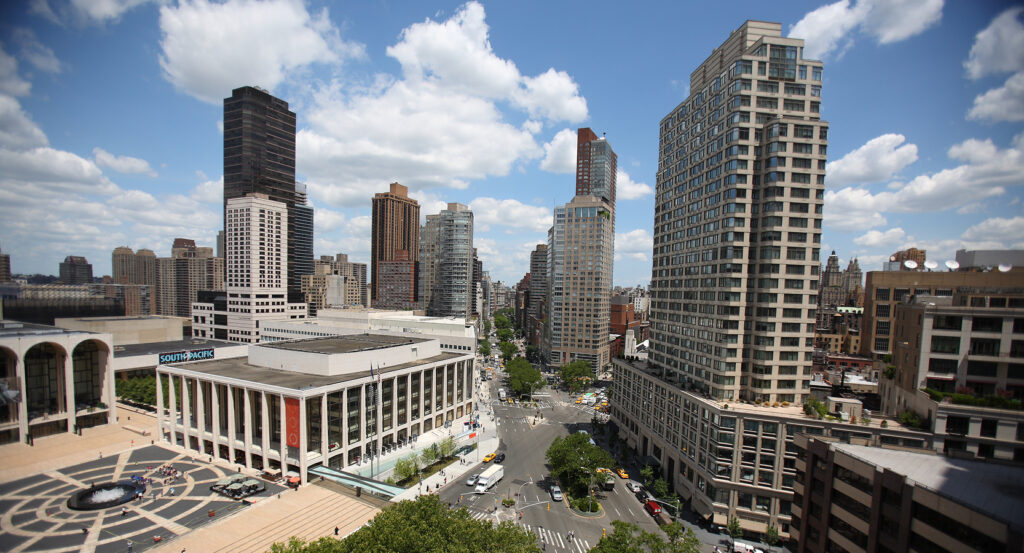
Why David Geffen Hall matters.
David Geffen Hall is a renewed concert hall where Lincoln Square's performing-arts concentration meets the New York Philharmonic's historic home, expansive public interiors and a building reworked for a new generation of musical performance.
Set along Broadway near West 65th Street and just steps from the Metropolitan Opera House, the hall occupies the northern edge of Lincoln Center's central plaza behind a long travertine colonnade facing the Revson Fountain. Tod Williams Billie Tsien Architects reorganized the public interior around the Karen and Richard LeFrak Lobby, the Leon and Norma Hess Grand Promenade and a Southeast Welcome Center entered directly from Broadway, substantially enlarging the areas accessible beyond performances. A 50-foot media wall dominates the lobby and carries live simulcasts, visual art and cultural programming into a social area furnished for extended public use throughout the day. The Kenneth C. Griffin Sidewalk Studio places another performance room directly against Broadway behind large glass openings, exposing rehearsals and smaller programs to the street outside. The result is a concert building whose colonnaded plaza frontage, enlarged interior commons, immense media wall and transparent street-level studio extend its musical life beyond the auditorium into Lincoln Center's surrounding public realm.
What defines David Geffen Hall.
David Geffen Hall is best known for housing the New York Philharmonic in a concert building whose six-decade architectural history has been shaped by repeated attempts to resolve the acoustical problems of its original auditorium. Max Abramovitz of Harrison & Abramovitz designed Philharmonic Hall, which opened on September 23, 1962 as the first completed major venue at Lincoln Center and brought the Philharmonic from Carnegie Hall into the new performing-arts campus. Acoustical consultant Leo Beranek and Bolt, Beranek and Newman worked on the original room, including suspended overhead reflector panels whose performance became a focus of criticism soon after opening. Abramovitz's surviving professional archive contains acoustical studies by Beranek's firm, Paul S. Veneklasen & Associates, Vern O. Knudsen and Heinrich Keilholz across the following years, revealing an unusually sustained effort to improve the room. Keilholz directed alterations completed in 1969 that removed Beranek's overhead panels and installed a stepped wood ceiling, yet dissatisfaction continued. Audio entrepreneur and Philharmonic board member Avery Fisher made a $10.5 million gift in 1973, and the building took his name that year. A more dramatic reconstruction followed in 1976 under architect Philip Johnson and acoustician Cyril Harris, who created a substantially different interior within Abramovitz's existing shell. Musician concerns resurfaced by the early 1990s, particularly around hearing conditions onstage, leading to another stage intervention during Kurt Masur's tenure as Philharmonic music director. David Geffen's $100 million gift brought another naming chapter in 2015, decades after the building had become inseparable from a cycle of architectural modification, acoustical experimentation and Philharmonic performance.
The $550 million reconstruction completed in 2022 approached the auditorium through a comprehensive redesign by Diamond Schmitt Architects, led by Gary McCluskie, with Paul Scarbrough of Akustiks handling acoustics and Joshua Dachs of Fisher Dachs Associates directing theater planning. The team reduced capacity by 500 seats to 2,200 and advanced the stage 25 feet into the room, bringing the audience 30 percent closer to the performers and wrapping seating around the orchestra. Curving beechwood walls were sculpted with custom grooves to distribute sound, and a mesh ceiling carrying firefly-like fixtures replaced the visual weight of earlier overhead structures. Flexible stage configurations expanded the room beyond symphonic concerts into choral programs, recitals, semi-staged opera, dance, film and amplified music. Clara Wu Tsai and Joe Tsai supplied the catalytic gift that permitted the construction schedule to accelerate during the pandemic, and the redesigned auditorium received the name Wu Tsai Theater. Turner Construction Company managed construction, Kohler Ronan and Thornton Tomasetti provided engineering, and crews numbering close to 700 at peak periods worked through the pandemic shutdown. The project finished on budget and two years ahead of its earlier schedule, supporting 6,000 jobs and $600 million in economic activity. Opening day on October 8, 2022 centered on the world premiere of Etienne Charles's San Juan Hill: A New York Story, a Lincoln Center commission performed by Charles's Creole Soul with the New York Philharmonic under Jaap van Zweden. That commission connected the reconstructed hall with San Juan Hill, the predominantly Black and Puerto Rican neighborhood displaced during development of Lincoln Center, giving the reopening a direct historical relationship with the ground beneath the performing-arts campus.
How David Geffen Hall fits.
David Geffen Hall works as the anchor for a Lincoln Square outing connecting the preservation of performance history, self-taught art and an American Catholic church assembled through architecture and major artistic commissions.
Begin at The New York Public Library for the Performing Arts, whose institutional roots precede Lincoln Center through specialist collections created across several decades: the Theatre Collection began with David Belasco's papers in 1931, Carleton Sprague Smith proposed a performing-arts library and museum in 1932, sound collecting began in 1937 and the Dance Collection followed in 1944. Richard Rodgers contributed $150,000 toward a sound archive in 1962, three years before the Gordon Bunshaft-designed Library and Museum of the Performing Arts opened at Lincoln Center on November 30, 1965. Its holdings now span theater, dance, music, film and recorded sound, including manuscripts, stage designs, photographs, historic audio and other primary artifacts of performance. Continue to American Folk Art Museum, founded in 1961 and devoted to folk and self-taught artists whose practices developed largely outside formal academic training. Its collection exceeds 7,000 works across four centuries and nearly every continent, ranging from quilts and portraits to works by twentieth- and twenty-first-century self-taught artists. The institution has occupied its Lincoln Square location for more than three decades, creating a compact museum devoted to artistic production that sits outside the academy and many conventional art-historical hierarchies. Conclude at Church of St. Paul the Apostle, whose cornerstone was laid in 1876 for the Mother Church of the Paulist Fathers after founder Isaac Hecker envisioned an American basilica drawing upon early Christian precedents. Jeremiah O'Rourke prepared the plans, and Paulist priest and West Point engineer George Deshon assumed architectural leadership before completion in January 1885. Stanford White subsequently designed interior elements between 1887 and 1890, including the high altar in gold, onyx, alabaster, mosaic and Numidian marble, with John La Farge, Augustus Saint-Gaudens, Frederick MacMonnies and Bertram Goodhue contributing further artistic work. The progression moves from Bunshaft's institutional home for the preservation of ephemeral performance through a museum dedicated to artists outside formal training and culminates in Hecker's church, where O'Rourke, Deshon, White, La Farge, Saint-Gaudens and Goodhue built an unusually concentrated chapter of American architecture and art.
Where your story begins.
Foresyte Travel reveals places that feel extraordinary long before you arrive.
Enjoy editorial crafted for luxury travelers.
Foresyte may earn a commission when you book.







































































































