
Why Disneyland Park matters.
Disneyland Park is a pioneering themed park where Anaheim Resort's entertainment culture meets cinematic environments, advanced attraction engineering and Walt Disney's original conception of a place built for adults and children together.
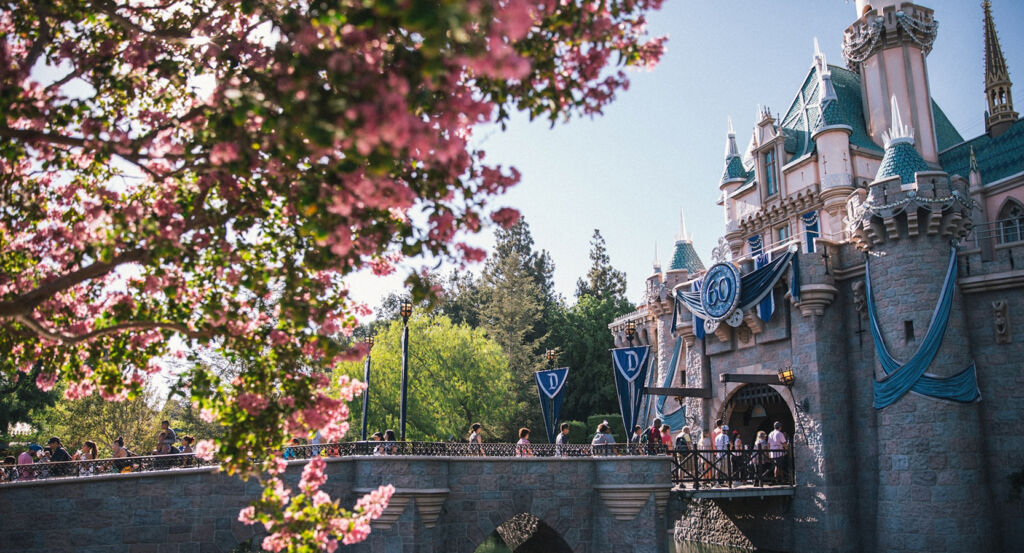
Set along Harbor Boulevard near Ball Road and just steps from Anaheim GardenWalk, the park occupies the historic core of Disneyland Resort within a compact plan organized around a central hub. Main Street, U.S.A. forms the principal approach before Sleeping Beauty Castle marks the transition toward Fantasyland, with Adventureland, Frontierland and Tomorrowland extending into distinct spatial territories around the center. The 77-foot castle uses forced perspective and progressively reduced architectural scale to create greater apparent height, turning a relatively modest structure into the park's primary visual anchor. A railroad encircles much of the property, reinforcing the perimeter as a continuous physical boundary around the themed interiors and linking stations distributed across the park. The result is a tightly composed environment whose hub plan, differentiated lands, controlled architectural scale and perimeter railway established a physical model that profoundly shaped subsequent themed entertainment.
What defines Disneyland Park.
Disneyland Park is best known for turning Walt Disney's long-developing idea for family entertainment into the park that opened in Anaheim on July 17, 1955 and became a model for a new branch of the entertainment industry. Disney's interest grew from outings with his daughters and his conviction that parents and children should have a place where both groups participated in the recreation. Walt and Roy O. Disney hired Stanford Research Institute analyst Harrison “Buzz” Price to evaluate economic feasibility and location, and Price examined ten Orange County sites through population, accessibility, climate and related factors. The analysis led the brothers to 160 acres of orange groves near the new Santa Ana Freeway in Anaheim, giving the project a large suburban site connected to Southern California's expanding highway network. Walt financed development partly through television, beginning the Disneyland anthology series on ABC in 1954 and using the medium to build national familiarity with the project before completion. Eighteen attractions debuted when the park opened, including Jungle Cruise, Disneyland Railroad, Peter Pan's Flight, Mr. Toad's Wild Ride and King Arthur Carrousel. The dedication on July 17 became a national television event viewed by 90 million people, extending the opening far past the physical audience in Anaheim. Development continued almost immediately, and the first major expansion arrived in 1959 with Matterhorn Bobsleds, Submarine Voyage and the Disneyland-Alweg Monorail System. Vice President Richard Nixon and his family joined Walt Disney during the June 14 dedication, alongside more than 2,000 members of the press, celebrities and dignitaries. Matterhorn Bobsleds carried particular engineering significance as the first roller coaster to employ tubular steel track and an electronic dispatch system permitting multiple vehicles on the course.
Technological experimentation produced another major chapter as Disney artists and engineers moved beyond conventional mechanical figures toward increasingly sophisticated animated characters and ride systems. Walt Disney's Enchanted Tiki Room formally brought Audio-Animatronics figures to Disneyland in 1963 through hundreds of moving birds, flowers and tikis coordinated with music and speech. New Orleans Square followed in 1966 as the first entirely new land added since opening, with Walt Disney and New Orleans mayor Victor Schiro participating in its dedication. Pirates of the Caribbean began as a proposed walk-through wax museum before advances in Audio-Animatronics and a boat system derived from it's a small world redirected the project into the attraction that opened March 18, 1967. Haunted Mansion required a different technical solution: its exterior stood by 1963, but interior development continued until the Omnimover system supplied the continuous “Doom Buggy” vehicles used when the attraction opened in 1969. Space Mountain arrived in 1977 with a single indoor track and larger trains developed specifically for Anaheim, followed by Tony Baxter's Big Thunder Mountain Railroad in 1979 after five years of planning and two years of construction. Decades later, Walt Disney Imagineering and Lucasfilm collaborated on the 14-acre Star Wars: Galaxy's Edge, which opened in 2019 as Disney's largest single-themed land expansion to that point. The succession from Audio-Animatronics through continuous ride systems, indoor coaster engineering and large-scale cinematic environments made Disneyland an enduring development laboratory for Disney's approach to themed entertainment.
How Disneyland Park fits.
Disneyland Park works as the anchor for an Anaheim outing connecting the agricultural colony that preceded the resort, the city's citrus economy and a civic institution preserving local history.
Begin at Founders' Park, where the 1857 Mother Colony House preserves the earliest surviving built fabric of the settlement established by fifty German colonists of the Los Angeles Vineyard Society. George Hansen, the society's superintendent and planner, constructed the redwood house as his residence and office while laying out fifty 20-acre vineyard lots for a community initially centered on Mission grapes. Disease destroyed 400,000 grapevines between 1884 and 1888, and citrus subsequently replaced viticulture as Anaheim's dominant agricultural chapter. The neighboring 1894 Woelke-Stoffel House carries that later period into Queen Anne architecture, placing the colony and citrus eras together within the same historical site. Continue to Anaheim Packing House, built for the Anaheim Orange & Lemon Association in 1919 as the citrus industry reshaped the city surrounding Disney's future site. The Mission Revival building cost $40,000 and incorporated an endless conveyor system moving fruit through the packing operation, followed in 1926 by a pre-cooler and chilling tower supporting iced long-distance rail shipments. The association closed the facility in 1955 as suburban development displaced surrounding groves, placing the end of its original industrial life in the same year Disneyland opened. The restored structure later became a two-story food hall, preserving one of the industrial buildings associated with the agricultural economy that preceded Anaheim's postwar expansion. Conclude at Muzeo Museum and Cultural Center, whose historic Carnegie Library traces Anaheim's civic development before and after Disneyland's arrival. Andrew Carnegie committed $10,000 toward the library after the city agreed to provide the site and annual operating funds, and 75 residents raised money for the property. Los Angeles architect John C. Austin designed the two-story building, Kuechel and Rowley completed construction within the Carnegie grant, and the library opened January 1, 1909. The building ceased library service in 1963, survived a later demolition threat, received municipal historical protection in 1978 and entered the National Register of Historic Places in 1979 before joining Muzeo in 2007. The progression moves from Anaheim's vineyard colony through the industrial infrastructure of its citrus economy and culminates in a preserved civic institution, placing Disneyland within the deeper agricultural and municipal history of the city Walt Disney selected for his park.
Where your story begins.
Foresyte Travel reveals places that feel extraordinary long before you arrive.
Enjoy editorial crafted for luxury travelers.
Foresyte may earn a commission when you book.





































































































