
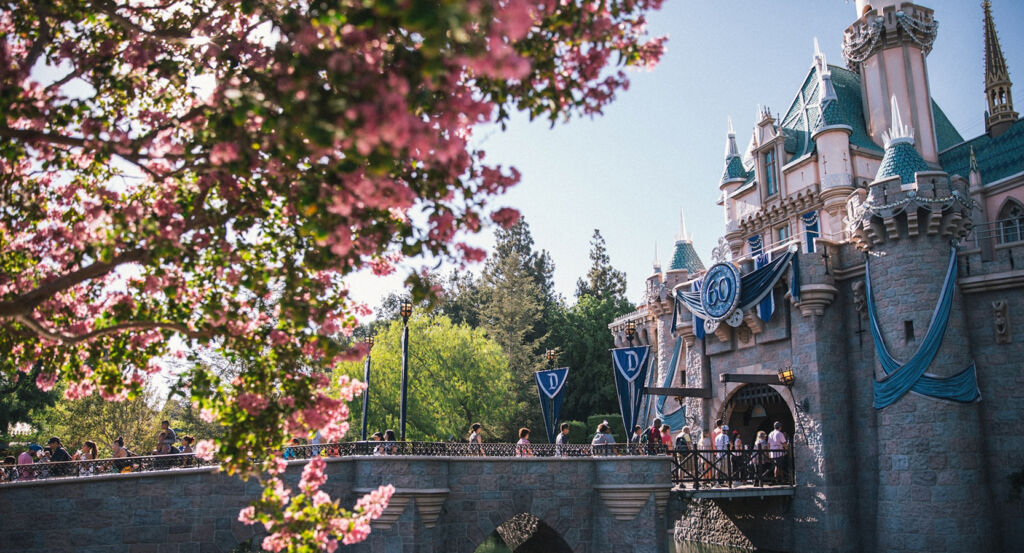
Why Disneyland Resort matters.
Disneyland Resort is an expansive entertainment destination where Anaheim Resort's concentration of hotels and attractions meets two Disney theme parks, a pedestrian entertainment district and an interconnected campus descended from Walt Disney's original 1955 park.
Set along Harbor Boulevard near Katella Avenue and just west of Anaheim GardenWalk, the resort occupies a substantial campus centered on a pedestrian esplanade separating Disneyland Park from Disney California Adventure Park. Disneyland Park extends north from that shared entrance, Disney California Adventure occupies the southern side, and Downtown Disney District runs west toward the resort hotels, creating a compact arrangement navigable largely on foot. Disney's Grand Californian Hotel & Spa physically adjoins Disney California Adventure, strengthening the architectural continuity between lodging, parkland and the central promenade. The Disneyland Monorail adds an elevated 2.5-mile circuit between Tomorrowland and Downtown Disney, passing through several sections of the wider property as part of the resort's internal transportation network. The result is an unusually concentrated destination whose facing park entrances, central esplanade, adjoining hotel, western commercial promenade and elevated monorail organize multiple Disney properties around a cohesive pedestrian core.
What defines Disneyland Resort.
Disneyland Resort is best known for growing from Walt Disney's original Disneyland into the two-park destination whose Anaheim origins reshaped the modern themed-entertainment industry. Walt had developed the park idea across several years before commissioning Stanford Research Institute to determine its economic feasibility and location, with analyst Harrison “Buzz” Price examining population, accessibility and climate across ten Orange County possibilities. Price, Walt and Roy O. Disney selected 160 acres of Anaheim orange groves near the Santa Ana Freeway, assembled from parcels held by 17 owners. Financing drew upon Walt's personal assets and outside partners, with ABC advancing $500,000 toward construction and guaranteeing bank loans in exchange for a weekly television program. That Disneyland series debuted on October 27, 1954, giving Walt a national platform for films, characters and updates on the developing park. WED Enterprises assembled artists and designers with motion-picture backgrounds, including Dick Irvine and Marvin Davis, as Walt built an internal creative group capable of translating cinematic design methods into permanent physical environments. Structural engineer Don Edgren worked in the field for Wheeler & Gray, Admiral Joe Fowler supervised major construction responsibilities, and horticulturists Bill and Jack Evans converted former agricultural acreage into extensively planted settings. Construction began July 21, 1954 and continued almost to the July 17, 1955 dedication, compressing the initial build into slightly less than one year. The $17 million park opened to an invited audience on July 17 and to the public the following day, creating the foundation from which Disney subsequently developed parks across three continents.
The transformation from a single park into Disneyland Resort reached its decisive stage through a $1.4 billion development program completed 2001. Disney California Adventure opened on February 8 on land formerly occupied by Disneyland's parking area, initially organizing 55 acres around Golden State, Hollywood Pictures Backlot and Paradise Pier. Peter Dominick of Urban Design Group designed Disney's Grand Californian Hotel & Spa around the California Arts and Crafts tradition associated with architects including Greene & Greene, making it Disney's first hotel physically located within a theme park. Downtown Disney District opened January 12, 2001 as the pedestrian commercial connection among the parks and hotels, completing the principal pieces of the new resort configuration. Disney California Adventure later underwent substantial reconstruction, with Cars Land and the remade Buena Vista Street opening in 2012, Pixar Pier following in 2018 and Avengers Campus joining the park in 2021. Disney's Paradise Pier Hotel subsequently became Pixar Place Hotel, extending Pixar design across a resort property outside the theme parks. Anaheim approved DisneylandForward in 2024, allowing greater flexibility for future attractions, lodging, dining and entertainment across Disney property without enlarging the resort's existing geographic boundaries; Disney committed $1.9 billion in resort investment during the plan's first decade. The destination reached its 70th anniversary in 2025 as a complex of two theme parks, three hotels and Downtown Disney District, marking seven decades of physical expansion from the original Anaheim property.
How Disneyland Resort fits.
Disneyland Resort works as the anchor for an Anaheim outing connecting the city's nineteenth-century agricultural origins, its citrus economy and one of Orange County's most consequential works of modern religious architecture.
Begin at Founders' Park, positioned on the western boundary of the original Anaheim Colony and centered on two surviving houses from distinct agricultural eras. George Hansen, superintendent of the Los Angeles Vineyard Society, built the Mother Colony House in 1857, the same year the colony divided its land into fifty 20-acre vineyard lots planted principally with Mission grapes. Pierce's Disease destroyed 400,000 grapevines between 1884 and 1888, accelerating Anaheim's transition toward citrus cultivation; the neighboring Woelke-Stoffel House arrived in 1894 during that succeeding agricultural period. The Mother Colony House was moved from Anaheim Boulevard in 1928, dedicated as Orange County's first historical museum in 1929 and later joined the Woelke-Stoffel House on the National Register of Historic Places in 2013. Continue to Anaheim Packing House, constructed in 1919 for the Anaheim Orange & Lemon Association in Mission Revival form at a cost of $40,000. Its industrial equipment included an endless conveyor carrying fruit through the building, and a large golden orange above the entrance advertised the association's principal crop to traffic along the highway. A pre-cooler and chilling tower arrived in 1926 as ice became increasingly important for long-distance rail shipment, tying the facility directly to the infrastructure that carried Southern California citrus into national markets. The association closed the packing operation in 1955 as suburban development displaced surrounding groves, placing the end of its original agricultural function in the same year Disneyland opened elsewhere in Anaheim. Conclude at Christ Cathedral, whose 34-acre campus originated under televangelist Robert H. Schuller and assembled major architecture by Richard Neutra, Philip Johnson, Richard Meier and Gin D. Wong. Johnson and John Burgee designed the former Crystal Cathedral, whose vast glass enclosure became the architectural center of Schuller's internationally broadcast Hour of Power. The Roman Catholic Diocese of Orange purchased the campus in 2012 and undertook a $29 million conversion of the former Protestant church for Catholic worship, creating the diocese's new cathedral center while retaining the larger collection of modern architecture. The progression moves from Anaheim's vineyard colony through the industrial infrastructure of its citrus era and culminates in a modern religious campus shaped by several major twentieth-century architects, tracing the city that existed before Disneyland and continued developing around it.
Where your story begins.
Foresyte Travel reveals places that feel extraordinary long before you arrive.
Enjoy editorial crafted for luxury travelers.
Foresyte may earn a commission when you book.





































































































