
Why Dodger Stadium matters.
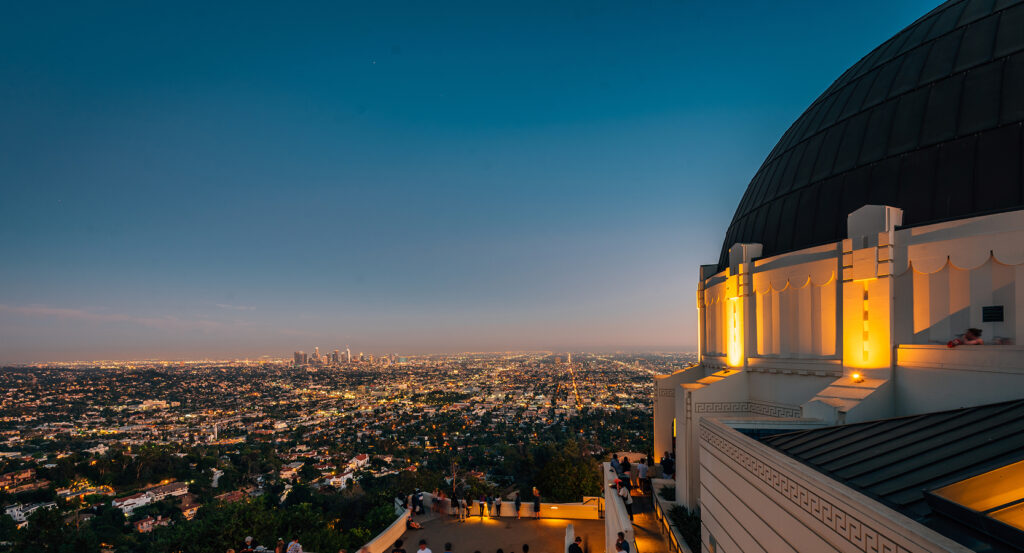
Dodger Stadium is a Mid-Century Modern ballpark where Elysian Park's hillside setting meets terraced architecture, open-air baseball and sweeping views across the Los Angeles basin.
Set within Chavez Ravine near Vin Scully Avenue and just steps from Los Angeles Police Academy, the stadium occupies a steeply contoured basin between Elysian Park, the Los Angeles River and Downtown, with terraced hillsides rising toward long views of the San Gabriel Mountains. Emil Praeger arranged six seating levels against the terrain so entrances arrive at grade across different elevations, allowing the grandstand to settle into the ravine instead of standing as a conventional freestanding bowl. Edward Fickett developed the Southern California architectural character through pastel colors, folded metal roofs, inverted canopies, abstract urns and landscaped entrance terraces. Twenty-one terraced entrances and parking areas distributed across the surrounding slopes extend the architecture outward from the seating bowl into a broad hillside composition. The result is a ballpark whose tiered circulation, modernist detailing, landscaped approaches and integration with Chavez Ravine preserve an unusually complete expression of early-1960s Southern California design.
What defines Dodger Stadium.
Dodger Stadium is best known for becoming Walter O'Malley's purpose-built Los Angeles home for the Dodgers after his effort to secure a new ballpark in Brooklyn ended with the franchise moving west in 1958. The club spent its first four Los Angeles seasons at the LA Memorial Coliseum as O'Malley developed the new stadium with architect and civil engineer Emil Praeger, whose previous work with the Dodgers included Holman Stadium in Vero Beach. Construction began in 1959 and required millions of cubic yards of earthwork across Chavez Ravine, with excavated soil redistributed to shape the immense surrounding site. More than 25,000 concrete grandstand pieces were cast and cured on the property, translating Praeger's engineering into a vast precast structure assembled within the reshaped terrain. The project cost $23 million and produced a 56,000-seat stadium, the first privately financed Major League ballpark since Yankee Stadium in 1923. Opening day arrived on April 10, 1962 against the Cincinnati Reds before 52,564 spectators, beginning a first season in which Los Angeles won 102 games and Maury Wills earned National League MVP honors after stealing 104 bases. Sandy Koufax threw the first Los Angeles Dodgers no-hitter at the stadium that June, then helped the club sweep the New York Yankees there to secure the 1963 World Series. His September 9, 1965 perfect game against the Chicago Cubs remains the franchise's only perfect game, with Koufax striking out 14 in a 1-0 victory. The stadium later became the site of Fernandomania's 1981 emergence, Olympic baseball during the 1984 Los Angeles Games and Kirk Gibson's pinch-hit walk-off home run against Dennis Eckersley in Game 1 of the 1988 World Series.
The property beneath the stadium carries a separate history extending through the Mexican American communities of Palo Verde, La Loma and Bishop, which occupied the Chavez Ravine hillsides before the ballpark project. By the 1940s, those neighborhoods encompassed 315 acres and housed 1,100 predominantly Mexican American residents, with homes, businesses and agricultural plots distributed across the steep terrain. Los Angeles pursued the land during the 1950s for the proposed Elysian Park Heights public-housing development, and residents faced acquisition and displacement before that housing plan collapsed amid political opposition. Remaining families continued contesting removal after the city redirected the property toward the Dodgers stadium agreement, and the 1959 eviction of the Aréchiga family became the most visible episode of the conflict. Decades later, the stadium itself entered a major architectural renewal after Guggenheim Baseball Management acquired the Dodgers in 2012. Levin & Associates led a preservation-focused rehabilitation completed in 2013, restoring the original hexagonal form of the outfield scoreboards alongside broader alterations. Janet Marie Smith directed subsequent development, including a $100 million project centered on a two-acre Centerfield Plaza, renovated left- and right-field pavilions and a new vertical circulation route using bridges, escalators and elevators. That work retained the 56,000-seat capacity and field dimensions, extending a preservation strategy that has kept Praeger's original stadium operating through more than six decades of architectural and baseball history.
How Dodger Stadium fits.
Dodger Stadium works as the anchor for an outing connecting Los Angeles railroad expansion, the surviving center of the city's original Chinatown and the Italian immigrant community that developed around the old Plaza.
Begin at Los Angeles State Historic Park, a 32-acre landscape occupying land once crossed by Southern Pacific's River Station complex. Southern Pacific opened a freight house and depot there in 1875 as its tracks pushed into Los Angeles, then added a hotel in 1879 as passenger operations expanded. The railroad complex grew to include a roundhouse and turntable, blacksmith shop, machine shop, car shop, paint shop, coal dock and transfer facilities, making the property a substantial industrial gateway during the city's nineteenth-century expansion. Archaeological investigations have subsequently examined surviving features of River Station beneath the park, giving the open landscape a direct physical connection with the railroad infrastructure that accelerated Los Angeles's metropolitan growth. Continue to Chinese American Museum, housed in the Garnier Building constructed by Philippe Garnier in 1890 and leased to Chinese American merchants before completion. The building became an unofficial civic center for Los Angeles's original Chinatown, accommodating shops, schools, temples, churches, the Chinese Chamber of Commerce and community organizations between the 1890s and 1940s. City-led clearance beginning in 1933 displaced the surrounding Chinese community as Union Station and later transportation projects consumed much of the district, yet the Garnier Building survived. Preservation efforts beginning in the 1980s eventually secured 7,200 square feet for the Chinese American Museum, the first institution in Southern California dedicated to the region's Chinese American history. Conclude at Italian American Museum of Los Angeles, occupying Italian Hall, a community building constructed in 1908 within the city's former Little Italy. The hall became a gathering place for a community whose presence in Los Angeles predates California statehood and now survives as one of the oldest structures associated with the enclave. The 6,000-square-foot museum preserves 6,000 artifacts, photographs and historical documents extending from the eighteenth century into the present, including an early Bank of Italy savings bank, Maria Angela Ricci's passport, Leo Ricci's World War I dog tag and objects connected with Italian American businesses and cultural life across the West. The progression moves from Southern Pacific's nineteenth-century transportation complex through the surviving institutional center of old Chinatown and culminates in Italian Hall's preservation of another immigrant community rooted around the historic Plaza, connecting three layers of Los Angeles development below the hills of Chavez Ravine.
Where your story begins.
Foresyte Travel reveals places that feel extraordinary long before you arrive.
Enjoy editorial crafted for luxury travelers.
Foresyte may earn a commission when you book.





































































































