
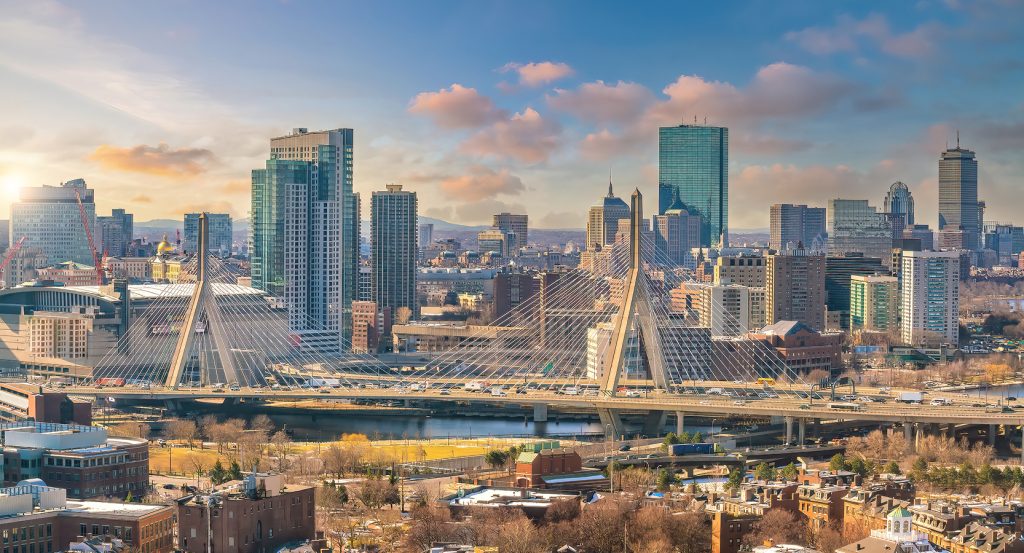
Why you should experience Drydock Avenue in Boston, Massachusetts.
Drydock Avenue is an enterprising corridor where Seaport District's maritime heritage, innovation economy, industrial legacy, and waterfront ambition converge into one of Boston's most distinctive streets.
Running through the Seaport District between the South Boston Waterfront and Fort Point, the corridor traces the edge of the historic Marine Industrial Park, where working piers, contemporary research facilities, harbor vistas, and restored industrial buildings reveal a waterfront continually shaped by commerce and innovation. Each successive block heightens the experience as granite seawalls, steel-framed structures, active marine infrastructure, public art, and expansive views across Reserved Channel reinforce the area's enduring relationship with Boston Harbor. The defining moment arrives as maritime industry, marine science, and cutting-edge technology occupy the same waterfront landscape, demonstrating how one of Boston's historic working ports continues evolving. The result is an experience defined by innovation, waterfront heritage, and one of the Seaport District's most compelling corridors.
What you should know about Drydock Avenue.
Drydock Avenue is best known for serving the Raymond L. Flynn Marine Park, established in 1910 as the South Boston Marine Industrial Park, where Boston's historic shipbuilding, cargo handling, seafood processing, manufacturing, and maritime commerce became concentrated along the city's working waterfront. The corridor derives its name from the grand Dry Dock No. 3, completed in 1905 by the United States Navy, whose 1,091-foot granite dry dock ranked among the largest in the nation and remains one of Boston Harbor's defining feats of marine engineering. Administration by the Boston Economic Development and Industrial Corporation (EDIC) helped preserve the district as one of the East Coast's largest maritime industrial campuses while attracting marine industries, advanced manufacturing firms, life sciences companies, seafood distributors, and research organizations that reinforced the corridor's economic importance. Granite bulkheads, steel piers, cargo berths, marine terminals, and working waterfront infrastructure continue expressing the industrial character that distinguishes Drydock Avenue from the surrounding Seaport District. Collectively, the corridor's naval engineering, maritime commerce, industrial specialization, harbor infrastructure, and continued economic evolution established Drydock Avenue as one of Boston's defining waterfront corridors.
Marine research became the defining force shaping the corridor as the John Joseph Moakley United States Courthouse, whose sustainable harborfront design helped anchor a broader wave of institutional investment that complemented Drydock Avenue's working waterfront. That relationship deepened with the arrival of the Innovation and Design Building, whose adaptive industrial interiors attracted manufacturers, designers, technology firms, and creative enterprises that continued the district's long tradition of production rather than replacing it with purely commercial activity. Harbor engineers, marine contractors, steel fabricators, and preservation specialists continue maintaining granite quay walls, heavy-duty wharves, maritime utilities, and historic industrial structures that support active port operations while preserving the corridor's authentic waterfront character. Together, these institutional investments, industrial adaptations, and specialized maritime trades demonstrate how Drydock Avenue continues expressing a rare balance between Boston's historic working harbor and its modern innovation economy.
How to fold Drydock Avenue into your trip.
Drydock Avenue works as an exploration of Boston's working waterfront and innovation district.
Begin at the Boston Design Center, where showrooms, design professionals, and preserved industrial architecture introduce the creative reinvention of the South Boston Waterfront before naturally leading toward Drydock Avenue. Continue to the Institute of Contemporary Art Boston, where harborfront galleries and bold contemporary architecture deepen appreciation for the Seaport District's transformation into one of Boston's leading cultural destinations. Conclude at the Boston Harborwalk at Fan Pier, where panoramic skyline views, active shipping channels, and expansive public space provide the defining waterfront payoff while revealing the broader harbor landscape surrounding Drydock Avenue. The progression moves naturally from industrial creativity to contemporary culture before culminating along Boston Harbor, revealing how Drydock Avenue connects the city's maritime past with its innovation-driven future.
Where your story begins.
Foresyte Travel reveals places that feel extraordinary long before you arrive.
Experience premium editorial crafted for luxury travelers.







































































































