Why Fenway Park matters.
Fenway Park is a historic baseball stadium where Fenway-Kenmore's sporting heritage meets the century-long history of the Boston Red Sox, the architectural peculiarities of America's oldest active Major League Baseball ballpark and the championship traditions that have shaped Boston's civic culture.
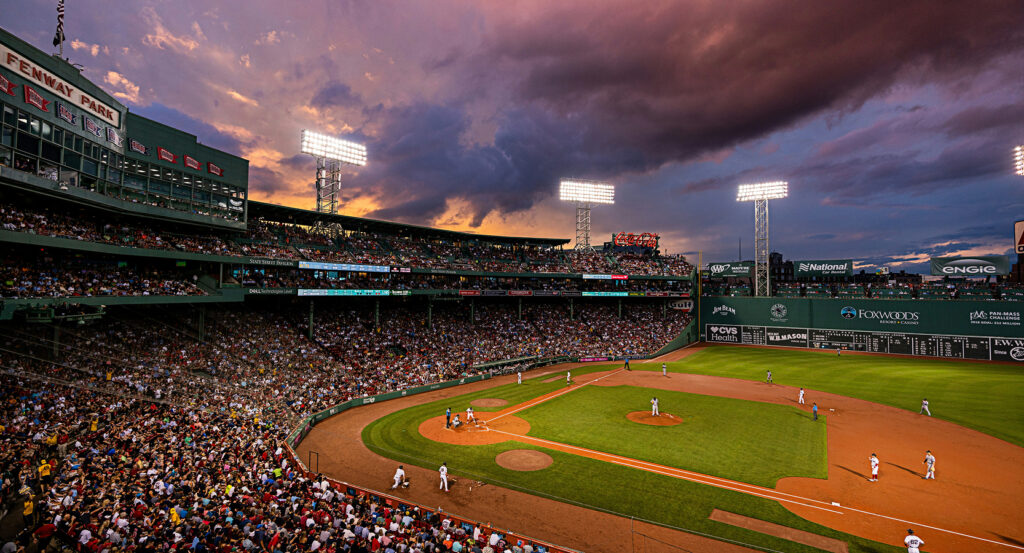
Set along Jersey Street near Brookline Avenue and just steps from the commercial blocks surrounding Kenmore Square, the ballpark occupies a tightly bounded urban parcel between Lansdowne Street and Van Ness Street, where grandstands rise directly above the surrounding neighborhood's historic streets. Its asymmetrical playing field, intimate seating tiers and exposed structural elements preserve the character of an early twentieth-century baseball stadium. The towering left-field wall, compact right-field dimensions and manually operated scoreboard create an unmistakable architectural composition. Brick facades, green-painted steelwork and narrow pedestrian concourses maintain close connections between the stadium and its surrounding streets. The result is an exceptionally distinctive sporting venue whose irregular geometry, historic construction and continuous association with the Red Sox have made it one of baseball's most celebrated grounds.
What defines Fenway Park.
Fenway Park is best known as the home of the Boston Red Sox since 1912 and the oldest ballpark currently used by a Major League Baseball team. Red Sox owner John I. Taylor selected a site in Boston's developing Fenway neighborhood to replace the club's former home at the Huntington Avenue Baseball Grounds. Architect James E. McLaughlin designed the new stadium, incorporating a steel-and-concrete grandstand suited to the irregular dimensions of the available property. Construction proceeded rapidly during the winter of 1911-1912, producing a modern sporting facility within an expanding residential and commercial district. Fenway Park opened on April 20, 1912, with the Red Sox defeating the New York Highlanders in an eleven-inning game. The club subsequently won the 1912 World Series, establishing an immediate connection between the new ballpark and championship baseball. A major fire in 1934 destroyed substantial portions of the original wooden seating structures, prompting extensive reconstruction under owner Tom Yawkey. The rebuilding introduced major changes to the grandstands and outfield boundaries, creating much of the stadium's enduring architectural character. The left-field wall became known as the Green Monster, its imposing height creating distinctive strategic challenges for hitters and outfielders. Ted Williams developed his extraordinary career within these surroundings, becoming one of baseball's greatest hitters and the last Major League player to finish a season with a batting average above .400. Carl Yastrzemski subsequently became a central figure in the club's history, winning the American League Triple Crown in 1967 and leading Boston to an unexpected pennant. The 1975 World Series produced one of Fenway's most celebrated moments when Carlton Fisk hit a dramatic home run in Game 6 against the Cincinnati Reds. The Red Sox ended an eighty-six-year championship drought in 2004, defeating the St. Louis Cardinals after an extraordinary postseason comeback against the New York Yankees. Further World Series championships followed in 2007, 2013 and 2018, establishing a sustained period of success within the franchise's modern history.
Pesky's Pole stands near the right-field foul line, marking one of the shortest home-run distances in Major League Baseball. Named for longtime Red Sox player and coach Johnny Pesky, the pole became an enduring feature of the stadium's distinctive outfield geometry. The manual scoreboard embedded within the left-field wall preserves an operating tradition associated with baseball's earlier generations. Scoreboard attendants work behind the wall to update inning totals and out-of-town results, maintaining a rare surviving example of manually operated stadium technology. The Green Monster Seats, introduced in 2003, occupy an elevated position above the left-field wall and provide an unusually direct perspective on the playing field. The stadium's right-field grandstand incorporates the famous lone red seat marking the landing point of Ted Williams' 502-foot home run on June 9, 1946. The seat commemorates the longest officially measured home run in Fenway Park history. The stadium's triangular center-field area and irregular outfield boundaries create unusual caroms and defensive challenges that have influenced generations of players. Its compact urban setting also contributes to the close relationship between spectators and the field, with seating positioned near the playing surface. The ballpark has hosted major events extending beyond professional baseball, including football games, boxing matches and concerts. The annual Fenway Bowl introduced another collegiate sporting event to the stadium's calendar, expanding its role within Boston's athletic community. The stadium's preservation has required substantial modernization, including structural improvements, expanded seating areas and upgraded facilities designed to sustain its continued use. Fenway Park's cultural importance rests in the coexistence of historic architecture, distinctive baseball traditions and more than a century of uninterrupted association with the Boston Red Sox.
How Fenway Park fits.
Fenway Park works as the sporting anchor for a Boston outing connecting the city's celebrated art collections, its academic and scientific institutions and the landscaped public spaces of the historic Fenway district.
Begin at Museum of Fine Arts, Boston, the major cultural institution founded in 1870 and established in its present Huntington Avenue location in 1909. Its Beaux-Arts building was designed by architect Guy Lowell, creating a substantial setting for one of the most comprehensive art collections in the United States. The museum's holdings include ancient Egyptian artifacts, Asian decorative arts, European painting and major works of American art. Its Art of the Americas Wing, designed by Foster + Partners and opened in 2010, expanded the presentation of artistic traditions across North, Central and South America. The museum's collection includes important paintings by John Singer Sargent, Claude Monet and Winslow Homer, establishing its international significance. Continue to Isabella Stewart Gardner Museum, the extraordinary cultural institution created by Boston collector and philanthropist Isabella Stewart Gardner. Its original building opened in 1903, incorporating a Venetian-inspired palazzo organized around a lush interior courtyard. Gardner arranged the collection according to her personal artistic interests, combining European paintings, sculpture, textiles and decorative objects within carefully composed galleries. The museum preserves works by Titian, Rembrandt and John Singer Sargent, connecting its intimate architectural environment with major achievements of European and American art. A contemporary expansion designed by Renzo Piano opened in 2012, introducing additional exhibition and performance facilities. Conclude at Back Bay Fens, the historic public landscape designed by Frederick Law Olmsted during the late nineteenth century. Developed as part of Boston's Emerald Necklace park system, the Fens transformed former tidal marshland into an interconnected landscape of waterways, walking paths and planted grounds. Its original design incorporated extensive drainage improvements, addressing the environmental challenges created by urban expansion and industrial development. The park contains the Kelleher Rose Garden, a formal horticultural landscape established in 1931, alongside athletic fields and substantial green spaces. Its pathways provide a landscaped connection between the Fenway neighborhood and the surrounding cultural institutions. The progression moves from Museum of Fine Arts, Boston's encyclopedic collections through Isabella Stewart Gardner Museum's intimate historic galleries and culminates at Back Bay Fens' Olmsted-designed landscape, connecting three defining dimensions of Boston's cultural and recreational geography.
Where your story begins.
Foresyte Travel reveals places that feel extraordinary long before you arrive.
Enjoy editorial crafted for luxury travelers.
Foresyte may earn a commission when you book.