
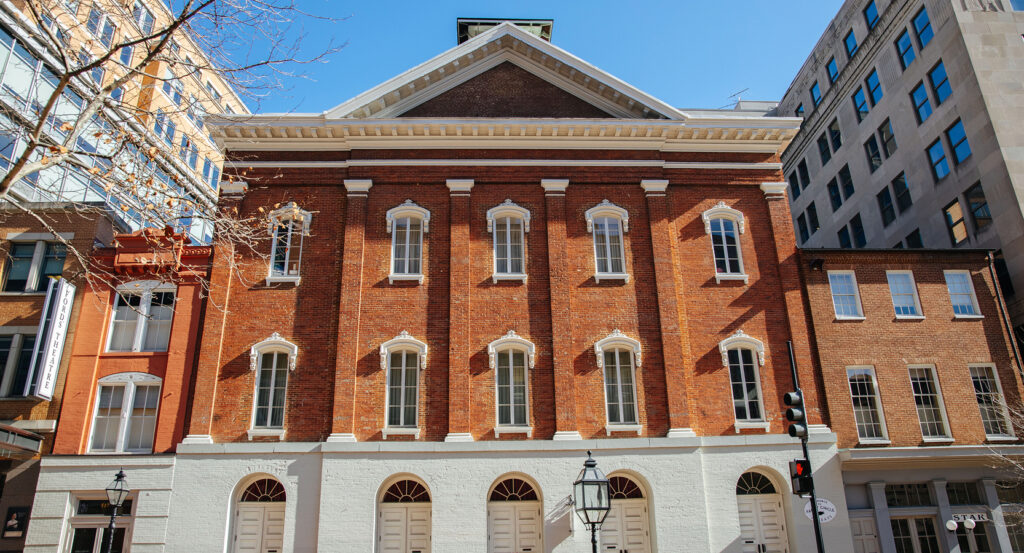
Why Ford's Theatre matters.
Ford's Theatre in Washington, D.C. is a portal into one of America's most defining moments.
Tucked into 10th Street NW, this historic playhouse carries the weight of both artistic triumph and national tragedy. Built in 1863 and lovingly restored to its original splendor, Ford's Theatre still glows with 19th-century charm, gilded balconies, velvet drapery, and gaslight-inspired chandeliers that flicker softly above the audience. But what makes it extraordinary is the way history still lives here. This is where President Abraham Lincoln was shot on the night of April 14, 1865, while watching Our American Cousin, a moment that changed the course of a nation. Today, the theatre balances reverence and vitality: an active performance venue that brings to life dramas, comedies, and historical works, while doubling as a living memorial to Lincoln's legacy. When the curtain rises, it feels as if past and present share the same breath. Ford's Theatre isn't just a relic of history, it's proof that even the darkest night can't silence the power of storytelling.
What defines Ford's Theatre.
Behind its solemn reputation lies a story of resilience, renewal, and national healing.
Originally a Baptist church, the building was transformed by entrepreneur John T. Ford into one of Washington's premier theatres during the Civil War. After the assassination, the theatre was closed for over a century, converted into offices and a museum as the site became synonymous with mourning. In 1968, after decades of debate and restoration, Ford's Theatre reopened, not as a static memorial, but as a working stage dedicated to Lincoln's love of the arts and his belief in unity through culture. Every architectural detail you see today, from the presidential box draped in flags to the recreated wallpaper patterns, was meticulously reconstructed from period drawings and artifacts. Beneath the theatre, an interpretive museum displays artifacts from that fateful night, including the derringer pistol used by John Wilkes Booth and Lincoln's chair. Across the street, the Petersen House, where Lincoln passed away, completes the narrative. The theatre's rebirth stands as a metaphor for the nation's own: wounded, but rebuilt with purpose and grace.
How Ford's Theatre fits.
To experience Ford's Theatre with depth, give yourself time, this isn't a quick stop; it's a reflection.
Start at the museum below the theatre, where immersive exhibits trace Lincoln's presidency, his assassination, and the tumultuous aftermath of the Civil War. Then ascend into the theatre itself, where rangers and guides recount the night of April 14 in vivid, haunting detail. Sit quietly for a moment in the orchestra section and look toward the presidential box, adorned with flags and a portrait of George Washington, and let the weight of history settle around you. If possible, attend one of the theatre's live performances; the contrast of art and history creates a rare resonant resonance. End your visit at the Petersen House across the street, where the story concludes with reverence and reflection. Afterward, step back into the streets of modern D.C., the hum of the capital around you, and you'll realize Ford's Theatre isn't just about what happened there, it's about what continues to endure: empathy, courage, and the belief that art can help a nation heal.
Where your story begins.
Foresyte Travel reveals places that feel extraordinary long before you arrive.
Enjoy editorial crafted for luxury travelers.
Foresyte may earn a commission when you book.







































































































