
Why Four Seasons Hotel Baltimore matters.
Four Seasons Hotel Baltimore is a waterfront luxury hotel where Harbor East's transformation from industrial port district to mixed-use urban center meets John Paterakis's redevelopment ambitions, contemporary American architecture, and Baltimore's expanding international hospitality market.
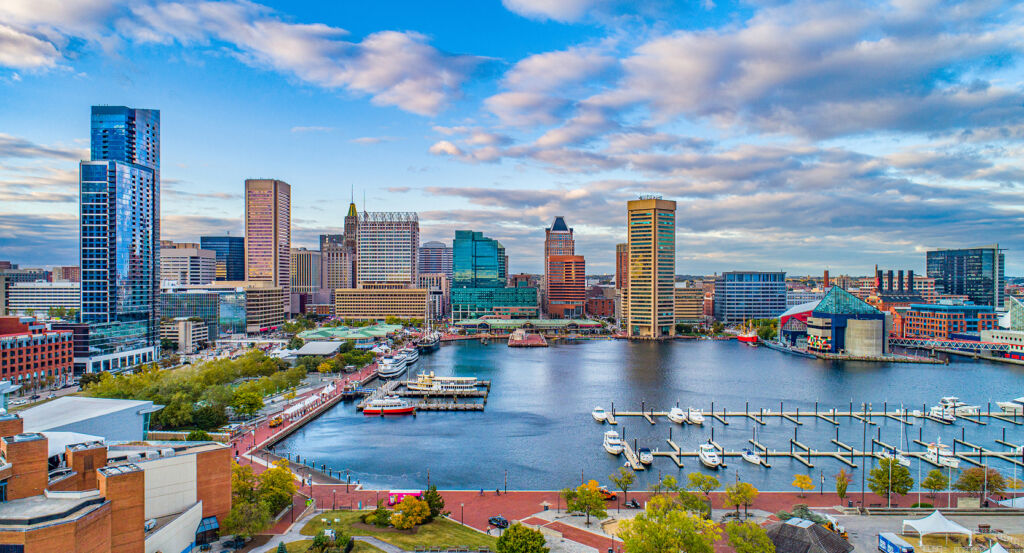
Positioned on International Drive near its intersection with Aliceanna Street, between the Harbor East Marina and the commercial blocks surrounding Harbor East Circle, the hotel occupies the eastern Inner Harbor waterfront, with the downtown skyline extending westward across the water. Its glass-clad tower rises above a broad podium, with projecting terraces and horizontal architectural divisions emphasizing the building's relationship with the harbor. Floor-to-ceiling glazing extends across the principal elevations, establishing views toward the water and surrounding city. A landscaped terrace incorporates an infinity-edge swimming pool whose western boundary visually merges with the harbor beyond. Inside, a broad lobby and sculptural staircase connect the reception areas with the principal gathering spaces. The result is a substantial waterfront hotel whose transparent architecture, elevated terraces, and landscaped public areas establish a direct physical relationship with Baltimore's Inner Harbor.
What defines Four Seasons Hotel Baltimore.
Four Seasons Hotel Baltimore is best known for opening on November 14, 2011, as the culminating hotel development within John Paterakis and Michael Beatty's transformation of Harbor East into a major mixed-use waterfront district. Paterakis, whose H&S Bakery business established his commercial position in Baltimore, entered large-scale waterfront property development during the 1990s. He formed H&S Properties with Beatty in 1995, establishing the organization responsible for assembling and redeveloping substantial portions of the former industrial shoreline. Their undertaking extended across seventy acres, introducing offices, residences, hotels, retail premises, and public infrastructure into an area historically associated with maritime commerce. Paterakis began pursuing a luxury hotel for the development in 2002, initially considering Ritz-Carlton before the brand committed to another Baltimore project. Negotiations subsequently shifted to Four Seasons, whose international management organization provided a hospitality partner for the waterfront investment. The original development concept incorporated two towers, with hotel accommodation and private residences organized alongside a substantial commercial office component. Construction began in 2007, but the financial crisis interrupted the project's financing and development chronology. The resulting changes separated portions of the original architectural program, with the neighboring Legg Mason Tower accommodating commercial offices and the Four Seasons development proceeding through a revised construction arrangement. The hotel represented an investment exceeding $200 million, connecting substantial private capital with the final stages of Harbor East's initial waterfront redevelopment. Architectural firms Beatty, Harvey & Coco and Hill Glazier Architects developed the building, coordinating its hospitality functions with the adjoining commercial development. The hotel opened under general manager Julien Carralero, introducing Four Seasons' established international operating standards into Baltimore's luxury accommodation sector. Mayor Stephanie Rawlings-Blake attended the opening, which marked the development of one of Harbor East's final waterfront parcels and introduced 300 hotel jobs. The original culinary partnership involved Michael Mina, whose restaurant organization established Wit & Wisdom as the hotel's principal dining destination. A separate Japanese restaurant, Pabu, followed in 2012, extending Mina's involvement into another culinary tradition. The hotel's commercial organization subsequently changed through the expansion of Baltimore-based Atlas Restaurant Group, whose restaurant partnerships introduced a substantial locally controlled hospitality presence. Wit & Wisdom closed in 2019, ending the original Mina restaurant partnership after seven years. Atlas opened Maximón at the beginning of 2020, completing a major transition in the property's restaurant operations. Another institutional development began in October 2025, when Four Seasons announced a multiyear renovation under the direction of Parker-Torres Design, extending the hotel's architectural evolution beyond its original construction.
BraytonHughes Design Studio developed the original interiors around contemporary American art, sculptural lighting, and an architectural treatment intended to complement the building's waterfront setting. The San Francisco practice organized the principal public areas around a broad reception lobby and grand staircase, introducing handblown Murano glass fixtures into the circulation spaces. Artist John Wigmore created a substantial installation of illuminated paper behind the reception desk, establishing a visual centerpiece through the relationship between light, translucent surfaces, and sculptural composition. The hotel's art collection became the largest within a Baltimore hotel, incorporating contemporary American and international works with particular attention to artists associated with the Washington Color School. That movement developed during the 1950s and 1960s through painters including Morris Louis, Kenneth Noland, and Gene Davis, whose experiments with color, stained canvas, and geometric abstraction influenced American postwar painting. The collection connects the hotel's international design commission with a regional artistic tradition that contributed substantially to twentieth-century American modernism. Landscape architects Mahan Rykiel Associates directed the ground-level streetscape and elevated recreational terraces, establishing planted outdoor spaces within the larger architectural composition. Their commission included the fourth- and fifth-floor amenity decks and outdoor spa treatment areas, integrating landscape architecture with the building's stepped waterfront profile. Patrick Sutton introduced another architectural contribution through the design of Maximón, developing an interior characterized by stone surfaces, marble furnishings, planted areas, and a courtyard organized around fountains and outdoor dining. The commission incorporates a dedicated performance stage, connecting Latin American culinary traditions with live music and social gathering. The property's culinary organization also includes The Bygone, whose elevated dining room references the decorative culture of American restaurants during the 1920s. The resulting program connects the original art-centered interior commission with subsequent restaurant architecture developed through Baltimore-based hospitality investment. Parker-Torres Design's renovation introduces another chapter through a decorative program led by Jessica Puliti, whose scheme draws on the colors and movement of the Inner Harbor. Navy textiles, warm neutral finishes, water-inspired carpeting, and commissioned abstract artwork establish the proposed relationship between the interior refurbishment and the surrounding maritime landscape. Custom chandeliers incorporate suspended crystal forms associated with moving water, extending the original emphasis on sculptural lighting into the property's subsequent architectural development.
How Four Seasons Hotel Baltimore fits.
Four Seasons Hotel Baltimore works as the starting point for a westward exploration of Baltimore's transportation history, African American cultural institutions, and nineteenth-century maritime engineering.
Begin at President Street Station, northeast of the hotel along President Street, where the Philadelphia, Wilmington and Baltimore Railroad completed a terminal in 1850. The station became an important interchange between northern rail services and Baltimore's transportation network, which required passengers to cross the city between separate railway terminals. Abraham Lincoln passed through the station during his secret journey to Washington in February 1861, shortly before his inauguration. On April 19, 1861, Massachusetts troops encountered a hostile crowd during their passage through Baltimore, producing fatalities in one of the Civil War's earliest violent confrontations. The surviving terminal preserves the architectural setting of these events and interprets the city's divided political loyalties during the conflict. Continue southwest along President Street toward the Reginald F. Lewis Museum of Maryland African American History & Culture, which opened in 2005 as a major institution dedicated to the experiences and achievements of Black Marylanders. Architects Philip Freelon and Gary Bowden collaborated on its design, producing the first major Downtown Baltimore building designed by African American architects. The institution commemorates businessman Reginald F. Lewis, whose acquisition of TLC Beatrice International in 1987 established him as the first African American to lead a company generating more than $1 billion in annual revenue. Its collections encompass Maryland's history of enslavement, abolition, entrepreneurship, artistic production, and civil rights, connecting individual achievements with the broader development of African American communities. Conclude at Seven Foot Knoll Lighthouse, reached by continuing west toward Pier 5, where a surviving Chesapeake Bay navigation structure preserves Baltimore's nineteenth-century maritime engineering. Constructed in 1855 by Baltimore ironfounders Murray and Hazelhurst, the lighthouse employed nine cast-iron screw piles driven into the seabed at the entrance to the Patapsco River. Its isolated position required resident keepers to maintain the beacon through severe weather and seasonal ice. Keeper Thomas Steinhise received a congressional medal for rescuing five sailors from a sinking tugboat during a 1933 storm. The light was automated in 1948 and transferred to Baltimore in 1988, when the structure was transported by barge to its preserved waterfront position. The progression moves from the railroad infrastructure associated with the Civil War through an institution preserving Maryland's African American history and culminates in a surviving lighthouse whose engineering and rescue history connect Baltimore with the maritime development of Chesapeake Bay.
Where your story begins.
Foresyte Travel reveals places that feel extraordinary long before you arrive.
Enjoy editorial crafted for luxury travelers.
Foresyte may earn a commission when you book.







































































































