
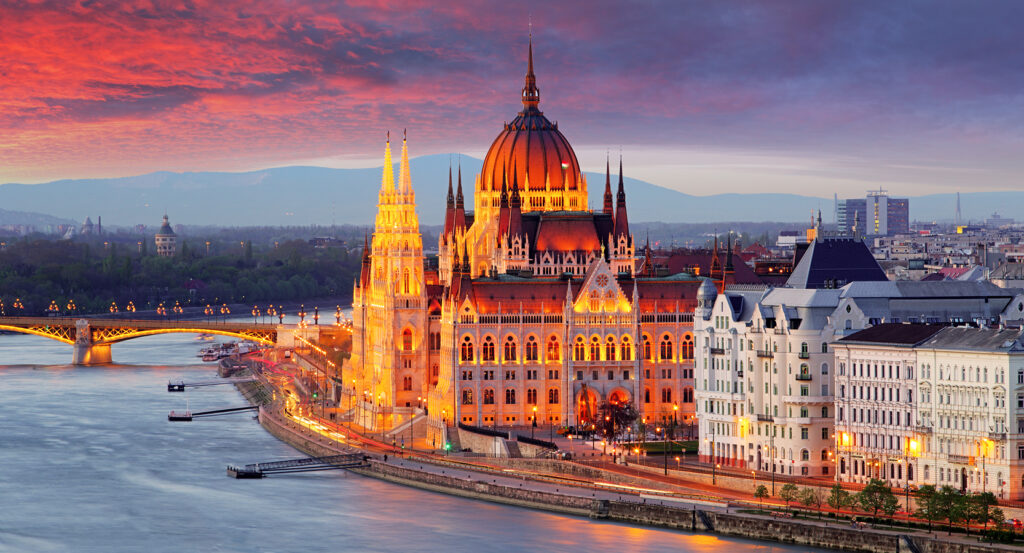
Why Four Seasons Hotel Gresham Palace Budapest matters.
Four Seasons Hotel Gresham Palace Budapest is a Danube-side Art Nouveau hotel where Budapest's imperial-era architecture meets Hungarian cuisine, contemporary cocktails and the Chain Bridge.
Set along Széchenyi István tér near Zrínyi utca and just steps from the Chain Bridge, the hotel occupies the Pest-side threshold between the Danube, the Hungarian Academy of Sciences, St. Stephen's Basilica and the commercial streets leading toward Andrássy Avenue. Its restored façade, glass-roofed passage and ornate entrance place the building directly within Budapest's most concentrated riverfront composition. Wrought-iron gates, mosaics, stained glass and chandeliers carry the original palace interior into the lobby and public rooms. KOLLÁZS, MÚZSA and the hotel's afternoon tea give dining, cocktails and ceremony separate expressions beneath the restored structure. The result is a hotel that joins Budapest's Art Nouveau inheritance with the river, bridge and civic architecture of Széchenyi István tér.
What defines Four Seasons Hotel Gresham Palace Budapest.
Four Seasons Hotel Gresham Palace Budapest is best known for restoring the 1906 Gresham Palace, originally built for the London-based Gresham Life Assurance Company. Architects Zsigmond Quittner and the Vágó brothers created the building during Budapest's early twentieth-century expansion along the Danube. The palace combined offices, apartments and commercial spaces within an Art Nouveau composition shaped by curved forms, ironwork, stained glass and ceramic decoration. Gresham's name connected the Budapest project to Sir Thomas Gresham and the English insurance company that commissioned the building. The palace stood opposite the Chain Bridge, placing it within the ceremonial route between Pest, Buda and the river crossing. Apartments occupied the building during the interwar period, while later decades brought decline and fragmented use. Gresco Investments acquired the property in the 1990s and began a restoration that reconstructed damaged mosaics, ironwork, glass and decorative surfaces. Four Seasons converted Gresham Palace into a hotel that opened in 2004 after the restoration. The project retained the building's original urban role while giving its passageways, salons and upper floors a new hospitality program. Glass ceilings, peacock motifs, geometric tilework and sculpted details preserve the visual language of Hungarian Secession architecture. The hotel's significance comes from the survival of an entire Art Nouveau palace at the point where Budapest's riverfront, bridge and civic centre converge.
KOLLÁZS places contemporary French and Hungarian cooking inside the former palace through a brasserie menu shaped by Budapest's café traditions and the produce of the Carpathian Basin. The dining room faces the Chain Bridge and Danube, giving the restaurant a direct relationship with the city beyond its Art Nouveau interior. Hungarian specialties sit beside French techniques, seasonal vegetables, fish and meat dishes. MÚZSA occupies the lobby as a cocktail bar whose design draws on Gresham's decorative language and Budapest's history of literary cafés. Its drinks use Hungarian spirits, local ingredients and modern presentations within a room of glass, brass and patterned surfaces. Afternoon tea extends the hotel's public program into a slower ritual of pastries, sandwiches and Hungarian-inspired sweets. The service takes place beneath the restored glass ceiling, where the building's original circulation space becomes a social salon. KOLLÁZS, MÚZSA and afternoon tea create three distinct forms of public life inside the same architectural shell. Brasserie cooking connects Budapest with Paris, the cocktail program turns local ingredients toward contemporary technique and tea service preserves the grand-hotel tradition. Their relationship with the restored palace keeps the hotel's culinary character attached to its Art Nouveau setting. The hotel's guest rooms and suites occupy the former apartments and offices while retaining the building's relationship with the Danube and bridge. Curved corners, decorative glass, mosaic surfaces and iron details continue through private and public spaces. A spa and pool extend the restoration into contemporary health and leisure without severing the building from its historic circulation. The central passage remains the clearest expression of Gresham Palace's original ambition, combining daylight, ornament and movement beneath a glass canopy. Four Seasons Hotel Gresham Palace Budapest operates as both a hotel and a surviving urban palace whose architectural language remains visible at every scale.
How Four Seasons Hotel Gresham Palace Budapest fits.
Four Seasons Hotel Gresham Palace Budapest works as a starting point for tracing Budapest from scientific nation-building to Catholic grandeur and Hungarian opera.
Begin at Hungarian Academy of Sciences, whose neoclassical headquarters has stood on Széchenyi István tér since the nineteenth century. Count István Széchenyi founded the institution in 1825 with a major donation to advance Hungarian language, scholarship and national culture. The building's ceremonial rooms, library and scientific collections place intellectual life directly beside the Danube and the Chain Bridge. Continue to St. Stephen's Basilica, whose vast dome and twin bell towers define the Central Pest skyline. Construction began in 1851, and the church reached completion in 1905 after the collapse of the original dome forced a major redesign. József Hild, Miklós Ybl and József Kauser shaped the final building through successive architectural phases. Conclude at Hungarian State Opera House, opened in 1884 on Andrássy Avenue after Miklós Ybl designed its Neo-Renaissance auditorium and palace-like exterior. Franz von Reichenberg conducted the first performance, while the institution later became associated with composers, singers and conductors central to Hungarian musical culture. The progression moves from the academy's nineteenth-century intellectual foundation through the basilica's national religious monument and culminates in the opera house's public performance tradition.
Where your story begins.
Foresyte Travel reveals places that feel extraordinary long before you arrive.
Enjoy editorial crafted for luxury travelers.
Foresyte may earn a commission when you book.





































































































