
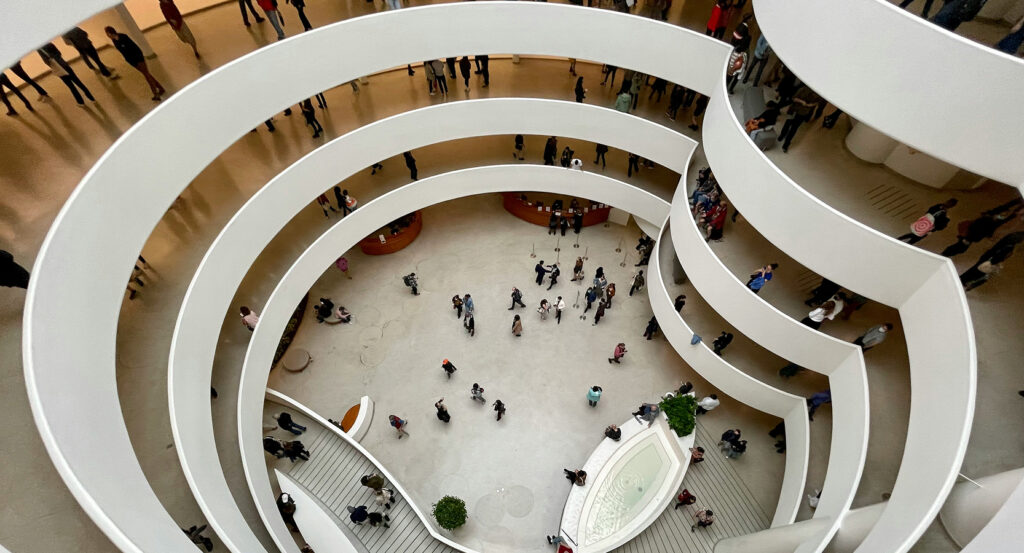
Why you should experience The Ramps at The Guggenheim Museum in New York City, New York.
The Ramps at The Guggenheim Museum are an architectural masterpiece where the Upper East Side's cultural legacy, modernist design, spatial innovation, and artistic presentation converge within one of the world's most influential museum interiors.
Set within the Guggenheim Museum along 5th Avenue near East 89th Street and just steps from Central Park, this continuous spiraling gallery carries visitors upward beneath a soaring glass dome through one of Frank Lloyd Wright's most revolutionary architectural compositions. Sweeping curves, uninterrupted circulation, sculptural concrete forms, and carefully orchestrated natural light dissolve the boundaries between architecture and exhibition, allowing every artwork to participate in a unified spatial experience. Every ascent reveals new perspectives across the museum's iconic rotunda while reinforcing Wright's vision of art experienced as a continuous journey. The result is an architectural environment defined by visionary design, spatial fluidity, and one of the most celebrated museum interiors ever constructed.
What you should know about The Ramps at The Guggenheim Museum.
The Ramps at The Guggenheim Museum are best known for forming the defining architectural feature of Frank Lloyd Wright's final masterpiece, conceived in 1943 when Solomon R. Guggenheim commissioned the architect to create a museum that would fundamentally redefine how art is experienced. Rejecting the traditional sequence of enclosed galleries, Wright developed a continuous quarter-mile ( 400-meter) helical ramp rising beneath a dramatic glazed rotunda, allowing visitors to descend gradually through exhibitions while maintaining uninterrupted visual connections across the museum's soaring central space. Construction began in 1956, and although both Wright and Guggenheim died before completion, the museum opened on 21 October 1959, immediately establishing the spiral ramps as one of the most revolutionary architectural concepts in museum history. Wright described the design as an “inverted ziggurat,” employing reinforced concrete technology to create flowing curved forms that contrasted dramatically with Manhattan's rigid street grid while expressing his philosophy of organic architecture, in which structure, movement, light, and human experience function as an integrated whole. The ramps' subtle incline of 3 percent allows visitors to circulate continuously across six levels without interruption, transforming movement itself into an essential component of the museum experience. Although many artists initially questioned displaying paintings on curved walls, the architectural innovation soon became internationally celebrated, influencing generations of museum design across the world. In 2008, an extensive $29 million restoration conserved the museum's historic concrete surfaces, skylight, and interior finishes, while the building achieved designation as a UNESCO World Heritage Site in 2019 as one of “The 20th-Century Architecture of Frank Lloyd Wright,” recognizing the spiral ramps as one of modern architecture's defining achievements.
The architectural composition integrates continuous circulation, sculptural geometry, natural illumination, and carefully proportioned exhibition spaces into a singular spatial experience that remains unmatched in museum design. The gently ascending spiral, expansive rotunda, uninterrupted sightlines, and grand glass dome continually reshape visitors' perceptions of scale, movement, and artwork throughout the journey. Rotating exhibitions regularly reinterpret the ramps through installations ranging from intimate paintings to grand contemporary commissions, demonstrating the enduring adaptability of Wright's design more than six decades after its completion. Every element demonstrates how architectural innovation, engineering, curatorial vision, and cultural preservation combine to create one of the most influential museum interiors in the history of modern architecture.
How to fold The Ramps at The Guggenheim Museum into your trip.
The Ramps at The Guggenheim Museum are best experienced as the architectural centerpiece of an exploration along Museum Mile.
Begin at The Met Fifth Avenue, where encyclopedic collections establish the historical foundations of world art before continuing to The Ramps at The Guggenheim Museum. Continue through the Guggenheim Museum Rotunda, where Frank Lloyd Wright's soaring central space reveals the spiral ramps from their most dramatic perspective. Conclude in Central Park, where the expansive landscapes opposite 5th Avenue provide a memorable finale celebrating the discussion between visionary architecture, public space, and cultural institutions that defines Manhattan's Upper East Side. The progression moves naturally from classical museum collections to one of modern architecture's greatest achievements before concluding through New York's most celebrated urban landscape, revealing why The Ramps at The Guggenheim Museum remain among the world's defining architectural experiences.
Where your story begins.
Foresyte Travel reveals places that feel extraordinary long before you arrive.
Experience premium editorial crafted for luxury travelers.







































































































