
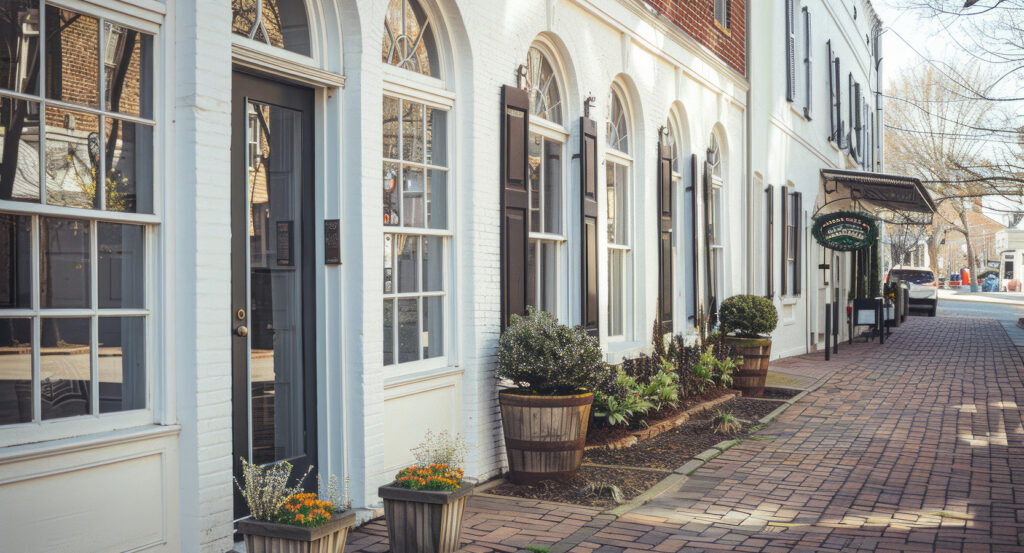
Why Georgetown matters.
Historic Georgetown in Washington, D.C. is a living mosaic of America's story, layered in cobblestones, ivy-clad facades, and the hum of life that never truly slows.
Long before the capital existed, Georgetown thrived as a tobacco port on the Potomac River, and you can still feel that colonial pulse as you walk its tree-lined streets. Rows of 18th- and 19th-century brick townhouses stand shoulder to shoulder, their shutters painted in soft colonial hues, while gas lamps flicker at dusk like whispers from another era. C&O Canal boats glide past walkers and cyclists, offering serene glimpses of a time when this waterway served as the city's commercial heart. Yet history here doesn't feel distant, it's interwoven with the neighborhood's modern rhythm. Upscale boutiques, art galleries, and cafes tuck themselves inside preserved structures, blending refinement with authenticity. The air carries the aroma of roasted coffee and river breeze, mingling with echoes of laughter spilling from rooftop patios and waterfront restaurants. Georgetown has evolved from a port town to a playground for diplomats, scholars, and dreamers, yet it has never lost its sense of place, an elegant corner of D.C. where the past and present share a heartbeat.
What defines Historic Georgetown.
Behind its polished charm, Georgetown holds stories of resilience, reinvention, and quiet revolution.
Founded in 1751, 40 years before the establishment of Washington, D.C. Georgetown once rivaled Alexandria as one of the region's most important ports. Its early prosperity was fueled by tobacco and trade, and remnants of those early warehouses still stand along the waterfront. By the 19th century, the neighborhood became a hub of political and cultural influence, home to figures like Francis Scott Key, who lived here when he wrote The Star-Spangled Banner. Later, during the civil rights movement, Georgetown served as a crossroads for activism, its churches and meeting halls hosting organizers and intellectuals pushing for equality. The area's historic preservation movement began earlier than most, by the 1950s, concerned residents fought to protect the neighborhood from redevelopment, leading to its designation as a National Historic Landmark District in 1967. Georgetown University, established in 1789, anchors the district both intellectually and spiritually, its Gothic towers rising above the Potomac as symbols of continuity. Few realize that the neighborhood's charm owes much to strict preservation codes, even small alterations to building exteriors must be approved, ensuring that the cobblestone streets, wrought-iron railings, and colonial facades remain frozen in time. The result is a rare blend of authenticity and vitality: a neighborhood that honors its past not by trapping it, but by living it. And beneath its polished surface, Georgetown remains a place of dualities, a working-class port reborn as an enclave of power, a quiet sanctuary steps from the political roar of downtown.
How Historic Georgetown fits.
Exploring Georgetown is best done slowly, on foot, with curiosity as your guide and no rush to reach the end.
Start along M Street or Wisconsin Avenue, where cobblestone alleys lead into boutique-lined lanes and hidden courtyards. Stop for breakfast at a historic café or grab a pastry from Baked & Wired before wandering toward the waterfront. Georgetown Waterfront Park offers sweeping views of the Potomac and the Key Bridge, perfect for watching rowers slice through the river at dawn. From there, walk along the C&O Canal Towpath, once a major artery of 19th-century commerce, now a peaceful greenway where time feels suspended. Don't miss the Old Stone House on M Street, built in 1765 and considered the oldest unchanged home in Washington, D.C., its small garden offers a quiet refuge amid the city's hum. Architecture lovers can trace styles from Georgian to Federal to Victorian, while shoppers will find everything from designer boutiques to antique bookstores tucked into centuries-old facades. When evening falls, head to the waterfront restaurants or one of the hidden jazz lounges that lend the neighborhood its soft nocturnal glow. A walk up to Georgetown University's Healy Hall provides panoramic views of the skyline, glowing with both the modern Capitol and the old canal lights below. Whether you're savoring dinner by candlelight, catching the scent of magnolias in summer, or simply listening to your footsteps echo along the cobblestones, Historic Georgetown reminds you that history isn't something you visit, it's something you feel. Here, every brick and breeze seems to whisper the same truth: that the beauty of a city lies not in its monuments alone, but in the neighborhoods that remember how it all began.
Where your story begins.
Foresyte Travel reveals places that feel extraordinary long before you arrive.
Enjoy editorial crafted for luxury travelers.
Foresyte may earn a commission when you book.







































































































