
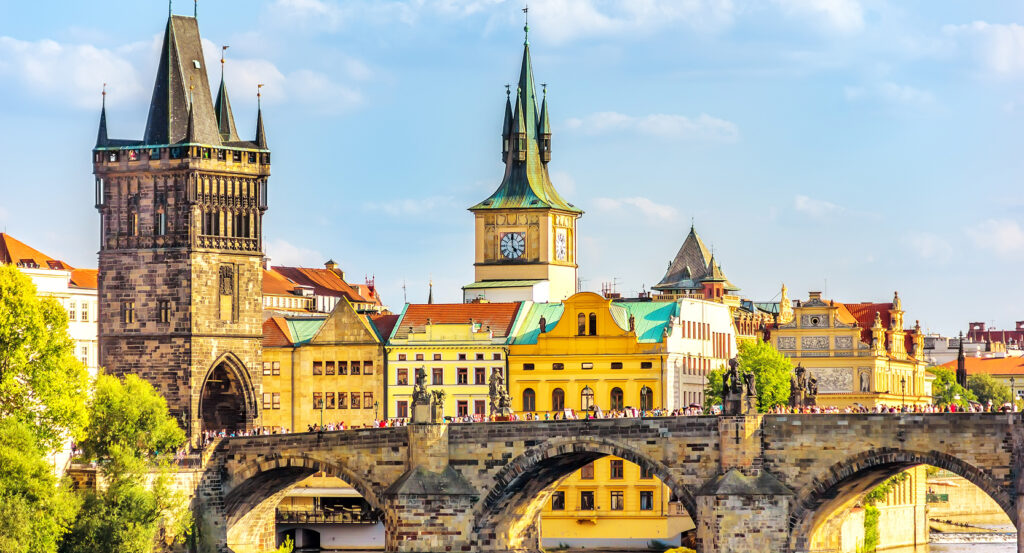
Why you should experience Golden Well Hotel Prague in Prague, Czech Republic.
Golden Well Hotel Prague is Prague lived at its most refined and situated in a place that feels simultaneously historic and singular, a hotel that does not merely position you near the city's iconic sites, but makes those sites part of the resonant architecture of your stay.
Perched above the Mala Strana district and literally adjacent to Prague Castle, Golden Well occupies a location most visitors never truly absorb, where quiet lanes, baroque rooftops, church spires, and woodland skyline layers converge into daily life. Arrival here is almost cinematic: you leave the main circulation paths of the city and ascend into a place that feels like a threshold between eras. The lobby and public areas are composed with a logic of calm authority. Proportions are generous without being ostentatious, materials are warm and tactile, limestone, wood, soft metals, and lighting is intentionally layered to support psychological ease instead of physical spike. There's no rush to impress; instead, the space feels composed, deliberate, and sensitive to the rhythm of arrival. Guest rooms and suites express this sensibility with exceptional precision. Each room feels like a deliberately composed field. Beds are designed for deep, restorative sleep after long walking days through cobblestone streets, cathedral precincts, and museum galleries. Linens, fabrics, and finishes are refined without being decorative for its own sake: texture holds meaning, and everything feels chosen for functionality paired with warmth. Windows frame Prague in panoramic fragments, rooftops, green hills, spires, and narrow lanes, making the city external yet intimate, a lived environment. Furniture is purposeful and elegantly restrained. Desks are scaled for real work, seating invites extended reading or quiet conversation, and storage allows you to unpack and inhabit the room rather than treat it like a transit space. Lighting is layered with both practical and psychological intelligence, enabling smooth transitions from morning focus to evening calm. Bathrooms match the hotel's subtle luxury. Spacious circulation, carefully selected fixtures, walk-in rain showers or bathtubs in larger suites, and finishes that feel natural under use rather than imposed all reinforce a design logic that values comfort, longevity, and tactile ease. Dining and shared spaces at Golden Well Hotel Prague are spaces of presence. Breakfast unfolds with elegance and composure in a room that feels like a refined urban salon rather than a buffet hall, setting a tone of thoughtfulness before you step into the city's layers. Lounges and communal areas are curated for sociality and repose, spaces where conversation, planning, and reflection can unfold. The hotel's terrace is one of its defining features: a space where air, light, and panorama provide visual relief after streets and squares, and where quiet presence becomes part of your travel rhythm. Service throughout the hotel is polished, intuitive, and situationally aware. Interactions feel genuinely helpful rather than scripted, offering direction informed by deep local knowledge: the quietest walking routes to the castle, hidden courtyards, refined restaurants, galleries that reward repeat exploration, and moments of Prague that aren't on every itinerary.
What you should know about Golden Well Hotel Prague.
Golden Well Hotel Prague was conceived as a spatial continuation of Prague's historical identity, not as a thematic overlay or heritage façade with modern inserts.
Rather than imposing modern hospitality tropes on its site, the hotel's design embraces the topography and sequence of Prague's oldest quarter. Its position on the hill near the Castle was chosen with intention: not for views alone, but for the psychological transition from the city's dense medieval grid to a calm, elevated beat that lets you observe the city. Internally, spaces were designed to mediate between urban energy and personal presence. Circulation paths are composed with sightlines that reduce physical overload, materials that anchor attention rather than amplify it, and dimensions calibrated for comfort rather than drama. Interiors avoid surface noise and trend cycles, favoring materials that age gracefully and forge memory. Guest room planning was guided by behavioral observation: how people rest, work, and transition between different parts of their day in a historic city environment. This resulted in layouts that feel intuitive, resolved, and calm, spaces where wardrobes, desks, seating, and lighting integrate organically into the rhythm of the room. Bathrooms emphasize usability as a daily ritual rather than visual ornament, with finishes selected for tactile reliability and spatial clarity. Dining spaces were conceived as cultural infrastructure. Breakfast is structured as a composed pause rather than a rushed necessity, and other shared spaces function as calm intermediaries between departure and return. The terrace was integrated not as a view deck but as a psychological reset point, allowing guests to inhabit air, light, and panorama at transitions between exploration and rest. Operational culture aligns closely with these design principles. Staff training emphasizes contextual intelligence, cultural literacy, and adaptive responsiveness. This produces interactions that feel grounded and situationally aware. Over time, the hotel has built loyalty among travelers who return not for trend or performance but for consistency and presence, those who appreciate environments that function with resonant coherence. In Prague's hospitality landscape, where many historic properties rely on decorative heritage language or novelty branding, Golden Well's distinction lies in architectural and experiential integration, spaces that support you under real use.
How to fold Golden Well Hotel Prague into your trip.
Golden Well Hotel Prague works best when you treat it as a central hub of calm orientation for your exploration rather than a separate retreat from the city.
Begin mornings with intention. Enjoy breakfast in composed calm, letting light and vista orient your internal rhythm before you step into Prague's streets. Walk toward Prague Castle in early light via serene lanes, allowing the city's layers to reveal themselves sequentially. Midday returns to the hotel become restorative rather than interruptive, rest, read, plan, or take a moment on the terrace before heading back out. Use the hotel's thoughtful service to plan deeper engagements: quieter museums, refined galleries, hidden courtyards, and neighborhood cafés that feel integral to Prague's identity. In the afternoon, explore Mala Strana's rooftops, the river's promenade, or lesser-known architectural enclaves, returning in stages. Evenings unfold with coherence. Dine in nearby refined restaurants or at the hotel's spaces before walking along the Vltava under lights that feel both intimate and expansive. Late returns to the hotel feel calm and absorbent rather than abrupt because the interior language supports decompression rather than adrenaline. Golden Well Prague pairs especially well with extended stays, design-oriented exploration, cultural immersion, and trips where presence matters more than pacing. By the time you leave, the hotel will feel less like a place you used and more like a frame through which Prague became visible, navigable, and deeply present, not softened and not diluted, but experienced with clarity, calm, and a refined sense of orientation. In a city abundant with history and aesthetic density, that kind of coherence becomes its own rare form of luxury.
Where your story begins.
Foresyte Travel reveals places that feel extraordinary long before you arrive.
Experience premium editorial crafted for luxury travelers.





































































































