
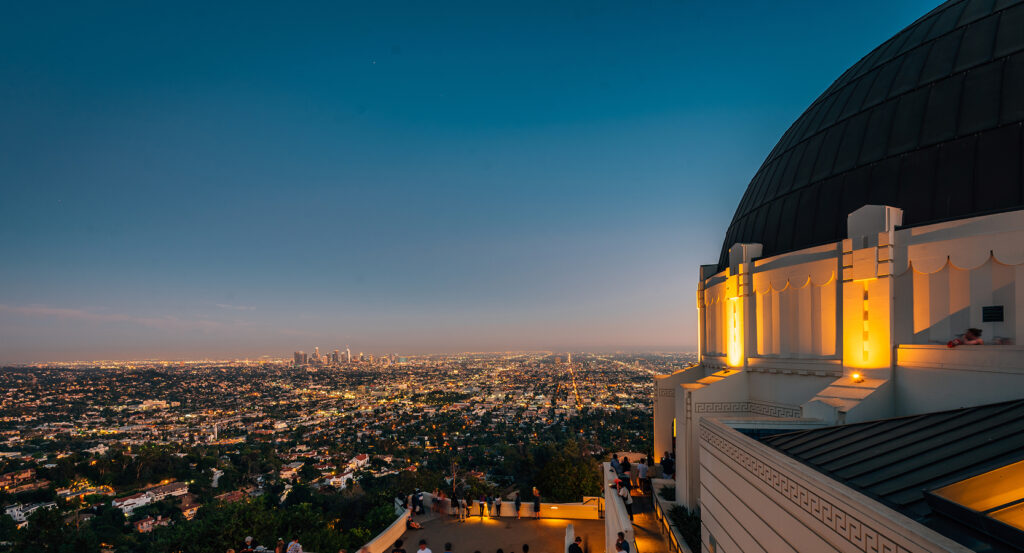
Why Granada Hills matters.
Granada Hills is a spacious enclave where the Northwest San Fernando Valley's suburban character meets broad residential tracts, remnant orchard landscapes and foothill streets climbing toward the Santa Susana Mountains.
Positioned between Porter Ranch, Northridge, and Mission Hills, the neighborhood occupies the northern Valley floor and adjoining foothills, where long east-west streets cross gently rising terrain before residential development reaches the broken slopes below the mountain front. Ranch houses, deep setbacks, mature trees and detached homes on unusually generous parcels create a low-rise fabric whose scale remains closely tied to the mid-century building boom that absorbed former agricultural ground. Chatsworth Street supplies the primary encounter through a compact commercial center surrounded by residential blocks, concentrating storefronts and community institutions within a district otherwise dominated by detached houses. Balboa Boulevard creates a secondary north-south passage through successive residential tracts, moving across broad intersections and increasingly elevated ground as the Valley floor approaches the northern hills. The result is a neighborhood whose generous parcels, mature landscape and gradual ascent toward the mountains preserve the physical imprint of Granada Hills's passage from semi-rural settlement into one of the northern Valley's major postwar residential communities.
What defines Granada Hills.
Granada Hills is best known for developing from Sunshine Ranch, an immense agricultural property whose subdivision during the 1920s created the foundation for the modern community. Los Angeles annexed the territory in 1915, two years before Oklahoma oilman J. H. Mosier acquired 4,100 acres and created Sunshine Ranch. Mosier devoted 1,200 acres to citrus and apricot orchards, walnut groves, beans and alfalfa, supplementing crop production with substantial dairy and poultry operations. More than 2,000 acres carried citrus plantings between 1917 and 1924, and several surviving ranch houses remain physical remnants of that agricultural period. Mosier sold Sunshine Ranch to Edwards and Wildey in 1925, bringing a real-estate company that invested millions of dollars in streets, sidewalks and other improvements before dividing the former ranch into smaller agricultural and residential holdings. Housing and school construction accelerated during 1927 and 1928 as the subdivision entered its first substantial building phase. Sunshine Ranch became Granada in 1927, taking a name inspired by Granada, Spain, then adopted Granada Hills in 1942 to distinguish the community from Grenada in Northern California. Agriculturist and ranch superintendent John Orcutt planted 114 Deodar cedars along White Oak Avenue in 1931, creating the extraordinary allée later recognized by Los Angeles as a Historic-Cultural Monument. The community remained substantially semi-agricultural into the postwar years, but population growth altered that scale with exceptional speed, rising from fewer than 5,000 residents 1950 to 50,000 a decade later. Residential tracts constructed from the 1950s through the 1970s consumed much of the remaining agricultural ground, leaving orchard trees, deep setbacks and the White Oak cedars as enduring physical remnants of Sunshine Ranch.
Joseph Eichler brought a radically different residential chapter to the northern edge of the community when his company developed Balboa Highlands between 1962 and 1964. Eichler had already built thousands of houses across Northern California when he entered Southern California, where his company completed only three tracts: Balboa Highlands, a development in Orange and another in Thousand Oaks. Balboa Highlands became his sole Los Angeles County development, concentrating Mid-Century Modern houses designed by architects A. Quincy Jones, Frederick Emmons and Claude Oakland within Granada Hills. Atriums reached through sliding-glass doors organized many of the houses, extending domestic rooms toward enclosed outdoor courts and giving the tract an architectural language sharply separated from the conventional ranch houses spreading across the surrounding Valley. Broad rooflines, exposed structural elements and extensive glazing reinforced the connection between interior rooms and private exterior areas. The tract's architectural significance eventually made Balboa Highlands the first post-World War II neighborhood in the San Fernando Valley to receive historic district status, with Los Angeles adopting its preservation overlay in 2010. Granada Hills contains one of Southern California's rare concentrations of Eichler houses, placing a nationally significant strand of mid-century residential design inside a community whose dominant postwar growth otherwise followed the mass suburban development of the San Fernando Valley.
How Granada Hills fits.
Granada Hills works as the anchor for an outing connecting the Spanish mission that reorganized the northern Valley, among its oldest surviving residences and an automotive collection created through J. B. Nethercutt's exacting approach to restoration.
Begin at Mission San Fernando Rey de España, founded by Father Fermín Francisco de Lasuén on September 8, 1797 and named for Ferdinand III of Castile. Francisco Reyes's house on Encino Rancho initially sheltered the missionary, and an adobe chapel blessed in December 1806 preceded the church standing on the mission grounds. The earthquake of 1812 damaged that chapel, prompting construction of a replacement completed in 1818. San Fernando's convento developed into the largest freestanding adobe in California and originally functioned as a hospice for travelers, giving the complex an architectural scale commensurate with its role on the route linking Spanish settlements through the Valley. Continue to Andres Pico Adobe, whose earliest portion dates to 1834 on former San Fernando Mission ground. The house later became associated with General Andrés Pico, though Pico himself resided at the mission during his ranching years; his son Rómulo and ward Catalina married and occupied the adobe beginning in 1873. They enlarged the structure with a second story and other additions, turning the earlier building into Ranchito Rómulo. Archaeologist Mark R. Harrington, then curator of the Southwest Museum, restored the deteriorated property during the 1930s, and the City of Los Angeles purchased it decades later when demolition threatened its survival. The San Fernando Valley Historical Society has maintained its headquarters there since 1969. Conclude at The Nethercutt Collection, created by J. B. and Dorothy Nethercutt from a restoration pursuit that began with two automobile purchases in 1956: a 1936 Duesenberg Convertible Roadster and a 1930 DuPont Town Car. The DuPont consumed eighteen months and more than $65,000 before winning Best of Show at the Pebble Beach Concours d'Elegance in 1958, the first of six victories Nethercutt achieved there by 1992. Nethercutt had left the California Institute of Technology to join the cosmetics business of his aunt, Merle Nethercutt Norman, and his business success financed an automotive collection eventually opened to the public in 1971. More than 250 restored American and European automobiles now share the institution with mechanical musical instruments and antique furniture, extending Nethercutt's original restoration discipline across several forms of mechanical and decorative craftsmanship. The progression moves from Spanish mission settlement through a surviving Californio-era residence and culminates in Nethercutt's twentieth-century collection, connecting three radically different chapters of San Fernando Valley history through architecture, preservation and craftsmanship.
Where your story begins.
Foresyte Travel reveals places that feel extraordinary long before you arrive.
Enjoy editorial crafted for luxury travelers.
Foresyte may earn a commission when you book.





































































































